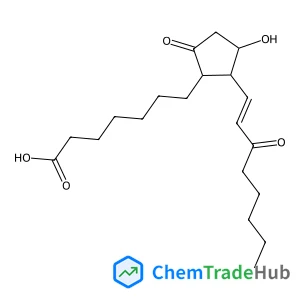
(11alpha,13E)-11-Hydroxy-9,15-dioxoprost-13-en-1-oic acid
CAS Number:
22973-19-9
Molecular Formula:
C20H32O5
Synthesis and characterization of dual hydrophilic random and block copolymers of acrylic acid (AA) or methacrylic acid (MAA) with poly(ethylene glycol) (PEG) via different controlled radical polymerization techniques are discussed. Initially, reversible addition fragmentation chain transfer (RAFT) polymerization was employed to synthesize homo, random and block copolymers of AA and MAA in ethanol. The polymers were characterized in detail by means of size exclusion chromatography (SEC), 1H NMR spectroscopy, matrix assisted laser desorption ionization time of flight (MALDI-TOF) mass spectrometry as well as MALDI-TOF MS coupled with collision induced dissociation (CID) to identify the end groups and the repeating units. Following that, atom transfer radical polymerization (ATRP) and RAFT polymerization were employed for the preparation of block copolymers using a PEG macroinitiator and a PEG macro chain transfer agent. Moreover, graft copolymers that contain oligo(ethyleneglycol) pendant groups and AA or MAA have been prepared using the RAFT polymerization process. Additionally, selected homo or block copolymers were tested for their water-uptake properties using a thermal gravimetrical analyzer with a controlled humidity chamber. An advantageous behavior of the copolymers compared to the related homopolymers was reached with the obtained ability to absorb moisture over the complete humidity range as well as to a very high absolute water uptake.
Christophe Candolfi, Anne Dauscher, Janusz Tobola, Jiří Hejtmánek, Bertrand Lenoir
DOI: 10.1039/C9CP00213H
Evgeny A. Bondarenko, Eugene A. Streltsov, Alexander V. Mazanik, Anatoly I. Kulak, Vytautas Grivickas, Patrik Ščajev, Ekaterina V. Skorb
DOI: 10.1039/C8CP03225D
Christina Kjær, Steen Brøndsted Nielsen
DOI: 10.1039/C8CP07340F
Stefan Permien, Tobias Neumann, Sylvio Indris, Gero Neubüser, Lorenz Kienle, Andy Fiedler, Anna-Lena Hansen, Diego Gianolio, Thomas Bredow, Wolfgang Bensch
DOI: 10.1039/C8CP02919A
Marvin Asido, Peter Eberhardt, Clara Nassrin Kriebel, Markus Braun, Clemens Glaubitz, Josef Wachtveitl
DOI: 10.1039/C8CP07418F
Adrian M. Mak
DOI: 10.1039/C8CP04075C
Junhui Weng, Shang-Peng Gao
DOI: 10.1039/C8CP04743J
Zonghao Shen, John A. Kilner, Stephen J. Skinner
DOI: 10.1039/C8CP02797H
Bastiaan Molleman, Tjisse Hiemstra
DOI: 10.1039/C8CP02346H
Qing Lu, Yi-Ming Wen, Zhao-Yi Zeng, Xiang-Rong Chen, Qi-Feng Chen
DOI: 10.1039/C8CP07246A
6-(3-Fluorophenyl)picolinic acid is generally considered safe for laboratory use...
(3R)-3-Pyrrolidinol is used in the pharmaceutical industry as a precursor for dr...
When handling (4R,5R)-4,5-Diethoxycarbonyl-2,2-dimethyldioxolane (CAS: 59779-75-...
1-(6-Chloroimidazo[1,2-b]pyridazin-3-yl)ethanone is often synthesized via a mult...
The market for N-Ethyl-3,4-dimethylbenzylamine (CAS: 39180-83-1) remains steady,...
Tert-butyl 3-(pyrrolidin-1-yl)azetidine-1-carboxylate is a chemical compound wit...
1-Bromo-3-chloro-2,4-dimethoxybenzene (CAS: 1228956-93-1) falls under the classi...
The safety of 8-Bromo-2-methyl-3,4-dihydroisoquinolin-1(2H)-one (CAS: 1368622-07...
Benzyl [(3S)-2,6-dioxo-3-piperidinyl]carbamate is generally safe when handled wi...
1-{[4-(4,4,5,5-Tetramethyl-1,3,2-dioxaborolan-2-yl)phenyl]sulfonyl}pyrrolidine s...

Polymer Chemistry welcomes submissions in all areas of polymer science that have a strong focus on macromolecular chemistry. Manuscripts may cover a broad range of fields, yet no direct application focus is required.

![2-[({[(2-Methyl-2-propanyl)oxy]carbonyl}amino)methyl]isonicotinic acid structure](https://static.chemtradehub.com/structs/473/473924-63-9-973b.webp "2-[({[(2-Methyl-2-propanyl)oxy]carbonyl}amino)methyl]isonicotinic acid structure")