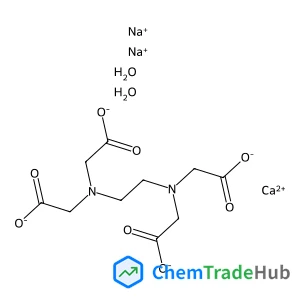
EthylenediaminetetraaceticacidcalciumDisodiumsalthydrate
CAS Number:
23411-34-9
Molecular Formula:
C10H16CaN2Na2O10
Chao Yuan, Mengyu Huang, Yanhua Cheng, Xiaobing Luo
Manipulating thermal transport across hard/soft material interfaces is important for composites which are critical for a wide range of applications, including electronic packaging, thermal storage, sensors and medicine. To increase the interfacial thermal conductance (Gint), a previous strategy has focused on using a self-assembled monolayer (SAM) to bridge the phonon spectra mismatch between the materials constituting the interface. Here, we introduce a general strategy aiming for interfaces which are incompatible with the previous strategy. Copper (Cu) and epoxy resin are chosen as representative materials constituting the interface. The proposed strategy relies on using a strongly bonding SAM to covalently connect Cu and epoxy. The thermal measurements show that Gint can be enhanced by as much as 11 fold. An interesting result is found that the Cu/epoxy interface, modified with the SAM used in the previous strategy, shows approximate 2-fold lower Gint. Through a series of experiments, including tensile strength and wettability tests, the formation and characters of bonds in different interface systems are explored and understood. The correlation between bonding characters and Gint is also elucidated. We demonstrate that when the structure of the soft material is complex, interfacial thermal transport should be tuned by covalent bonds rather than by phonon spectra match. Finally, the great potential of the proposed strategy in manipulating the thermal properties of nanocomposites is illustrated here with a theoretical prediction.
Tian Zhang, Changzheng Cui, Shengli Chen, Xinping Ai, Hanxi Yang, Ping Shen, Zhenrong Peng
DOI: 10.1039/B600876C
Jiehua Zhou, Nadia Hafdi, Jean-Paul Behr, Patrick Erbacher
DOI: 10.1039/B601381C
Jean-Philippe Ebran, Rita G. Hazell, Troels Skrydstrup
DOI: 10.1039/B511491H
Valérie G. H. Lafitte, Abil E. Aliev, Peter N. Horton, Michael B. Hursthouse, Helen C. Hailes
DOI: 10.1039/B600459H
Junko Kagimoto, Kenta Fukumoto, Hiroyuki Ohno
DOI: 10.1039/B600771F
Christian C. Gruber, Tina M. Poessl, Frank Niehaus, Juergen Eck, Reinhold Oehrlein, Andreas Hafner
DOI: 10.1039/B602487D
Koichi Mikami, Kazuki Wakabayashi, Yukinori Yusa, Kohsuke Aikawa
DOI: 10.1039/B517585B
Jonathan D. Sellars, Patrick G. Steel, Michael J. Turner
DOI: 10.1039/B602642G
1H-Indazole-6-carbonitrile finds applications in pharmaceuticals, where it serve...
Waste containing Dioctyl (2E)-2-butenedioate (CAS: 2997-85-5) should be collecte...
Sodium [(1,2-benzoxazol-3-ylmethyl)sulfonyl]azanide is primarily used in pharmac...
Dimethyl 4-(4,4,5,5-tetramethyl-1,3,2-dioxaborolan-2-yl)-2,6-pyridinedicarboxyla...
Waste containing 2-Fluoro-6-hydrazinopyridine (CAS: 80714-39-2) should be manage...
6-Formyl-2-pyridinecarboxylic acid is an organic compound with the molecular for...
Research trends for this compound indicate a focus on its potential applications...
9H-Tribenzo[b,d,f]azepine is typically synthesized via a multi-step process invo...
1-Cyclopropyl-7-ethoxy-6-fluoro-8-methoxy-4-oxo-1,4-dihydro-3-quinolinecarboxyli...
Waste containing Methyl 3-oxo-1,2,3,4-tetrahydro-6-quinoxalinecarboxylate (CAS: ...

Physical Chemistry Chemical Physics (PCCP) is an international journal co-owned by 19 physical chemistry and physics societies from around the world. This journal publishes original, cutting-edge research in physical chemistry, chemical physics and biophysical chemistry. To be suitable for publication in PCCP, articles must include significant innovation and/or insight into physical chemistry; this is the most important criterion that reviewers and Editors will judge against when evaluating submissions. The journal has a broad scope and welcomes contributions spanning experiment, theory, computation and data science. Topical coverage includes spectroscopy, dynamics, kinetics, statistical mechanics, thermodynamics, electrochemistry, catalysis, surface science, quantum mechanics, quantum computing and machine learning. Interdisciplinary research areas such as polymers and soft matter, materials, nanoscience, energy, surfaces/interfaces, and biophysical chemistry are welcomed if they demonstrate significant innovation and/or insight into physical chemistry. Joined experimental/theoretical studies are particularly appreciated when complementary and based on up-to-date approaches.
![Sodium (2Z)-7-{[(2R)-2-amino-2-carboxyethyl]sulfanyl}-2-({[(1S)-2,2-dimethylcyclopropyl]carbonyl}amino)-2-heptenoate structure](https://static.chemtradehub.com/structs/811/81129-83-1-441c.webp "Sodium (2Z)-7-{[(2R)-2-amino-2-carboxyethyl]sulfanyl}-2-({[(1S)-2,2-dimethylcyclopropyl]carbonyl}amino)-2-heptenoate structure")