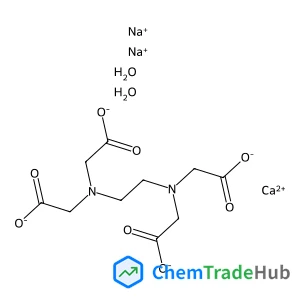
EthylenediaminetetraaceticacidcalciumDisodiumsalthydrate
CAS Number:
23411-34-9
Molecular Formula:
C10H16CaN2Na2O10
Christian C. Gruber, Tina M. Poessl, Frank Niehaus, Juergen Eck, Reinhold Oehrlein, Andreas Hafner
Employing the over-expressed highly organic solvent tolerant alcohol dehydrogenase ADH-‘A’ from Rhodococcus ruber DSM 44541, versatile building blocks, which were not accessible by the wild type catalyst, were obtained in > 99% e.e.; furthermore, employing d8-2-propanol as deuterium source, stereoselective biocatalytic deuterium transfer was made feasible to furnish enantiopure deuterium labeled sec-alcohols on a preparative scale employing a single enzyme.
Andrey V. Shlyakhtin, Vladimir V. Bagrov, Pavel D. Komarov, Andrei V. Churakov
DOI: 10.1039/D0PY01297A
Subaru Konishi, Yu Kashiwagi, Go Watanabe, Takuya Katashima, Osamu Urakawa, Akira Harada
DOI: 10.1039/D0PY01347A
Julie Meimoun, Yann Bernhard, Lydie Pelinski, Till Bousquet, Sylvain Pellegrini, Jean-Marie Raquez, Julien De Winter, Pascal Gerbaux, Frédéric Cazaux, Jean-François Tahon, Valérie Gaucher, Thomas Chenal, Audrey Favrelle-Huret, Philippe Zinck
DOI: 10.1039/D0PY01301C
Ethan W. Kent, Evan M. Lewoczko, Bin Zhao
DOI: 10.1039/D0PY01466D
Mengmeng Li, Sixuan Wang, Feifei Li, Lin Zhou, Lin Lei
DOI: 10.1039/D0PY01031F
Lloyd Shaw, Lian R. Hutchings
DOI: 10.1039/D0PY01099E
Antoine Breuillac, Florent Caffy, Thomas Vialon, Renaud Nicolaÿ
DOI: 10.1039/D0PY00164C
Xiaoling Fu, Hongjie Yang
DOI: 10.1039/D0PY01545H
1H-Indazole-6-carbonitrile finds applications in pharmaceuticals, where it serve...
Waste containing Dioctyl (2E)-2-butenedioate (CAS: 2997-85-5) should be collecte...
Sodium [(1,2-benzoxazol-3-ylmethyl)sulfonyl]azanide is primarily used in pharmac...
Dimethyl 4-(4,4,5,5-tetramethyl-1,3,2-dioxaborolan-2-yl)-2,6-pyridinedicarboxyla...
Waste containing 2-Fluoro-6-hydrazinopyridine (CAS: 80714-39-2) should be manage...
6-Formyl-2-pyridinecarboxylic acid is an organic compound with the molecular for...
Research trends for this compound indicate a focus on its potential applications...
9H-Tribenzo[b,d,f]azepine is typically synthesized via a multi-step process invo...
1-Cyclopropyl-7-ethoxy-6-fluoro-8-methoxy-4-oxo-1,4-dihydro-3-quinolinecarboxyli...
Waste containing Methyl 3-oxo-1,2,3,4-tetrahydro-6-quinoxalinecarboxylate (CAS: ...

ChemComm publishes urgent research which is of outstanding significance and interest to experts in the field, while also appealing to the journal’s broad chemistry readership. Our communication format is ideally suited to short, urgent studies that are of such importance that they require accelerated publication. Our scope covers all topics in chemistry, and research at the interface of chemistry and other disciplines (such as materials science, nanoscience, physics, engineering and biology) where there is a significant novelty in the chemistry aspects. Major topic areas covered include: Analytical Chemistry Catalysis Chemical Biology and medicinal chemistry Computational Chemistry and Machine Learning Energy and sustainable chemistry Environmental Chemistry Green Chemistry Inorganic Chemistry Materials Chemistry Nanoscience Organic Chemistry Physical Chemistry Polymer Chemistry Supramolecular Chemistry
![(1S)-1,5-Anhydro-1-[3-(1-benzothiophen-2-ylmethyl)-4-fluorophenyl]-D-glucitol structure](https://static.chemtradehub.com/structs/761/761423-87-4-dbeb.webp "(1S)-1,5-Anhydro-1-[3-(1-benzothiophen-2-ylmethyl)-4-fluorophenyl]-D-glucitol structure")