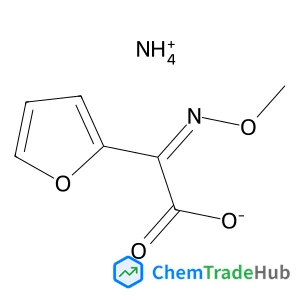
Ammonium (Z)-2-(furan-2-yl)-2-(methoxyimino)acetate
CAS Number:
97148-39-5
Molecular Formula:
C7H10N2O4
The first page of this article is displayed as the abstract.
Xiang-Jin Kong, Chao Peng, Yao-Han Lan, Wen-xiu Li, Shuai-Shuai Chi, Chao Zheng, Lin-Yi Dong, Xian-Hua Wang
DOI: 10.1039/C9AY01229J
Heng Qian, Chaoran Liu, Qian Yang, Xinya Liu, Haixiang Gao, Wenfeng Zhou
DOI: 10.1039/C9AY01518C
Kui Yang, Shuang Chao, Feiyu Zhang, Yuxin Pei, Zhichao Pei
DOI: 10.1039/C9CC07373F
Ebrahim Azadniya, Gertrud E. Morlock
DOI: 10.1039/C9AY01465A
Suraj Pavagada, Robert B. Channon, Jason Y. H. Chang, Sung Hye Kim
DOI: 10.1039/C9CC90472G
Olivier Back, Bruno Donnadieu, Moritz von Hopffgarten, Susanne Klein, Ralf Tonner, Gernot Frenking, Guy Bertrand
DOI: 10.1039/C1SC00027F
Chen Jiang, Yuewei Yao, Chuilian Kong, Jiaqi Du, Jingjing Meng, Cheng Yao
DOI: 10.1039/C9AY01234F
Wei-Jie Huang, Pang-Hua Huang, Sheng-Hsiung Yang
DOI: 10.1039/C6CC07062K
DOI: 10.1039/JA9900500239
Jana Pisk, Tomica Hrenar, Mirta Rubčić, Gordana Pavlović, Vladimir Damjanović, Jasna Lovrić, Marina Cindrić, Višnja Vrdoljak
DOI: 10.1039/C7CE02136D
1H-Indazole-6-carbonitrile finds applications in pharmaceuticals, where it serve...
Waste containing Dioctyl (2E)-2-butenedioate (CAS: 2997-85-5) should be collecte...
Sodium [(1,2-benzoxazol-3-ylmethyl)sulfonyl]azanide is primarily used in pharmac...
Dimethyl 4-(4,4,5,5-tetramethyl-1,3,2-dioxaborolan-2-yl)-2,6-pyridinedicarboxyla...
Waste containing 2-Fluoro-6-hydrazinopyridine (CAS: 80714-39-2) should be manage...
6-Formyl-2-pyridinecarboxylic acid is an organic compound with the molecular for...
Research trends for this compound indicate a focus on its potential applications...
9H-Tribenzo[b,d,f]azepine is typically synthesized via a multi-step process invo...
1-Cyclopropyl-7-ethoxy-6-fluoro-8-methoxy-4-oxo-1,4-dihydro-3-quinolinecarboxyli...
Waste containing Methyl 3-oxo-1,2,3,4-tetrahydro-6-quinoxalinecarboxylate (CAS: ...

ChemComm publishes urgent research which is of outstanding significance and interest to experts in the field, while also appealing to the journal’s broad chemistry readership. Our communication format is ideally suited to short, urgent studies that are of such importance that they require accelerated publication. Our scope covers all topics in chemistry, and research at the interface of chemistry and other disciplines (such as materials science, nanoscience, physics, engineering and biology) where there is a significant novelty in the chemistry aspects. Major topic areas covered include: Analytical Chemistry Catalysis Chemical Biology and medicinal chemistry Computational Chemistry and Machine Learning Energy and sustainable chemistry Environmental Chemistry Green Chemistry Inorganic Chemistry Materials Chemistry Nanoscience Organic Chemistry Physical Chemistry Polymer Chemistry Supramolecular Chemistry