


Stimuli-responsive, biocompatible hydrogel derived from glycogen and poly(N-isopropylacrylamide) for colon targeted delivery of ornidazole and 5-amino salicylic acid
Literature Information
Publication Date
2016-07-26
DOI
10.1039/C6PY01128D
Impact Factor
5.582
Authors
Priyapratim Patra, Arun Prabhu Rameshbabu, Dipankar Das, Santanu Dhara, Asit Baran Panda, Sagar Pal
View Original
Abstract
In the present article, a novel biocompatible and stimuli-responsive hydrogel (cl-Gly/pNIPAm) has been fabricated through free radical polymerisation using biopolymer glycogen (Gly), N-isopropylacrylamide (NIPAm) monomer and ethylene glycol dimethacrylate (EGDMA) crosslinker. Several grades of hydrogels have been developed and an optimized grade (i.e. c-Gly/NIPAm 4 with higher % crosslinking) has been used for characterisation and application towards colon targeted drugs carrier. The temperature and pH sensitivity of the cl-Gly/pNIPAm hydrogel have been studied by assessing equilibrium swelling at 25/37 °C and pH 1.2/7.4. The LCST of the developed hydrogel has been determined and found to be in the range of 32.5–34 °C. The degradation kinetics of the hydrogel has been performed. The hydrogel demonstrates good compatibility towards human mesenchymal stem cells (hMSCs). It is degraded by hen egg lysozyme. The synthesized hydrogel can load colon targeted drugs, 5-amino salicylic acid (5-ASA) and ornidazole, efficiently and released both drugs in a controlled manner, while ∼96–97% of drugs remained stable after 2 months. The release kinetics and mechanism have also been studied.
Recommended Journals

Advances in Colloid and Interface Science

Chemical Reviews

Chemical & Pharmaceutical Bulletin

Accounts of Chemical Research

Chemistry of Natural Compounds

Journal of the American Chemical Society

Journal of the Chinese Chemical Society

Chemistry of Heterocyclic Compounds

Carbon

Bulletin of the Chemical Society of Japan
Related Literature
Polymeric vesicles with well-defined poly(methyl methacrylate) (PMMA) brushes via surface-initiated photopolymerization (SIPP)
Fengting Chen, Xuesong Jiang, Rui Liu, Jie Yin
2010-11-05
Paper
DOI: 10.1039/C0PY00288G
Thiol–isocyanate “click” reactions: rapid development of functional polymeric surfaces
Ryan M. Hensarling, Santosh B. Rahane, Arthur P. LeBlanc, Bradley J. Sparks, Evan M. White, Jason Locklin, Derek L. Patton
2010-10-18
Communication
DOI: 10.1039/C0PY00292E
2-[1-(2,4-Dibenzhydryl-6-methylphenylimino)ethyl]-6-[1-(arylimino)ethyl]pyridylcobalt(ii) dichlorides: Synthesis, characterization and ethylenepolymerization behavior
Weizhen Zhao, Wenhong Yang, Carl Redshaw, Tongling Liang, Yongwen Liu, Wen-Hua Sun
2012-01-25
Paper
DOI: 10.1039/C2PY00590E
Solubility in CO2 and swelling studies by in situIR spectroscopy of vegetable-based epoxidized oils as polyurethane precursors
Stéphanie Foltran, Lise Maisonneuve, Eric Cloutet, Benoit Gadenne, Carine Alfos, Thierry Tassaing, Henri Cramail
2011-12-22
Paper
DOI: 10.1039/C2PY00476C
BF3·Et2O-mediated Friedel–Crafts C–H bond polymerization to synthesize π-conjugation-interrupted polymer semiconductors
Zheng-Dong Liu, Yong-Zheng Chang, Chang-Jin Ou, Jin-Yi Lin, Ling-Hai Xie, Cheng-Rong Yin, Ming-Deng Yi, Yan Qian, Nai-En Shi, Wei Huang
2011-07-27
Communication
DOI: 10.1039/C1PY00203A
Synthesis of hydrogels viaring-opening metathesispolymerization: factors affecting gelation
Ahmad E. Madkour, Joshua M. Grolman, Gregory N. Tew
2010-11-01
Paper
DOI: 10.1039/C0PY00151A
Graphite oxide as a carbocatalyst for the preparation of fullerene-reinforced polyester and polyamide nanocomposites
Daniel R. Dreyer, Karalee A. Jarvis, Paulo J. Ferreira, Christopher W. Bielawski
2012-01-18
Paper
DOI: 10.1039/C2PY00545J
Scope and limitation of the copper free thermal Huisgen cross-linking reaction to stabilize the chromophores orientation in electro-optic polymers
Annabelle Scarpaci, Clément Cabanetos, Errol Blart, Yann Pellegrin, Véronique Montembault, Laurent Fontaine, Vincent Rodriguez, Fabrice Odobel
2010-10-13
Paper
DOI: 10.1039/C0PY00203H
Stable azlactone-functionalized nanoparticles prepared from thermoresponsive copolymers synthesized by RAFT polymerization
Martin E. Levere, Hien The Ho, Sagrario Pascual, Laurent Fontaine
2011-10-17
Paper
DOI: 10.1039/C1PY00320H
You might also like
Compound Q&A
What is 3-Fluoro-2-methylbenzylamine (CAS: 771573-36-5)?
3-Fluoro-2-methylbenzylamine is an organic compound with the CAS number 771573-3...
771573-36-53-Fluoro-2-methylben...
Compound Q&A
Is Tert-butyl 2-(oxetan-3-ylidene)acetate (CAS: 1207175-03-8) safe?
Tert-butyl 2-(oxetan-3-ylidene)acetate is considered safe for its intended uses ...
1207175-03-8Tert-butyl 2-(oxetan...
Compound Q&A
What precautions should be taken when handling 4-Acetyl-2-fluorobenzonitrile (CAS: 214760-18-6)?
Proper personal protective equipment (PPE) such as gloves, goggles, and a lab co...
214760-18-64-Acetyl-2-fluoroben...
Compound Q&A
How is 2-Ethyl-4-methyl-1,3-thiazole (CAS: 15679-12-6) typically synthesized?
2-Ethyl-4-methyl-1,3-thiazole is commonly synthesized via the reaction of thiour...
15679-12-62-Ethyl-4-methyl-1,3...
Compound Q&A
How should 5',5''-([2,2'-Bithiophene]-5,5'-diyl)bis(([1,1':3',1''-terphenyl]-4,4''-dicarboxylic acid)) (CAS: 1227780-71-3) be stored?
This compound should be stored in a cool, dry place away from direct sunlight an...
1227780-71-35',5''''-([2,2'-Bith...
Compound Q&A
What regulatory guidelines apply to L-Lysine Acetate Salt (CAS: 52315-92-1)?
L-Lysine Acetate Salt (CAS: 52315-92-1) is subject to various regulatory guideli...
52315-92-1L-LYSINE ACETATE SAL...
Compound Q&A
Is 6-Fluoro-3-hydroxy-2-pyrazinecarboxamide (CAS: 259793-96-9) safe?
6-Fluoro-3-hydroxy-2-pyrazinecarboxamide (CAS: 259793-96-9) is generally conside...
259793-96-96-Fluoro-3-hydroxy-2...
Compound Q&A
What are the physical and chemical properties of 1,1'-Sulfonylbis(1H-imidazole) (CAS: 7189-69-7)?
1,1'-Sulfonylbis(1H-imidazole) is a crystalline solid with a molecular weight of...
7189-69-71,1'-Sulfonylbis(1H-...
Compound Q&A
What industries use 4-methyl-7-nitro-1H-indole-3-carbonitrile (CAS: 289483-82-5)?
4-Methyl-7-nitro-1H-indole-3-carbonitrile (CAS: 289483-82-5) is primarily used i...
289483-82-54-methyl-7-nitro-1H-...
Compound Q&A
How should waste containing 5-Bromo-3-indolyl-beta-galactoside (CAS: 97753-82-7) be handled?
Waste containing 5-Bromo-3-indolyl-beta-galactoside (CAS: 97753-82-7) should be ...
97753-82-75-Bromo-3-indolyl-be...
Source Journal
Polymer Chemistry

CiteScore:
8.6
Self-citation Rate:
7.3%
Articles per Year:
457
Polymer Chemistry welcomes submissions in all areas of polymer science that have a strong focus on macromolecular chemistry. Manuscripts may cover a broad range of fields, yet no direct application focus is required.
Recommended Compounds
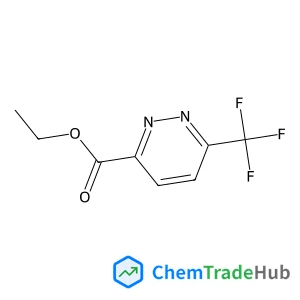
Ethyl 6-(trifluoromethyl)pyridazine-3-carboxylate
CAS Number:
1192155-06-8
Molecular Formula:
C8H7F3N2O2
Recommended Suppliers







Disclaimer
This page provides academic journal information for reference and research purposes only. We are not affiliated with any journal publishers and do not handle publication submissions. For publication-related inquiries, please contact the respective journal publishers directly.
If you notice any inaccuracies in the information displayed, please contact us at support@chemtradehub.com. We will promptly review and address your concerns.