


![(2E)-4-[(1R,2S,8R,19S,21R)-14-Hydroxy-11-isopropenyl-8,23,23-trimethyl-5-(3-methyl-2-buten-1-yl)-16,20-dioxo-3,7,22-trioxaheptacyclo[17.4.1.1~8,12~.0~2,17~.0~2,21~.0~4,15~.0~6,13~]pentacosa-4(15),5,13
,17-tetraen-21-yl]-2-methyl-2-butenoic acid structure](https://static.chemtradehub.com/structs/173/173867-04-4-d2d3.webp "(2E)-4-[(1R,2S,8R,19S,21R)-14-Hydroxy-11-isopropenyl-8,23,23-trimethyl-5-(3-methyl-2-buten-1-yl)-16,20-dioxo-3,7,22-trioxaheptacyclo[17.4.1.1~8,12~.0~2,17~.0~2,21~.0~4,15~.0~6,13~]pentacosa-4(15),5,13
,17-tetraen-21-yl]-2-methyl-2-butenoic acid structure")
Scope and limitation of the copper free thermal Huisgen cross-linking reaction to stabilize the chromophores orientation in electro-optic polymers
Literature Information
Publication Date
2010-10-13
DOI
10.1039/C0PY00203H
Impact Factor
5.582
Authors
Annabelle Scarpaci, Clément Cabanetos, Errol Blart, Yann Pellegrin, Véronique Montembault, Laurent Fontaine, Vincent Rodriguez, Fabrice Odobel
View Original
Abstract
New methacrylate copolymers incorporating two complementary thermally cross-linkable groups (azide or ethynyl) for implementation in electro-optic devices were synthesized and their nonlinear optical properties were investigated. These copolymers were prepared from a monomer containing Disperse Red 1 (DR1) as active NLO chromophore which is end substituted either by an azide or ethynyl group connected via a rigid (phenyl) or flexible spacer (alkyl chain). The second monomer is either a trimethylsilyl-propargyl methacrylate, or an azidopropyl methacrylate or a trimethylsilyl-phenyl methacrylate. The determination of the reactivity ratios showed that the monomer containing the DR1 chromophore is more reactive than trimethylsilyl-propargyl methacrylate. The cross-linking temperatures of these polymers range from 150 °C to 187 °C depending on the rigidity of the spacers connecting the cross-linkable units. These polymers displayed relatively high macroscopic electro-optic stability, enhanced upon cross-linking by more than 40 °C relative to non-cross-linked polymers. The results underscore the importance of the flexibility of the spacers to achieve the stable bulk electro-optic response. While rigidity is favorable to maintain the orientation of the chromophores, the optimal polymer is the one containing a flexible and a rigid spacer, since the mobility of the reactive groups is a key parameter which guarantees a high cross-linking conversion within the polymer. This study demonstrates the versatility of this new cross-linking process because we showed that the reactive groups (azide or trimethylsilylacetylated groups) can be interconverted (on the chromophore or as polymer side chain) with no change on the overall electro-optic activity and its thermal stability. Furthermore, preliminary kinetic study indicates that the Huisgen reaction rate can be controlled by the substituent on the ethynyl group opening the possibility to tune the cross-linking temperature by the careful choice of this substituent.
Recommended Journals

Environmental Toxicology and Pharmacology

Mini-Reviews in Medicinal Chemistry

Coloration Technology

Contact Lens & Anterior Eye

Physical Chemistry Chemical Physics

Molecular Diversity

European Journal of Organic Chemistry

Nature Reviews Drug Discovery

Journal of Enzyme inhibition and Medicinal Chemistry

Current Pharmaceutical Biotechnology
Related Literature
A microwave molecular solution based approach towards high-κ-tantalum(v)oxide nanoparticles: synthesis, dielectric properties and electron paramagnetic resonance spectroscopic studies of their defect chemistry
R. C. Hoffmann, M. Kaloumenos, D. Spiehl, E. Erdem, S. Repp, S. Weber, J. J. Schneider
2015-11-03
Paper
DOI: 10.1039/C5CP05166E
Periodic Hartree–Fock and hybrid density functional calculations on the metallic and the insulating phase of (EDO-TTF)2PF6
Gerrit-Jan Linker, Paul H. M. van Loosdrecht, Piet Th. van Duijnen, Ria Broer
2015-10-21
Paper
DOI: 10.1039/C5CP05187H
Negative photoconductivity of InAs nanowires
Yuxiang Han, Xiao Zheng, Mengqi Fu, Dong Pan, Xing Li, Yao Guo, Jianhua Zhao, Qing Chen
2015-11-17
Paper
DOI: 10.1039/C5CP06139C
Vibronic couplings and coherent electron transfer in bridged systems
Raffaele Borrelli, Amedeo Capobianco, Alessandro Landi, Andrea Peluso
2015-06-30
Paper
DOI: 10.1039/C5CP01190F
An EPR study of ampullosporin A, a medium-length peptaibiotic, in bicelles and vesicles
Annalisa Dalzini, Fernando Formaggio, Claudio Toniolo, Marina Gobbo, Anna Lisa Maniero
2015-11-19
Paper
DOI: 10.1039/C5CP04136H
Tetraalkylammonium interactions with dodecyl sulfate micelles: a molecular dynamics study
Guokui Liu, Heng Zhang, Gang Liu, Shiling Yuan, Chengbu Liu
2015-11-19
Paper
DOI: 10.1039/C5CP05639J
Spectral lineshapes in nonlinear electronic spectroscopy
Artur Nenov, Angelo Giussani, Benjamin P. Fingerhut, Ivan Rivalta, Elise Dumont, Shaul Mukamel
2015-06-02
Paper
DOI: 10.1039/C5CP01167A
Thermal phase behavior and ion hopping in a 1,2,4-triazolium perfluorobutanesulfonate protic organic ionic plastic crystal
Anirban Mondal, Anurag Prakash Sunda, Sundaram Balasubramanian
2015-12-09
Paper
DOI: 10.1039/C5CP05701A
Unraveling the interplay between hydrogen bonding and rotational energy barrier to fine-tune the properties of triazine molecular glasses
Audrey Laventure, Guillaume De Grandpré, Armand Soldera, Olivier Lebel, Christian Pellerin
2015-12-07
Paper
DOI: 10.1039/C5CP06630A
Characterizing the nanoclay induced constrained amorphous region in model segmented polyurethane–urea/clay nanocomposites and its implications on gas barrier properties
Sangram K. Rath, Kathi Sudarshan, Rupesh S. Bhavsar, Ulhas K. Kharul, Pradeep K. Pujari, Manoranjan Patri, Devang V. Khakhar
2015-11-17
Paper
DOI: 10.1039/C5CP05260B
You might also like
Compound Q&A
What is 3-Fluoro-2-methylbenzylamine (CAS: 771573-36-5)?
3-Fluoro-2-methylbenzylamine is an organic compound with the CAS number 771573-3...
771573-36-53-Fluoro-2-methylben...
Compound Q&A
Is Tert-butyl 2-(oxetan-3-ylidene)acetate (CAS: 1207175-03-8) safe?
Tert-butyl 2-(oxetan-3-ylidene)acetate is considered safe for its intended uses ...
1207175-03-8Tert-butyl 2-(oxetan...
Compound Q&A
What precautions should be taken when handling 4-Acetyl-2-fluorobenzonitrile (CAS: 214760-18-6)?
Proper personal protective equipment (PPE) such as gloves, goggles, and a lab co...
214760-18-64-Acetyl-2-fluoroben...
Compound Q&A
How is 2-Ethyl-4-methyl-1,3-thiazole (CAS: 15679-12-6) typically synthesized?
2-Ethyl-4-methyl-1,3-thiazole is commonly synthesized via the reaction of thiour...
15679-12-62-Ethyl-4-methyl-1,3...
Compound Q&A
How should 5',5''-([2,2'-Bithiophene]-5,5'-diyl)bis(([1,1':3',1''-terphenyl]-4,4''-dicarboxylic acid)) (CAS: 1227780-71-3) be stored?
This compound should be stored in a cool, dry place away from direct sunlight an...
1227780-71-35',5''''-([2,2'-Bith...
Compound Q&A
What regulatory guidelines apply to L-Lysine Acetate Salt (CAS: 52315-92-1)?
L-Lysine Acetate Salt (CAS: 52315-92-1) is subject to various regulatory guideli...
52315-92-1L-LYSINE ACETATE SAL...
Compound Q&A
Is 6-Fluoro-3-hydroxy-2-pyrazinecarboxamide (CAS: 259793-96-9) safe?
6-Fluoro-3-hydroxy-2-pyrazinecarboxamide (CAS: 259793-96-9) is generally conside...
259793-96-96-Fluoro-3-hydroxy-2...
Compound Q&A
What are the physical and chemical properties of 1,1'-Sulfonylbis(1H-imidazole) (CAS: 7189-69-7)?
1,1'-Sulfonylbis(1H-imidazole) is a crystalline solid with a molecular weight of...
7189-69-71,1'-Sulfonylbis(1H-...
Compound Q&A
What industries use 4-methyl-7-nitro-1H-indole-3-carbonitrile (CAS: 289483-82-5)?
4-Methyl-7-nitro-1H-indole-3-carbonitrile (CAS: 289483-82-5) is primarily used i...
289483-82-54-methyl-7-nitro-1H-...
Compound Q&A
How should waste containing 5-Bromo-3-indolyl-beta-galactoside (CAS: 97753-82-7) be handled?
Waste containing 5-Bromo-3-indolyl-beta-galactoside (CAS: 97753-82-7) should be ...
97753-82-75-Bromo-3-indolyl-be...
Source Journal
Polymer Chemistry

CiteScore:
8.6
Self-citation Rate:
7.3%
Articles per Year:
457
Polymer Chemistry welcomes submissions in all areas of polymer science that have a strong focus on macromolecular chemistry. Manuscripts may cover a broad range of fields, yet no direct application focus is required.
Recommended Compounds
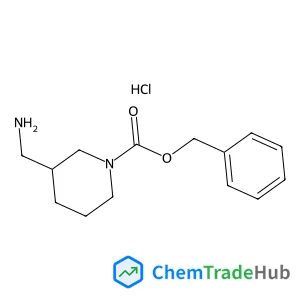
Benzyl 3-(aminomethyl)piperidine-1-carboxylate hydrochloride
CAS Number:
1186663-23-9
Molecular Formula:
C14H21ClN2O2
Recommended Suppliers





Disclaimer
This page provides academic journal information for reference and research purposes only. We are not affiliated with any journal publishers and do not handle publication submissions. For publication-related inquiries, please contact the respective journal publishers directly.
If you notice any inaccuracies in the information displayed, please contact us at support@chemtradehub.com. We will promptly review and address your concerns.