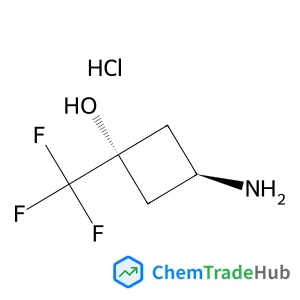
cis-3-Amino-1-(trifluoromethyl)cyclobutanol hydrochloride (1:1)
CAS Number:
1408075-16-0
Molecular Formula:
C5H9ClF3NO
A. Dolgopolov, K. N. Grafskaia, D. E. Demco, X. Zhu, M. Möller
In supramolecular assemblies, absorption of water can assist the channel formation, similarly to biological systems and Nafion-like commercial ion-selective membranes. In this work, we investigate humidity-induced formation of water channels in wedge-shaped amphiphilic molecules, namely sodium 4′-[3′′,4′′,5′′-tris(alkyloxy)benzoyloxy]azobenzene-4-sulfonates. The studied molecules contain a polar sulfonate group at the tip and a hydrophobic periphery composed of alkyl chains of two different lengths. Upon increasing the relative humidity (RH) the amount of absorbed water significantly increases for the mesogen with dodecyl chains as compared to the one with octyl groups. In the former case, water sorption is accompanied by a considerable enhancement of ionic conductivity and a phase transition. In particular, an increase of RH induces a transition from a lamellar to a columnar phase resulting in the formation of 1D water channels running along the axis of the supramolecular columns. For the compound with shorter alkyl chains the lamellar phase exists in the entire RH-range exhibiting pronounced swelling at high RH-values and thereby forming a 2D water channel structure. NMR diffusometry was used to address the different molecular motions in the lyotropic mesophases of the studied amphiphiles.
Hong Du, Xuxia Yao, Xiaodong Li, Zhiquan Shen
DOI: 10.1039/C6PY01346E
Emily A. Hoff, Brooks A. Abel, Chase A. Tretbar, Charles L. McCormick, Derek L. Patton
DOI: 10.1039/C6PY01563H
Yi Pan, Zhaohui Zheng, Xiaobin Ding
DOI: 10.1039/C7PY00904F
Csaba Fodor, Tímea Stumphauser, Ralf Thomann, Yi Thomann, Béla Iván
DOI: 10.1039/C6PY00848H
Wei Zhu, Zheng-Dong Ding, Xuan Wang, Tao Li, Rui Shen, Yunxing Li, Zaijun Li, Xuehong Ren, Zhi-Guo Gu
DOI: 10.1039/C7PY00876G
Takaya Terashima, Mitsuo Sawamoto, Heather D. Maynard
DOI: 10.1039/C4PY01346H
Chuanlong Li, Chuanshuang Chen, Shanlong Li, Tahir Rasheed, Ping Huang, Tong Huang, Yinglin Zhang, Wei Huang, Yongfeng Zhou
DOI: 10.1039/C7PY00908A
Makoto Ouchi, Hajime Kammiyada, Mitsuo Sawamoto
DOI: 10.1039/C7PY00638A
Zhi Li, De-Yi Wang
DOI: 10.1039/C7PY00660H
4-Nitrophenyl phosphate disodium salt hexahydrate is primarily used as a substra...
2-(Trifluoromethyl)-1,3-oxazole-4-carboxylic Acid (CAS: 1060816-01-4) is widely ...
2-Fluoro-4-biphenylcarboxylic acid should be stored in a cool, dry place at room...
Prednisolone-21-Carboxylic Acid is primarily used in the pharmaceutical industry...
4-(Hydrazinomethyl)-1,2,3-benzenetriol (CAS: 3614-72-0) should be stored in a co...
4-Amino-1-methyl-1H-pyrazole-5-carboxylic acid hydrochloride (CAS: 92534-70-8) i...
Dehydropachymic acid (CAS: 77012-31-8) is regulated by various agencies. It fall...
The market and research trends for 6-[(2,2-Dimethylpropanoyl)amino]nicotinic aci...
1,10-Phenanthroline-2,9-dicarbaldehyde should be stored in a cool, dry place awa...
5-Carbamoyl-11-oxo-10,11-dihydro-5H-dibenzo[b,f]azepin-10-yl acetate can be synt...

Physical Chemistry Chemical Physics (PCCP) is an international journal co-owned by 19 physical chemistry and physics societies from around the world. This journal publishes original, cutting-edge research in physical chemistry, chemical physics and biophysical chemistry. To be suitable for publication in PCCP, articles must include significant innovation and/or insight into physical chemistry; this is the most important criterion that reviewers and Editors will judge against when evaluating submissions. The journal has a broad scope and welcomes contributions spanning experiment, theory, computation and data science. Topical coverage includes spectroscopy, dynamics, kinetics, statistical mechanics, thermodynamics, electrochemistry, catalysis, surface science, quantum mechanics, quantum computing and machine learning. Interdisciplinary research areas such as polymers and soft matter, materials, nanoscience, energy, surfaces/interfaces, and biophysical chemistry are welcomed if they demonstrate significant innovation and/or insight into physical chemistry. Joined experimental/theoretical studies are particularly appreciated when complementary and based on up-to-date approaches.