












Design of well-defined shape memory networks with high homogeneity: towards advanced shape memory polymeric materials
Literature Information
Publication Date
2017-06-15
DOI
10.1039/C7PY00904F
Impact Factor
5.582
Authors
Yi Pan, Zhaohui Zheng, Xiaobin Ding
View Original
Abstract
Designing precisely defined network architecture that could integrate desired material properties into a single network is a great challenge for the development of advanced polymeric materials. For thermally induced shape memory polymers, rapid response, controllable recovery in a narrow temperature window and a large achievable number of cycles are critical for their applications. Here, we report the synthesis of a well-defined shape memory network with high homogeneity via efficient step-growth thiol-norbornene photopolymerization. Because of the uniform distribution of the switch segments and netpoints, the single polymer network exhibits a combination of perfect shape fixity and recovery, rapid response, outstanding cycle life at the high strain and unusual tunable multiple shape memory effects in a narrow temperature range, which may lead to an even more diverse range of applications.
Recommended Journals
Related Literature
Determination of vitamin D3 conjugated metabolites: a complementary view on hydroxylated metabolites
Roger Bouillon
2022-12-20
Paper
DOI: 10.1039/D2AN01982E
A machine learning based approach for quantitative evaluation of cell migration in Transwell assays based on deformation characteristics
Fei Zhang, Rongbiao Zhang, Mingji Wei, Guoxiao Li
2023-02-14
Paper
DOI: 10.1039/D2AN01882A
Rapid exocytosis kinetics measured by amperometry within volcano microelectrodes
Nicolas Maïno, Arnaud Bertsch, Philippe Renaud
2023-04-11
Paper
DOI: 10.1039/D2AN01779B
Molecular simulation-guided aptasensor design of robust and sensitive lateral flow strip for cadmium ion detection
Muhammad Irfan, Ghulam Murtaza, Shangnan Fu, Ailiang Chen, Feng Qu, Xin Su
2023-03-20
Paper
DOI: 10.1039/D3AN00202K
Solvent-regulated fluorescence off–on signaling of Ni(ii) and Zn(ii) with the formation of two mononuclear complexes with an ATP detection ability by Zn(ii) assembly
Subham Ray, Soumik Laha, Manik Das, Uttam Kumar Das, Arijit Bag, Indranil Choudhuri, Nandan Bhattacharya, Bidhan Chandra Samanta, Tithi Maity
2022-12-20
Paper
DOI: 10.1039/D2AN01938H
“Lighting up” fluoride: cellular imaging and zebrafish model interrogations using a simple ESIPT-based mycophenolic acid precursor-based probe
Neha Jain, Prasad M. Sonawane, Haoyan Liu, Arkaprava Roychaudhury, Youngseob Lee, Jongkeol An, Donghyeon Kim, Dongwook Kim, Yunsu Kim, Yeu-Chun Kim, Kyung-Bin Cho, Hee-Sung Park, Cheol-Hee Kim
2023-05-15
Paper
DOI: 10.1039/D3AN00646H
Electrogenerated chemiluminescence resonance energy transfer between luminol and MnO2 nanosheets decorated with Cu2O nanoparticles for sensitive detection of RNase H
Yahao Shi, Chunting Chen, Yahui Zhang, Yongping Dong, Shangbing Wang
2023-02-11
Paper
DOI: 10.1039/D3AN00002H
Highly sensitive and specific detection of silver ions using a dual-color fluorescence co-localization strategy
Chenhui Hao, Jinxiu Wei, Shenfei Zong, Zhuyuan Wang, Hong Wang, Yiping Cui
2023-01-06
Paper
DOI: 10.1039/D2AN01662A
A dual-emitting immunosensor based on manganese dioxide nanoflowers and zinc sulfide quantum dots with enhanced electrochemiluminescence performance for the ultrasensitive detection of procalcitonin
Na Wang, Juan Yang, Zhi Luo, Dongmiao Qin, Yusheng Wu, Biyang Deng
2023-03-28
Paper
DOI: 10.1039/D3AN00153A
Overview and considerations in bottom-up proteomics
Rachel M. Miller, Lloyd M. Smith
2022-11-14
Tutorial Review
DOI: 10.1039/D2AN01246D
You might also like
Compound Q&A
What are the main uses of 4-Nitrophenyl phosphate disodium salt hexahydrate (CAS: 333338-18-4)?
4-Nitrophenyl phosphate disodium salt hexahydrate is primarily used as a substra...
333338-18-44-Nitrophenyl phosph...
Compound Q&A
What are the main uses of 2-(Trifluoromethyl)-1,3-oxazole-4-carboxylic Acid (CAS: 1060816-01-4)?
2-(Trifluoromethyl)-1,3-oxazole-4-carboxylic Acid (CAS: 1060816-01-4) is widely ...
1060816-01-42-(Trifluoromethyl)-...
Compound Q&A
How should 2-Fluoro-4-biphenylcarboxylic acid (CAS: 137045-30-8) be stored?
2-Fluoro-4-biphenylcarboxylic acid should be stored in a cool, dry place at room...
137045-30-82-Fluoro-4-biphenylc...
Compound Q&A
What industries use Prednisolone-21-Carboxylic Acid (CAS: 61549-70-0)?
Prednisolone-21-Carboxylic Acid is primarily used in the pharmaceutical industry...
61549-70-0Prednisolone-21-Carb...
Compound Q&A
How should 4-(Hydrazinomethyl)-1,2,3-benzenetriol (CAS: 3614-72-0) be stored?
4-(Hydrazinomethyl)-1,2,3-benzenetriol (CAS: 3614-72-0) should be stored in a co...
3614-72-04-(Hydrazinomethyl)-...
Compound Q&A
What industries use 4-Amino-1-methyl-1H-pyrazole-5-carboxylic acid hydrochloride (CAS: 92534-70-8)?
4-Amino-1-methyl-1H-pyrazole-5-carboxylic acid hydrochloride (CAS: 92534-70-8) i...
92534-70-84-Amino-1-methyl-1H-...
Compound Q&A
What regulatory guidelines apply to dehydropachymic acid (CAS: 77012-31-8)?
Dehydropachymic acid (CAS: 77012-31-8) is regulated by various agencies. It fall...
77012-31-8Dehydropachymic acid
Compound Q&A
What is the market or research trend for 6-[(2,2-Dimethylpropanoyl)amino]nicotinic acid (CAS: 898561-66-5)?
The market and research trends for 6-[(2,2-Dimethylpropanoyl)amino]nicotinic aci...
898561-66-56-[(2,2-Dimethylprop...
Compound Q&A
How should 1,10-Phenanthroline-2,9-dicarbaldehyde (CAS: 57709-62-3) be stored?
1,10-Phenanthroline-2,9-dicarbaldehyde should be stored in a cool, dry place awa...
57709-62-31,10-Phenanthroline-...
Compound Q&A
How is 5-Carbamoyl-11-oxo-10,11-dihydro-5H-dibenzo[b,f]azepin-10-yl acetate (CAS: 113952-21-9) typically synthesized?
5-Carbamoyl-11-oxo-10,11-dihydro-5H-dibenzo[b,f]azepin-10-yl acetate can be synt...
113952-21-95-Carbamoyl-11-oxo-1...
Source Journal
Polymer Chemistry

CiteScore:
8.6
Self-citation Rate:
7.3%
Articles per Year:
457
Polymer Chemistry welcomes submissions in all areas of polymer science that have a strong focus on macromolecular chemistry. Manuscripts may cover a broad range of fields, yet no direct application focus is required.
Recommended Compounds
![[(1S,2S,3R,4S,7R,9S,10S,12R,15S)-4,12-Diacetyloxy-15-[(2R,3S)-3-benzamido-3-phenyl-2-(2,2,2-trichloroethoxycarbonyloxy)propanoyl]oxy-1,9-dihydroxy-10,14,17,17-tetramethyl-11-oxo-6-oxatetracyclo[11.3.1.03,10.04,7]heptadec-13-en-2-yl] benzoate structure](https://static.chemtradehub.com/structs/100/100431-55-8-7104.webp "[(1S,2S,3R,4S,7R,9S,10S,12R,15S)-4,12-Diacetyloxy-15-[(2R,3S)-3-benzamido-3-phenyl-2-(2,2,2-trichloroethoxycarbonyloxy)propanoyl]oxy-1,9-dihydroxy-10,14,17,17-tetramethyl-11-oxo-6-oxatetracyclo[11.3.1.03,10.04,7]heptadec-13-en-2-yl] benzoate structure")
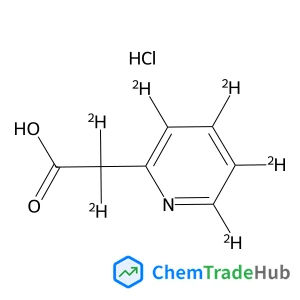
2,2-dideuterio-2-(3,4,5,6-tetradeuterio-2-pyridyl)acetic acid;hydrochloride
CAS Number:
1329799-67-8
Molecular Formula:
C7H2ClD6NO2

Recommended Suppliers




Disclaimer
This page provides academic journal information for reference and research purposes only. We are not affiliated with any journal publishers and do not handle publication submissions. For publication-related inquiries, please contact the respective journal publishers directly.
If you notice any inaccuracies in the information displayed, please contact us at support@chemtradehub.com. We will promptly review and address your concerns.