












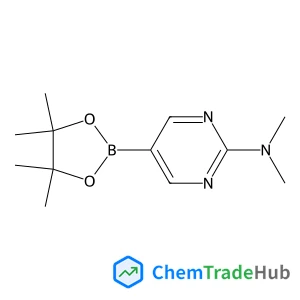
N,N-Dimethyl-5-(4,4,5,5-tetramethyl-1,3,2-dioxaborolan-2-yl)-2-pyrimidinamine
CAS Number:
1032759-30-0
Molecular Formula:
C12H20BN3O2
Pablo Rivero
By using first-principles methods based on density functional theory we revisited the zero-temperature phase diagram of stoichiometric SrCoO3, a ferromagnetic metallic perovskite that undergoes significant structural, electronic, and magnetic changes as its content of oxygen is decreased. We considered both bulk and epitaxial thin film geometries. In the bulk case, we found that a tetragonal P4/mbm phase with moderate Jahn–Teller distortions and a c/a ratio of is consistently predicted to have a lower energy than the thus far assumed ground-state cubic Pmm phase. In thin films, we found two phase transitions occurring at compressive and tensile epitaxial strains. However, in contrast to previous theoretical predictions, our results show that: (i) the phase transition induced by tensile strain is isostructural and involves only a change in magnetic spin order (that is, not a metallic to insulator transformation), and (ii) the phase transition induced by compressive strain comprises simultaneous structural, electronic and magnetic spin order changes, but the required epitaxial stress is so large (<−6%) that is unlikely to be observed in practice. Our findings call for a revision of the crystallographic data obtained in fully oxidised SrCoO3 samples at low temperatures, as well as of previous first-principles studies.
Emilia Olsson, Jonathon Cottom, Xavier Aparicio-Anglès
DOI: 10.1039/C9CP00995G
Hao Wang, Wei Wei, Fengping Li, Baibiao Huang, Ying Dai
DOI: 10.1039/C9CP01196J
Barbora Tarabová, Petr Lukeš, Malte U. Hammer, Helena Jablonowski, Thomas von Woedtke, Stephan Reuter, Zdenko Machala
DOI: 10.1039/C9CP00871C
Balázs Olasz, Gábor Czakó
DOI: 10.1039/C8CP06207B
Xiang Liu, Wenbo Mi
DOI: 10.1039/C9CP00033J
Kamila Akhmetova, Haiyan Fan
DOI: 10.1039/C8CP04789H
DOI: 10.1039/C9CP01234F
Marc Figueras, Carmen Sousa, Francesc Illas
DOI: 10.1039/C9CP01569H
Giuseppe Cassone, Holger Kruse, Jiri Sponer
DOI: 10.1039/C8CP07492E
William D. Hong, Christopher N. Lam, Yangyang Wang, Youjun He, Luis E. Sánchez-Díaz, Changwoo Do
DOI: 10.1039/C8CP07520D
When considering alternatives to 1-(4-Chlorophenyl)-N-hydroxymethanimine (CAS: 3...
This compound should be stored in a cool, dry place away from direct sunlight. I...
3-(4-Bromophenyl)-5-(2-fluorophenyl)-1,2,4-oxadiazole is synthesized through a m...
5-Chloro-2-(4-chlorophenyl)-4-methyl-6-[3-(1-piperidinyl)propoxy]pyrimidine (CAS...
2-Chloro-4-(difluoromethoxy)pyridine is used in the pharmaceutical industry for ...
3-Chloro-6-methylpyridazine (CAS: 1121-79-5) is classified under the Globally Ha...
Several alternatives can be used in the synthesis of Methyl 4,5-dimethyl-2-nitro...
Alternatives to (2E,2'E)-3,3'-(1,4-Phenylene)bisacrylaldehyde include other acry...
3-Amino-5-chloropyridin-2-ol hydrochloride is an organic compound with the CAS n...
When handling 6,7-Difluoro-2,3-dihydro-4H-chromen-4-one, it is essential to wear...

Physical Chemistry Chemical Physics (PCCP) is an international journal co-owned by 19 physical chemistry and physics societies from around the world. This journal publishes original, cutting-edge research in physical chemistry, chemical physics and biophysical chemistry. To be suitable for publication in PCCP, articles must include significant innovation and/or insight into physical chemistry; this is the most important criterion that reviewers and Editors will judge against when evaluating submissions. The journal has a broad scope and welcomes contributions spanning experiment, theory, computation and data science. Topical coverage includes spectroscopy, dynamics, kinetics, statistical mechanics, thermodynamics, electrochemistry, catalysis, surface science, quantum mechanics, quantum computing and machine learning. Interdisciplinary research areas such as polymers and soft matter, materials, nanoscience, energy, surfaces/interfaces, and biophysical chemistry are welcomed if they demonstrate significant innovation and/or insight into physical chemistry. Joined experimental/theoretical studies are particularly appreciated when complementary and based on up-to-date approaches.
![6-Bromo-2,3-dihydro-1H-pyrido[2,3-b][1,4]oxazine structure](https://static.chemtradehub.com/structs/120/1203499-17-5-b4d1.webp "6-Bromo-2,3-dihydro-1H-pyrido[2,3-b][1,4]oxazine structure")





