












Electronic and magnetic properties of the one-dimensional interfaces of two-dimensional lateral GeC/BP heterostructures
Literature Information
Publication Date
2019-04-02
DOI
10.1039/C9CP01196J
Impact Factor
3.676
Authors
Hao Wang, Wei Wei, Fengping Li, Baibiao Huang, Ying Dai
View Original
Abstract
We studied the electronic and magnetic properties of one-dimensional (1D) interfaces of two dimensional (2D) GeC/BP lateral heterostructures by first-principles calculations. We showed that an inner electric field exists in the heterostructures, and the 1D interfaces exhibit metallic properties when the ribbon width is larger than a critical value. In other words, the 1DEG/1DHG (one dimensional electron gas/one dimensional hole gas) with π bonding character appear at the interfaces. We verified that the existence of the polar discontinuity at the interfaces is the pre-requisite for this insulator-to-metal transition, which can be understood by the topology classification of the formal polarization of the honeycomb structures with C3 symmetry and the corresponding charge compensation mechanism was also discussed. We predicted the emergence of magnetism at the interfaces, with the width-dependent spin polarization being attributed to the Stoner instability. Increasing DOS at the interfaces leads to a paramagnetic to ferromagnetic transition.
Recommended Journals
Related Literature
A new, simple approach to confer permanent antimicrobial properties to hydroxylated surfaces by surface functionalization
Othman Bouloussa
2008-01-03
Communication
DOI: 10.1039/B716026G
Fabrication of Cd(OH)2 nanorings by ultrasonic chiselling on Cd(OH)2 nanoplates
Jian-Jun Miao, Rui-Ling Fu, Jian-Min Zhu, Ke Xu, Jun-Jie Zhu, Hong-Yuan Chen
2006-06-13
Communication
DOI: 10.1039/B604688F
New palladium-catalyzed aerobic oxidative cleavage and cyclization of N-aryl peptide derivatives
Laurent El Kaïm, Rocio Gamez-Montaño, Laurence Grimaud, Tannya Ibarra-Rivera
2008-01-18
Communication
DOI: 10.1039/B716849G
Poly(acenaphtho[1,2-b]thieno[3,4-e]pyrazine): a new low band gap conjugated polymer
Jon P. Nietfeld, Christopher L. Heth, Seth C. Rasmussen
2008-01-02
Communication
DOI: 10.1039/B713126G
Unprecedented twofold intramolecular hydroamination in diam(m)ine-dicarboxylatodichloridoplatinum(iv) complexes – ethane-1,2-diaminevs.ammine ligands
Michael R. Reithofer, Mathea S. Galanski, Vladimir B. Arion, Bernhard K. Keppler
2008-01-09
Communication
DOI: 10.1039/B715680D
Highly active iridium(i) complexes for catalytic hydrogen isotope exchange
Jack A. Brown, Stephanie Irvine, Alan R. Kennedy, William J. Kerr, Shalini Andersson, Göran N. Nilsson
2008-01-03
Communication
DOI: 10.1039/B715938B
STEM characterization on silicananowires with new mesopore structures by space-confined self-assembly within nano-scale channels
Michael Z. Hu, Donglu Shi, Douglas Blom
2008-01-23
Communication
DOI: 10.1039/B717461F
Direct synthesis of the 1,2,3-[C6H4PPP]− anion, isoelectronic with the indenyl anion [C6H4CHCHCH]−
Felipe García, Robert J. Less, Vesal Naseri, Mary McPartlin, Jeremy M. Rawson, Maria Sancho Tomas, Dominic S. Wright
2008-01-15
Communication
DOI: 10.1039/B718425E
2-D Self-assembly of the bis(phthalocyaninato)terbium(iii) single-molecule magnet studied by scanning tunnelling microscopy
Jordi Gómez-Segura, Ismael Díez-Pérez, Naoto Ishikawa, Motohiro Nakano, Jaume Veciana, Daniel Ruiz-Molina
2006-06-15
Communication
DOI: 10.1039/B606276H
Crystal structure of tricyclo-DNA: an unusual compensatory change of two adjacent backbone torsion angles
Pradeep S. Pallan, Damian Ittig, Annie Héroux, Zdzislaw Wawrzak, Christian J. Leumann, Martin Egli
2007-12-21
Communication
DOI: 10.1039/B716390H
You might also like
Compound Q&A
Are there alternatives to 1-(4-Chlorophenyl)-N-hydroxymethanimine (CAS: 3848-36-0) in synthesis?
When considering alternatives to 1-(4-Chlorophenyl)-N-hydroxymethanimine (CAS: 3...
3848-36-01-(4-Chlorophenyl)-N...
Compound Q&A
How should (1R,9S,10S,12S,14E,16S,19R,20R,21S,22R)-3,9,21-Trihydroxy-5,10,12,14,16,20,22-heptamethyl-23,24-dioxatetracyclo[17.3.1.1~6,9~.0~2,7~]tetracosa-2,5,7,14-tetraen-4-one (CAS: 183202-73-5) be stored?
This compound should be stored in a cool, dry place away from direct sunlight. I...
183202-73-5(1R,9S,10S,12S,14E,1...
Compound Q&A
How is 3-(4-Bromophenyl)-5-(2-fluorophenyl)-1,2,4-oxadiazole (CAS: 419553-16-5) typically synthesized?
3-(4-Bromophenyl)-5-(2-fluorophenyl)-1,2,4-oxadiazole is synthesized through a m...
419553-16-53-(4-Bromophenyl)-5-...
Compound Q&A
How is 5-Chloro-2-(4-chlorophenyl)-4-methyl-6-[3-(1-piperidinyl)propoxy]pyrimidine (CAS: 1639220-19-1) typically synthesized?
5-Chloro-2-(4-chlorophenyl)-4-methyl-6-[3-(1-piperidinyl)propoxy]pyrimidine (CAS...
1639220-19-15-Chloro-2-(4-chloro...
Compound Q&A
What industries use 2-Chloro-4-(difluoromethoxy)pyridine (CAS: 1206978-15-5)?
2-Chloro-4-(difluoromethoxy)pyridine is used in the pharmaceutical industry for ...
1206978-15-52-Chloro-4-(difluoro...
Compound Q&A
What regulatory guidelines apply to 3-Chloro-6-methylpyridazine (CAS: 1121-79-5)?
3-Chloro-6-methylpyridazine (CAS: 1121-79-5) is classified under the Globally Ha...
1121-79-53-Chloro-6-methylpyr...
Compound Q&A
Are there alternatives to Methyl 4,5-dimethyl-2-nitrobenzoate in synthesis?
Several alternatives can be used in the synthesis of Methyl 4,5-dimethyl-2-nitro...
90922-74-0Methyl 4,5-dimethyl-...
Compound Q&A
Are there alternatives to (2E,2'E)-3,3'-(1,4-Phenylene)bisacrylaldehyde in synthesis?
Alternatives to (2E,2'E)-3,3'-(1,4-Phenylene)bisacrylaldehyde include other acry...
63405-68-5(2E,2'E)-3,3'-(1,4-P...
Compound Q&A
What is 3-Amino-5-chloropyridin-2-ol hydrochloride (CAS: 1261906-29-9)?
3-Amino-5-chloropyridin-2-ol hydrochloride is an organic compound with the CAS n...
1261906-29-93-Amino-5-chloropyri...
Compound Q&A
What precautions should be taken when handling 6,7-Difluoro-2,3-dihydro-4H-chromen-4-one (CAS: 1092349-93-3)?
When handling 6,7-Difluoro-2,3-dihydro-4H-chromen-4-one, it is essential to wear...
1092349-93-36,7-Difluoro-2,3-dih...
Source Journal
Physical Chemistry Chemical Physics

CiteScore:
5.5
Self-citation Rate:
10.3%
Articles per Year:
3036
Physical Chemistry Chemical Physics (PCCP) is an international journal co-owned by 19 physical chemistry and physics societies from around the world. This journal publishes original, cutting-edge research in physical chemistry, chemical physics and biophysical chemistry. To be suitable for publication in PCCP, articles must include significant innovation and/or insight into physical chemistry; this is the most important criterion that reviewers and Editors will judge against when evaluating submissions. The journal has a broad scope and welcomes contributions spanning experiment, theory, computation and data science. Topical coverage includes spectroscopy, dynamics, kinetics, statistical mechanics, thermodynamics, electrochemistry, catalysis, surface science, quantum mechanics, quantum computing and machine learning. Interdisciplinary research areas such as polymers and soft matter, materials, nanoscience, energy, surfaces/interfaces, and biophysical chemistry are welcomed if they demonstrate significant innovation and/or insight into physical chemistry. Joined experimental/theoretical studies are particularly appreciated when complementary and based on up-to-date approaches.
Recommended Compounds
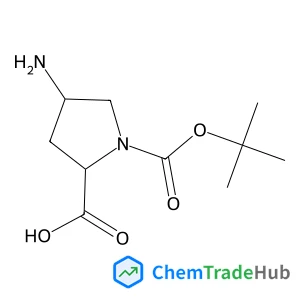
(2R,4R)-1-Boc-4-Aminopyrrolidine-2-carboxylic acid
CAS Number:
132622-98-1
Molecular Formula:
C10H18N2O4
Recommended Suppliers





Disclaimer
This page provides academic journal information for reference and research purposes only. We are not affiliated with any journal publishers and do not handle publication submissions. For publication-related inquiries, please contact the respective journal publishers directly.
If you notice any inaccuracies in the information displayed, please contact us at support@chemtradehub.com. We will promptly review and address your concerns.