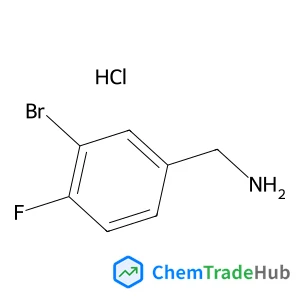
1-(3-Bromo-4-fluorophenyl)methanamine hydrochloride (1:1)
CAS Number:
202865-68-7
Molecular Formula:
C7H8BrClFN
Marc Figueras, Carmen Sousa, Francesc Illas
The influence of electron correlation into the decomposition of core level binding energy shifts, measured by X-ray photoelectron spectroscopy (XPS), into initial and final effects is analysed for a series of molecules where these effects are noticeable. Moreover, the series of molecules is chosen in such a way that electron delocalization and increasing number of electrons may provide a large screening of the core hole. A detailed analysis shows that the Hartree–Fock decomposition is biased whereas a physically meaningful decomposition is obtained when electron correlation effects are taken into account. The results show that in this case, trends in core level binding energy shifts are driven by initial state effects thus providing further support to the use of these observable quantities to interpret changes in the chemical bond in the neutral molecule rather than on the core ionized cation. Consequences for the theoretical interpretation of XPS data in materials and surface science are discussed.
Craig P. Butts, Michael Green, Thomas N. Hooper, Richard J. Kilby, John E. McGrady, Dimitrios A. Pantazis, Christopher A. Russell
DOI: 10.1039/B717204D
Stephen G. Davies, A. Christopher Garner, Euan C. Goddard, Dennis Kruchinin, Paul M. Roberts, Humberto Rodriguez-Solla, Andrew D. Smith
DOI: 10.1039/B604835H
Li Shang, Shaojun Dong
DOI: 10.1039/B717728C
Qing-Zheng Yang, Daria Khvostichenko, John D. Atkinson, Roman Boulatov
DOI: 10.1039/B717858A
Jon P. Nietfeld, Christopher L. Heth, Seth C. Rasmussen
DOI: 10.1039/B713126G
Wenting Shen, Sébastien Graule, Jeanne Crassous, Christophe Lescop, Heinz Gornitzka, Régis Réau
DOI: 10.1039/B714340K
Manolis J. Manos, Joon I. Jang, John B. Ketterson, Mercouri G. Kanatzidis
DOI: 10.1039/B712732D
Matthew A. Henderson, J. Scott McIndoe
DOI: 10.1039/B606938J
Sébastien Royer, Xavier Sécordel, Markus Brandhorst, Franck Dumeignil, Sylvain Cristol, Christophe Dujardin, Mickaël Capron, Edmond Payen, Jean-Luc Dubois
DOI: 10.1039/B714260A
When considering alternatives to 1-(4-Chlorophenyl)-N-hydroxymethanimine (CAS: 3...
This compound should be stored in a cool, dry place away from direct sunlight. I...
3-(4-Bromophenyl)-5-(2-fluorophenyl)-1,2,4-oxadiazole is synthesized through a m...
5-Chloro-2-(4-chlorophenyl)-4-methyl-6-[3-(1-piperidinyl)propoxy]pyrimidine (CAS...
2-Chloro-4-(difluoromethoxy)pyridine is used in the pharmaceutical industry for ...
3-Chloro-6-methylpyridazine (CAS: 1121-79-5) is classified under the Globally Ha...
Several alternatives can be used in the synthesis of Methyl 4,5-dimethyl-2-nitro...
Alternatives to (2E,2'E)-3,3'-(1,4-Phenylene)bisacrylaldehyde include other acry...
3-Amino-5-chloropyridin-2-ol hydrochloride is an organic compound with the CAS n...
When handling 6,7-Difluoro-2,3-dihydro-4H-chromen-4-one, it is essential to wear...

Physical Chemistry Chemical Physics (PCCP) is an international journal co-owned by 19 physical chemistry and physics societies from around the world. This journal publishes original, cutting-edge research in physical chemistry, chemical physics and biophysical chemistry. To be suitable for publication in PCCP, articles must include significant innovation and/or insight into physical chemistry; this is the most important criterion that reviewers and Editors will judge against when evaluating submissions. The journal has a broad scope and welcomes contributions spanning experiment, theory, computation and data science. Topical coverage includes spectroscopy, dynamics, kinetics, statistical mechanics, thermodynamics, electrochemistry, catalysis, surface science, quantum mechanics, quantum computing and machine learning. Interdisciplinary research areas such as polymers and soft matter, materials, nanoscience, energy, surfaces/interfaces, and biophysical chemistry are welcomed if they demonstrate significant innovation and/or insight into physical chemistry. Joined experimental/theoretical studies are particularly appreciated when complementary and based on up-to-date approaches.
![4-[(3-Chloro-2-fluorophenyl)amino]-7-methoxy-6-quinazolinyl acetate structure](https://static.chemtradehub.com/structs/740/740081-22-5-f58f.webp "4-[(3-Chloro-2-fluorophenyl)amino]-7-methoxy-6-quinazolinyl acetate structure")