


Structure and Li+ ion transport in a mixed carbonate/LiPF6 electrolyte near graphite electrode surfaces: a molecular dynamics study
Literature Information
Publication Date
2016-09-22
DOI
10.1039/C6CP05140E
Impact Factor
3.676
Authors
Mathew J. Boyer, Linas Vilčiauskas, Gyeong S. Hwang
View Original
Abstract
Electrolyte and electrode materials used in lithium-ion batteries have been studied separately to a great extent, however the structural and dynamical properties of the electrolyte–electrode interface still remain largely unexplored despite its critical role in governing battery performance. Using molecular dynamics simulations, we examine the structural reorganization of solvent molecules (cyclic ethylene carbonate : linear dimethyl carbonate 1 : 1 molar ratio doped with 1 M LiPF6) in the vicinity of graphite electrodes with varying surface charge densities (σ). The interfacial structure is found to be sensitive to the molecular geometry and polarity of each solvent molecule as well as the surface structure and charge distribution of the negative electrode. We also evaluated the potential difference across the electrolyte–electrode interface, which exhibits a nearly linear variation with respect to σ up until the onset of Li+ ion accumulation onto the graphite edges from the electrolyte. In addition, well-tempered metadynamics simulations are employed to predict the free-energy barriers to Li+ ion transport through the relatively dense interfacial layer, along with analysis of the Li+ solvation sheath structure. Quantitative analysis of the molecular arrangements at the electrolyte–electrode interface will help better understand and describe electrolyte decomposition, especially in the early stages of solid-electrolyte-interphase (SEI) formation. Moreover, the computational framework presented in this work offers a means to explore the effects of solvent composition, electrode surface modification, and operating temperature on the interfacial structure and properties, which may further assist in efforts to engineer the electrolyte–electrode interface leading to a SEI layer that optimizes battery performance.
Recommended Journals

Journal of Natural Medicines

Journal of Saudi Chemical Society

Chemistry Education Research and Practice

Nature Medicine

Russian Journal of Organic Chemistry

Current Opinion in Solid State & Materials Science

Current Opinion in Colloid & Interface Science

Drug Discovery Today

Acta Materialia

Russian Chemical Bulletin
Related Literature
Charge transfer to solvent dynamics in iodide aqueous solution studied at ionization threshold
Alexander Kothe, Martin Wilke, Alexandre Moguilevski, Nicholas Engel, Bernd Winter, Igor Yu. Kiyan
2014-11-27
Paper
DOI: 10.1039/C4CP02482F
Pool-BCGA: a parallelised generation-free genetic algorithm for the ab initio global optimisation of nanoalloy clusters
A. Shayeghi, D. Götz, J. B. A. Davis, R. Schäfer, R. L. Johnston
2014-12-01
Paper
DOI: 10.1039/C4CP04323E
Photoelectrocatalytic degradation of rhodamine B on TiO2 photonic crystals
Xiuzhen Zheng, Danzhen Li, Xiaofang Li, Linhui Yu, Peng Wang, Xiaoyun Zhang, Jialin Fang, Yu Shao, Yi Zheng
2014-06-09
Paper
DOI: 10.1039/C4CP01888E
From zeolite nets to sp3 carbon allotropes: a topology-based multiscale theoretical study
Igor A. Baburin, Vladimir A. Saleev, Alexandra V. Shipilova
2014-11-12
Paper
DOI: 10.1039/C4CP04569F
Molecular dynamics investigations of liquid–vapor interaction and adsorption of formaldehyde, oxocarbons, and water in graphitic slit pores
Pei-Hsing Huang, Shang-Chao Hung, Ming-Yueh Huang
2014-06-10
Paper
DOI: 10.1039/C4CP01922A
Near-band-edge exciton polarization change in ZnO nanowires
Zaiping Zeng, Alexia Petoni, Christos S. Garoufalis, Sotirios Baskoutas, Gabriel Bester
2014-11-12
Paper
DOI: 10.1039/C4CP04551C
A quantum algorithm for obtaining the energy spectrum of a physical system without guessing its eigenstates
2014-06-20
Paper
DOI: 10.1039/C4CP01351D
Quaternary ammonium and phosphonium based ionic liquids: a comparison of common anions
Rebecca K. Blundell, Peter Licence
2014-06-11
Paper
DOI: 10.1039/C4CP01901F
Physicochemical characterization of nanoparticles and their behavior in the biological environment
K. A. Eslahian, D. Docter, T. Lang, R. Zellner, K. Nienhaus, R. H. Stauber, M. Maskos
2014-05-30
Perspective
DOI: 10.1039/C4CP00058G
Surface-enhanced Raman scattering on a hierarchical structural Ag nano-crown array in different detection ways
Yi Wang, Yuyang Wang, Hailong Wang, Ming Cong, Weiqing Xu, Shuping Xu
2014-11-07
Paper
DOI: 10.1039/C4CP04387A
You might also like
Compound Q&A
Is 2-(2-chloroacetamido)-3-phenylpropanoic acid (CAS: 7765-11-9) safe?
2-(2-Chloroacetamido)-3-phenylpropanoic acid (CAS: 7765-11-9) is generally consi...
7765-11-92-(2-chloroacetamido...
Compound Q&A
Is 2-(Benzyloxy)-5-bromobenzoic acid (CAS: 62176-31-2) safe?
2-(Benzyloxy)-5-bromobenzoic acid can be handled safely if appropriate precautio...
62176-31-22-(Benzyloxy)-5-brom...
Compound Q&A
What is (4-Methyl-1,2,5-oxadiazol-3-yl)methanamine hydrochloride (CAS: 1159825-48-5)?
(4-Methyl-1,2,5-oxadiazol-3-yl)methanamine hydrochloride is a chemical compound ...
1159825-48-5(4-Methyl-1,2,5-oxad...
Compound Q&A
What is 2-(5-Hexylthiophen-2-yl)-4,4,5,5-tetramethyl-1,3,2-dioxaborolane (CAS: 917985-54-7)?
2-(5-Hexylthiophen-2-yl)-4,4,5,5-tetramethyl-1,3,2-dioxaborolane (CAS: 917985-54...
917985-54-72-(5-Hexylthiophen-2...
Compound Q&A
Are there alternatives to 4-(8-Methyl-9H-1,3-dioxolo[4,5-h][2,3]benzodiazepin-5-yl)benzenamine (CAS: 102771-26-6) in synthesis?
While 4-(8-Methyl-9H-1,3-dioxolo[4,5-h][2,3]benzodiazepin-5-yl)benzenamine (CAS:...
102771-26-64-(8-Methyl-9H-1,3-d...
Compound Q&A
What is the market or research trend for tert-butyl 3-hydroxy-4,5,7,8-tetrahydro-2H-pyrazolo[3,4-d]azepine-6-carboxylate (CAS: 851376-80-2)?
The market for tert-butyl 3-hydroxy-4,5,7,8-tetrahydro-2H-pyrazolo[3,4-d]azepine...
851376-80-2tert-butyl 3-hydroxy...
Compound Q&A
How should waste containing 3,5-Diamino-1H-pyrazole-4-carbonitrile (CAS: 6844-58-2) be handled?
Waste containing 3,5-Diamino-1H-pyrazole-4-carbonitrile (CAS: 6844-58-2) should ...
6844-58-23,5-Diamino-1H-pyraz...
Compound Q&A
How is (6-Fluoro-3-pyridinyl)boronic acid (CAS: 351019-18-6) typically synthesized?
(6-Fluoro-3-pyridinyl)boronic acid can be synthesized through the reaction of 6-...
351019-18-6(6-Fluoro-3-pyridiny...
Compound Q&A
What industries use Dibenzyl carbonimidoylbiscarbamate (CAS: 10065-79-9)?
Dibenzyl carbonimidoylbiscarbamate (CAS: 10065-79-9) finds applications in vario...
10065-79-9Dibenzyl carbonimido...
Compound Q&A
What is the market or research trend for (beta,beta,2,3,4,5,6-~2~H_7_)Phenylalanine (CAS: 74228-83-4)?
The market for (beta,beta,2,3,4,5,6-~2~H_7_)Phenylalanine (CAS: 74228-83-4) is g...
74228-83-4(beta,beta,2,3,4,5,6...
Source Journal
Physical Chemistry Chemical Physics

CiteScore:
5.5
Self-citation Rate:
10.3%
Articles per Year:
3036
Physical Chemistry Chemical Physics (PCCP) is an international journal co-owned by 19 physical chemistry and physics societies from around the world. This journal publishes original, cutting-edge research in physical chemistry, chemical physics and biophysical chemistry. To be suitable for publication in PCCP, articles must include significant innovation and/or insight into physical chemistry; this is the most important criterion that reviewers and Editors will judge against when evaluating submissions. The journal has a broad scope and welcomes contributions spanning experiment, theory, computation and data science. Topical coverage includes spectroscopy, dynamics, kinetics, statistical mechanics, thermodynamics, electrochemistry, catalysis, surface science, quantum mechanics, quantum computing and machine learning. Interdisciplinary research areas such as polymers and soft matter, materials, nanoscience, energy, surfaces/interfaces, and biophysical chemistry are welcomed if they demonstrate significant innovation and/or insight into physical chemistry. Joined experimental/theoretical studies are particularly appreciated when complementary and based on up-to-date approaches.
Recommended Compounds
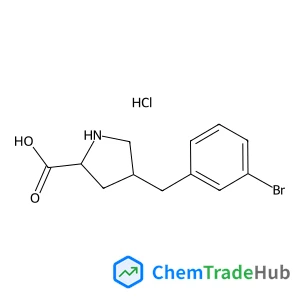
(2S,4R)-4-(3-Bromobenzyl)pyrrolidine-2-carboxylic acid hydrochloride
CAS Number:
1049734-10-2
Molecular Formula:
C12H15BrClNO2


Recommended Suppliers







Disclaimer
This page provides academic journal information for reference and research purposes only. We are not affiliated with any journal publishers and do not handle publication submissions. For publication-related inquiries, please contact the respective journal publishers directly.
If you notice any inaccuracies in the information displayed, please contact us at support@chemtradehub.com. We will promptly review and address your concerns.