












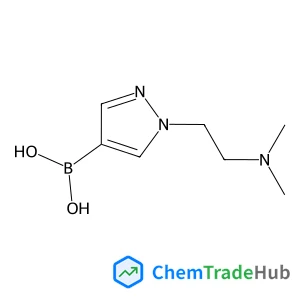
(1-(2-(Dimethylamino)ethyl)-1H-pyrazol-4-yl)boronic acid
CAS Number:
1086063-73-1
Molecular Formula:
C7H14BN3O2
Pei-Hsing Huang, Shang-Chao Hung, Ming-Yueh Huang
Formaldehyde exposure has been associated with several human cancers, including leukemia and nasopharyngeal carcinoma, motivating the present investigation on the microscopic adsorption behaviors of formaldehyde in multi-component-mixture-filled micropores. Molecular dynamics (MD) simulation was used to investigate the liquid–vapor interaction and adsorption of formaldehyde, oxocarbons, and water in graphitic slit pores. The effects of the slit width, system temperature, concentration, and the constituent ratio of the mixture on the diffusion and adsorption properties are studied. As a result of interactions between the components, the z-directional self-diffusivity (Dz) in the mixture substantially decreased by about one order of magnitude as compared with that of pure (single-constituent) adsorbates. When the concentration exceeds a certain threshold, the Dz values dramatically decrease due to over-saturation inducing barriers to diffusion. The binding energy between the adsorbate and graphite at the first adsorption monolayer is calculated to be 3.99, 2.01, 3.49, and 2.67 kcal mol−1 for CO2, CO, CH2O, and H2O, respectively. These values agree well with those calculated using the density functional theory coupled cluster method and experimental results. A low solubility of CO2 in water and water preferring to react with CH2O, forming hydrated methanediol clusters, are observed. Because the cohesion in a hydrated methanediol cluster is much higher than the adhesion between clusters and the graphitic surface, the hydrated methanediol clusters were hydrophobic, exhibiting a large contact angle on graphite.
K. Kinastowska, K. Piela, M. Gordel, A. Żak, R. Kołkowski, M. Samoć
DOI: 10.1039/C8CP02439A
A. Tsurumaki, O. Palumbo, S. Panero, A. Paolone, M. A. Navarra
DOI: 10.1039/C7CP08134K
Bjørn Kvamme, Juri Selvåg, Navid Saeidi, Tatiana Kuznetsova
DOI: 10.1039/C8CP02447B
Rafael Costa-Amaral, Juarez L. F. Da Silva
DOI: 10.1039/C8CP02874E
Andrey G. Cherstvy, Ralf Metzler
DOI: 10.1039/C7CP06922G
Rajeev Yadav, H. Peter Lu
DOI: 10.1039/C7CP08030A
Vincent V. Duong, Alexander L. Ayzner
DOI: 10.1039/C8CP04746D
Giel Berden, Evan R. Williams
DOI: 10.1039/C8CP01458B
2-(2-Chloroacetamido)-3-phenylpropanoic acid (CAS: 7765-11-9) is generally consi...
2-(Benzyloxy)-5-bromobenzoic acid can be handled safely if appropriate precautio...
(4-Methyl-1,2,5-oxadiazol-3-yl)methanamine hydrochloride is a chemical compound ...
2-(5-Hexylthiophen-2-yl)-4,4,5,5-tetramethyl-1,3,2-dioxaborolane (CAS: 917985-54...
While 4-(8-Methyl-9H-1,3-dioxolo[4,5-h][2,3]benzodiazepin-5-yl)benzenamine (CAS:...
The market for tert-butyl 3-hydroxy-4,5,7,8-tetrahydro-2H-pyrazolo[3,4-d]azepine...
Waste containing 3,5-Diamino-1H-pyrazole-4-carbonitrile (CAS: 6844-58-2) should ...
(6-Fluoro-3-pyridinyl)boronic acid can be synthesized through the reaction of 6-...
Dibenzyl carbonimidoylbiscarbamate (CAS: 10065-79-9) finds applications in vario...
The market for (beta,beta,2,3,4,5,6-~2~H_7_)Phenylalanine (CAS: 74228-83-4) is g...

Physical Chemistry Chemical Physics (PCCP) is an international journal co-owned by 19 physical chemistry and physics societies from around the world. This journal publishes original, cutting-edge research in physical chemistry, chemical physics and biophysical chemistry. To be suitable for publication in PCCP, articles must include significant innovation and/or insight into physical chemistry; this is the most important criterion that reviewers and Editors will judge against when evaluating submissions. The journal has a broad scope and welcomes contributions spanning experiment, theory, computation and data science. Topical coverage includes spectroscopy, dynamics, kinetics, statistical mechanics, thermodynamics, electrochemistry, catalysis, surface science, quantum mechanics, quantum computing and machine learning. Interdisciplinary research areas such as polymers and soft matter, materials, nanoscience, energy, surfaces/interfaces, and biophysical chemistry are welcomed if they demonstrate significant innovation and/or insight into physical chemistry. Joined experimental/theoretical studies are particularly appreciated when complementary and based on up-to-date approaches.
![Heptadecanoic Acid 3-[2-[4-(6-Fluoro-1,2-benzisoxazol-3-yl)-1-piperidinyl]ethyl]-6,7,8,9-tetrahydro-2-methyl-4-oxo-4H-pyrido[1,2-a]pyrimidin-9-yl Ester structure](https://static.chemtradehub.com/structs/140/1404053-62-8-9da4.webp "Heptadecanoic Acid 3-[2-[4-(6-Fluoro-1,2-benzisoxazol-3-yl)-1-piperidinyl]ethyl]-6,7,8,9-tetrahydro-2-methyl-4-oxo-4H-pyrido[1,2-a]pyrimidin-9-yl Ester structure")





