












Photoelectrocatalytic degradation of rhodamine B on TiO2 photonic crystals
Literature Information
Publication Date
2014-06-09
DOI
10.1039/C4CP01888E
Impact Factor
3.676
Authors
Xiuzhen Zheng, Danzhen Li, Xiaofang Li, Linhui Yu, Peng Wang, Xiaoyun Zhang, Jialin Fang, Yu Shao, Yi Zheng
View Original
Abstract
As the inverse-opal structure facilitates the separation of electron–hole pairs and electron transfer, it may generate many radical species with strong oxidation capability. When a low bias voltage was applied on the TiO2 electrodes with inverse-opal structure, they exhibited more excellent photoelectrochemical properties and photoelectrocatalytic activity than TiO2 film under simulated solar light irradiation. When different types of active species scavengers were added, the different performances of TiO2 photonic crystals in rhodamine B degradation showed that besides ˙OH and holes, which were the main active species in the photocatalysis, O2˙− played a vital role in the photoelectrocatalytic degradation process. Furthermore, the stronger signal of ˙OH-trapping photoluminescence and the variation in the concentration of nitroblue tetrazolium reflected that more ˙OH and O2˙− could be generated in the photoelectrocatalysis than that in the photocatalysis, and O2˙− was partially obtained from the cathode surface. At last, the roles active species played in the photoelectrocatalytic and photocatalytic processes were compared, and the possible degradation mechanisms of TiO2 photonic crystals in photoelectrocatalytic and photocatalytic systems were put forward, which could provide a good insight into the mechanism of photoelectrocatalytic degradation on TiO2 photonic crystals.
Related Literature
Synergetic effect of H and He impurities in Ti3AlC2: first principles calculations
Jiajia Liu, Canglong Wang, Xiaolu Zhu, Jitao Liu, Xingming Zhang, Xueqiang Gou, Wenshan Duan, Lei Yang
2018-06-25
Paper
DOI: 10.1039/C8CP02082E
Charge driven lateral structural evolution of ions in electric double layer capacitors strongly correlates with differential capacitance
Qiangqiang Meng
2018-02-26
Paper
DOI: 10.1039/C7CP08075A
The ozonolysis of isoprene in a cryogenic buffer gas cell by high resolution microwave spectroscopy
Jessica P. Porterfield, Sandra Eibenberger, David Patterson, Michael C. McCarthy
2018-05-31
Paper
DOI: 10.1039/C8CP02055H
Colloidal nanocrystals as LEGO® bricks for building electronic band structure models
Athmane Tadjine, Christophe Delerue
2018-02-27
Paper
DOI: 10.1039/C7CP08400E
Real time evolution of unprotected protonated galactosamine probed by IRMPD spectroscopy
C. Fraschetti, L. Guarcini, C. Zazza, L. Mannina, S. Circi, S. Piccirillo, B. Chiavarino, A. Filippi
2018-02-21
Paper
DOI: 10.1039/C7CP07642H
Polymorphism and metal-induced structural transformation in 5,5′-bis(4-pyridyl)(2,2′-bispyrimidine) adlayers on Au(111)
Diana Hötger, Pilar Carro, Rico Gutzler, Benjamin Wurster, Rajadurai Chandrasekar, Svetlana Klyatskaya, Roberto C. Salvarezza, Doris Grumelli
2018-05-01
Paper
DOI: 10.1039/C7CP07746G
Substituent effect on the dynamics of the inclusion complex formation between protoberberine alkaloids and cucurbit[7]uril
Zsombor Miskolczy, László Biczók, György Lendvay
2018-05-14
Paper
DOI: 10.1039/C8CP01845F
Photochemistry of glyoxylate embedded in sodium chloride clusters, a laboratory model for tropospheric sea-salt aerosols
Nina K. Bersenkowitsch, Milan Ončák, Christian van der Linde, Andreas Herburger, Martin K. Beyer
2018-02-28
Paper
DOI: 10.1039/C8CP00399H
You might also like
Compound Q&A
Is 2-(2-chloroacetamido)-3-phenylpropanoic acid (CAS: 7765-11-9) safe?
2-(2-Chloroacetamido)-3-phenylpropanoic acid (CAS: 7765-11-9) is generally consi...
7765-11-92-(2-chloroacetamido...
Compound Q&A
Is 2-(Benzyloxy)-5-bromobenzoic acid (CAS: 62176-31-2) safe?
2-(Benzyloxy)-5-bromobenzoic acid can be handled safely if appropriate precautio...
62176-31-22-(Benzyloxy)-5-brom...
Compound Q&A
What is (4-Methyl-1,2,5-oxadiazol-3-yl)methanamine hydrochloride (CAS: 1159825-48-5)?
(4-Methyl-1,2,5-oxadiazol-3-yl)methanamine hydrochloride is a chemical compound ...
1159825-48-5(4-Methyl-1,2,5-oxad...
Compound Q&A
What is 2-(5-Hexylthiophen-2-yl)-4,4,5,5-tetramethyl-1,3,2-dioxaborolane (CAS: 917985-54-7)?
2-(5-Hexylthiophen-2-yl)-4,4,5,5-tetramethyl-1,3,2-dioxaborolane (CAS: 917985-54...
917985-54-72-(5-Hexylthiophen-2...
Compound Q&A
Are there alternatives to 4-(8-Methyl-9H-1,3-dioxolo[4,5-h][2,3]benzodiazepin-5-yl)benzenamine (CAS: 102771-26-6) in synthesis?
While 4-(8-Methyl-9H-1,3-dioxolo[4,5-h][2,3]benzodiazepin-5-yl)benzenamine (CAS:...
102771-26-64-(8-Methyl-9H-1,3-d...
Compound Q&A
What is the market or research trend for tert-butyl 3-hydroxy-4,5,7,8-tetrahydro-2H-pyrazolo[3,4-d]azepine-6-carboxylate (CAS: 851376-80-2)?
The market for tert-butyl 3-hydroxy-4,5,7,8-tetrahydro-2H-pyrazolo[3,4-d]azepine...
851376-80-2tert-butyl 3-hydroxy...
Compound Q&A
How should waste containing 3,5-Diamino-1H-pyrazole-4-carbonitrile (CAS: 6844-58-2) be handled?
Waste containing 3,5-Diamino-1H-pyrazole-4-carbonitrile (CAS: 6844-58-2) should ...
6844-58-23,5-Diamino-1H-pyraz...
Compound Q&A
How is (6-Fluoro-3-pyridinyl)boronic acid (CAS: 351019-18-6) typically synthesized?
(6-Fluoro-3-pyridinyl)boronic acid can be synthesized through the reaction of 6-...
351019-18-6(6-Fluoro-3-pyridiny...
Compound Q&A
What industries use Dibenzyl carbonimidoylbiscarbamate (CAS: 10065-79-9)?
Dibenzyl carbonimidoylbiscarbamate (CAS: 10065-79-9) finds applications in vario...
10065-79-9Dibenzyl carbonimido...
Compound Q&A
What is the market or research trend for (beta,beta,2,3,4,5,6-~2~H_7_)Phenylalanine (CAS: 74228-83-4)?
The market for (beta,beta,2,3,4,5,6-~2~H_7_)Phenylalanine (CAS: 74228-83-4) is g...
74228-83-4(beta,beta,2,3,4,5,6...
Source Journal
Physical Chemistry Chemical Physics

CiteScore:
5.5
Self-citation Rate:
10.3%
Articles per Year:
3036
Physical Chemistry Chemical Physics (PCCP) is an international journal co-owned by 19 physical chemistry and physics societies from around the world. This journal publishes original, cutting-edge research in physical chemistry, chemical physics and biophysical chemistry. To be suitable for publication in PCCP, articles must include significant innovation and/or insight into physical chemistry; this is the most important criterion that reviewers and Editors will judge against when evaluating submissions. The journal has a broad scope and welcomes contributions spanning experiment, theory, computation and data science. Topical coverage includes spectroscopy, dynamics, kinetics, statistical mechanics, thermodynamics, electrochemistry, catalysis, surface science, quantum mechanics, quantum computing and machine learning. Interdisciplinary research areas such as polymers and soft matter, materials, nanoscience, energy, surfaces/interfaces, and biophysical chemistry are welcomed if they demonstrate significant innovation and/or insight into physical chemistry. Joined experimental/theoretical studies are particularly appreciated when complementary and based on up-to-date approaches.
Recommended Compounds

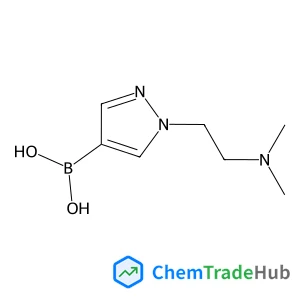
(1-(2-(Dimethylamino)ethyl)-1H-pyrazol-4-yl)boronic acid
CAS Number:
1086063-73-1
Molecular Formula:
C7H14BN3O2
![3,7-Di(1,1':3',1''-terphenyl-5'-yl)-10,11,12,13-tetrahydrodiindeno[7,1-de:1',7'-fg][1,3,2]dioxaphosphocin-5-ol 5-oxide structure](https://static.chemtradehub.com/structs/135/1352810-38-8-3f10.webp "3,7-Di(1,1':3',1''-terphenyl-5'-yl)-10,11,12,13-tetrahydrodiindeno[7,1-de:1',7'-fg][1,3,2]dioxaphosphocin-5-ol 5-oxide structure")
3,7-Di(1,1':3',1''-terphenyl-5'-yl)-10,11,12,13-tetrahydrodiindeno[7,1-de:1',7'-fg][1,3,2]dioxaphosphocin-5-ol 5-oxide
CAS Number:
1352810-38-8
Molecular Formula:
C53H39O4P

Recommended Suppliers




Disclaimer
This page provides academic journal information for reference and research purposes only. We are not affiliated with any journal publishers and do not handle publication submissions. For publication-related inquiries, please contact the respective journal publishers directly.
If you notice any inaccuracies in the information displayed, please contact us at support@chemtradehub.com. We will promptly review and address your concerns.