












Pool-BCGA: a parallelised generation-free genetic algorithm for the ab initio global optimisation of nanoalloy clusters
Literature Information
Publication Date
2014-12-01
DOI
10.1039/C4CP04323E
Impact Factor
3.676
Authors
A. Shayeghi, D. Götz, J. B. A. Davis, R. Schäfer, R. L. Johnston
View Original
Abstract
The Birmingham cluster genetic algorithm is a package that performs global optimisations for homo- and bimetallic clusters based on either first principles methods or empirical potentials. Here, we present a new parallel implementation of the code which employs a pool strategy in order to eliminate sequential steps and significantly improve performance. The new approach meets all requirements of an evolutionary algorithm and contains the main features of the previous implementation. The performance of the pool genetic algorithm is tested using the Gupta potential for the global optimisation of the Au10Pd10 cluster, which demonstrates the high efficiency of the method. The new implementation is also used for the global optimisation of the Au10 and Au20 clusters directly at the density functional theory level.
Related Literature
A critical assessment of force field accuracy against NMR data for cyclic peptides containing β-amino acids
C. Paissoni, F. Nardelli, S. Zanella, F. Curnis, L. Belvisi, G. Musco, M. Ghitti
2018-05-09
Paper
DOI: 10.1039/C8CP00234G
Structure–composition trends in multicomponent borosilicate-based glasses deduced from molecular dynamics simulations with improved B–O and P–O force fields
Baltzar Stevensson, Yang Yu, Mattias Edén
2018-02-07
Paper
DOI: 10.1039/C7CP08593A
Direct comparison between subnanometer hydration structures on hydrophilic and hydrophobic surfaces via three-dimensional scanning force microscopy
Chih-Wen Yang, Keisuke Miyazawa, Ing-Shouh Hwang
2018-08-28
Paper
DOI: 10.1039/C8CP02309C
Methanol as a hydrate inhibitor and hydrate activator
Bjørn Kvamme, Juri Selvåg, Navid Saeidi, Tatiana Kuznetsova
2018-08-07
Paper
DOI: 10.1039/C8CP02447B
Formation patterns of water clusters in CMK-3 and CMK-5 mesoporous carbons: a computational recognition study
Xuan Peng, Surendra Kumar Jain, Jayant Kumar Singh, Qibing Jin
2018-05-30
Paper
DOI: 10.1039/C8CP01887A
The effect of ether-functionalisation in ionic liquids analysed by DFT calculation, infrared spectra, and Kamlet–Taft parameters
A. Tsurumaki, O. Palumbo, S. Panero, A. Paolone, M. A. Navarra
2018-02-23
Paper
DOI: 10.1039/C7CP08134K
Pressure-induced switching properties of the iron(iii) spin-transition complex [FeIII(3-OMeSalEen)2]PF6
J. Laisney, H. J. Shepherd, L. Rechignat, G. Molnár, E. Rivière, M.-L. Boillot
2018-05-15
Paper
DOI: 10.1039/C8CP02376J
Zeolites with isolated-framework and oligomeric-extraframework hafnium species characterized with pair distribution function analysis
Koji Ohara, Yuriy Román-Leshkov, Toru Wakihara
2018-03-02
Communication
DOI: 10.1039/C8CP00464A
Comment on “Revisiting the definition of local hardness and hardness kernel” by C. A. Polanco-Ramirez, M. Franco-Pérez, J. Carmona-Espíndola, J. L. Gázquez and P. W. Ayers, Phys. Chem. Chem. Phys., 2017, 19, 12355
F. Guégan, W. Lamine, H. Chermette, C. Morell
2018-02-27
Comment
DOI: 10.1039/C7CP04100D
You might also like
Compound Q&A
Is 2-(2-chloroacetamido)-3-phenylpropanoic acid (CAS: 7765-11-9) safe?
2-(2-Chloroacetamido)-3-phenylpropanoic acid (CAS: 7765-11-9) is generally consi...
7765-11-92-(2-chloroacetamido...
Compound Q&A
Is 2-(Benzyloxy)-5-bromobenzoic acid (CAS: 62176-31-2) safe?
2-(Benzyloxy)-5-bromobenzoic acid can be handled safely if appropriate precautio...
62176-31-22-(Benzyloxy)-5-brom...
Compound Q&A
What is (4-Methyl-1,2,5-oxadiazol-3-yl)methanamine hydrochloride (CAS: 1159825-48-5)?
(4-Methyl-1,2,5-oxadiazol-3-yl)methanamine hydrochloride is a chemical compound ...
1159825-48-5(4-Methyl-1,2,5-oxad...
Compound Q&A
What is 2-(5-Hexylthiophen-2-yl)-4,4,5,5-tetramethyl-1,3,2-dioxaborolane (CAS: 917985-54-7)?
2-(5-Hexylthiophen-2-yl)-4,4,5,5-tetramethyl-1,3,2-dioxaborolane (CAS: 917985-54...
917985-54-72-(5-Hexylthiophen-2...
Compound Q&A
Are there alternatives to 4-(8-Methyl-9H-1,3-dioxolo[4,5-h][2,3]benzodiazepin-5-yl)benzenamine (CAS: 102771-26-6) in synthesis?
While 4-(8-Methyl-9H-1,3-dioxolo[4,5-h][2,3]benzodiazepin-5-yl)benzenamine (CAS:...
102771-26-64-(8-Methyl-9H-1,3-d...
Compound Q&A
What is the market or research trend for tert-butyl 3-hydroxy-4,5,7,8-tetrahydro-2H-pyrazolo[3,4-d]azepine-6-carboxylate (CAS: 851376-80-2)?
The market for tert-butyl 3-hydroxy-4,5,7,8-tetrahydro-2H-pyrazolo[3,4-d]azepine...
851376-80-2tert-butyl 3-hydroxy...
Compound Q&A
How should waste containing 3,5-Diamino-1H-pyrazole-4-carbonitrile (CAS: 6844-58-2) be handled?
Waste containing 3,5-Diamino-1H-pyrazole-4-carbonitrile (CAS: 6844-58-2) should ...
6844-58-23,5-Diamino-1H-pyraz...
Compound Q&A
How is (6-Fluoro-3-pyridinyl)boronic acid (CAS: 351019-18-6) typically synthesized?
(6-Fluoro-3-pyridinyl)boronic acid can be synthesized through the reaction of 6-...
351019-18-6(6-Fluoro-3-pyridiny...
Compound Q&A
What industries use Dibenzyl carbonimidoylbiscarbamate (CAS: 10065-79-9)?
Dibenzyl carbonimidoylbiscarbamate (CAS: 10065-79-9) finds applications in vario...
10065-79-9Dibenzyl carbonimido...
Compound Q&A
What is the market or research trend for (beta,beta,2,3,4,5,6-~2~H_7_)Phenylalanine (CAS: 74228-83-4)?
The market for (beta,beta,2,3,4,5,6-~2~H_7_)Phenylalanine (CAS: 74228-83-4) is g...
74228-83-4(beta,beta,2,3,4,5,6...
Source Journal
Physical Chemistry Chemical Physics

CiteScore:
5.5
Self-citation Rate:
10.3%
Articles per Year:
3036
Physical Chemistry Chemical Physics (PCCP) is an international journal co-owned by 19 physical chemistry and physics societies from around the world. This journal publishes original, cutting-edge research in physical chemistry, chemical physics and biophysical chemistry. To be suitable for publication in PCCP, articles must include significant innovation and/or insight into physical chemistry; this is the most important criterion that reviewers and Editors will judge against when evaluating submissions. The journal has a broad scope and welcomes contributions spanning experiment, theory, computation and data science. Topical coverage includes spectroscopy, dynamics, kinetics, statistical mechanics, thermodynamics, electrochemistry, catalysis, surface science, quantum mechanics, quantum computing and machine learning. Interdisciplinary research areas such as polymers and soft matter, materials, nanoscience, energy, surfaces/interfaces, and biophysical chemistry are welcomed if they demonstrate significant innovation and/or insight into physical chemistry. Joined experimental/theoretical studies are particularly appreciated when complementary and based on up-to-date approaches.
Recommended Compounds
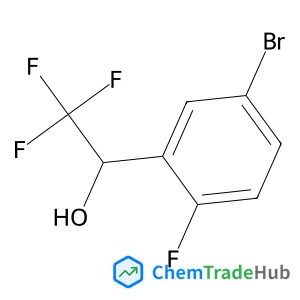
1-(5-Bromo-2-fluorophenyl)-2,2,2-trifluoroethanol
CAS Number:
1039827-16-1
Molecular Formula:
C8H5BrF4O
Recommended Suppliers






Disclaimer
This page provides academic journal information for reference and research purposes only. We are not affiliated with any journal publishers and do not handle publication submissions. For publication-related inquiries, please contact the respective journal publishers directly.
If you notice any inaccuracies in the information displayed, please contact us at support@chemtradehub.com. We will promptly review and address your concerns.