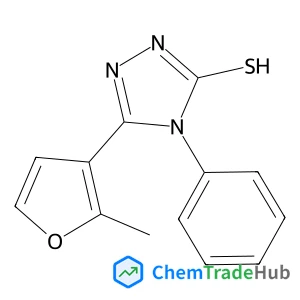
5-(2-Methyl-3-furyl)-4-phenyl-2,4-dihydro-3H-1,2,4-triazole-3-thione
CAS Number:
346464-59-3
Molecular Formula:
C13H11N3OS
Antoine Bonnot, Paul-Ludovic Karsenti, Frank Juvenal, Christopher Golz, Carsten Strohmann, Daniel Fortin, Michael Knorr, Pierre D. Harvey
EtS(CH2)4SEt, L1, forms with CuI a luminescent 2D polymer [Cu4I4{μ-L1}2]n (CP1), which exhibits no triplet excitation energy migration, but with CuBr, it forms a 3D material (CP2), [(Cu2Br2){μ-L1}]n consisting of parallel (Cu2Br2S2)n layers bridged by L1's. CP2 shows T1–T1 annihilation at 298 K but not at 77 K.
Ming-Jhe Li, Chien-Chen Lai, Yi-Hung Liu, Shie-Ming Peng, Sheng-Hsien Chiu
DOI: 10.1039/B906075H
Junji Kobayashi, Yuya Domoto, Takayuki Kawashima
DOI: 10.1039/B909881J
Alwin M. D. Wan, Daniel J. Brooks, Abdurrahman Gumus, Claudia Fischbach, George G. Malliaras
DOI: 10.1039/B911130A
DOI: 10.1039/B908378B
Gaojian Chen, Jatin Kumar, Andrew Gregory, Martina H. Stenzel
DOI: 10.1039/B910340F
Philippe Saint-Cricq, Thierry Pigot, Lionel Nicole, Clément Sanchez, Sylvie Lacombe
DOI: 10.1039/B911742C
Michael M. Madden, Claudia I. Rivera Vera, Wenjiao Song, Qing Lin
DOI: 10.1039/B912094G
Jian Zhu, Dieqing Zhang, Zhenfeng Bian, Guisheng Li, Yuning Huo, Yunfeng Lu, Hexing Li
DOI: 10.1039/B909692B
When handling lithium chloride hydrate (1:1:1) (CAS: 16712-20-2), it is importan...
4-(4H-1,2,4-Triazol-4-yl)piperidine is generally considered safe for use in phar...
Waste containing 1,3-Thiazole-2-carboxamide (CAS: 16733-85-0) should be collecte...
5-(Difluoromethyl)-2-fluorobenzonitrile (CAS: 934175-58-3) is subject to regulat...
Methyl 3-acetamido-2-thiophenecarboxylate can be synthesized by the reaction of ...
4-Isoquinolinecarbonitrile is a chemical compound with the CAS number 34846-65-6...
Store Methyl 1H-1,2,3-triazole-4-carboxylate (CAS: 877309-59-6) in a cool, dry p...
6-Bromo[1,3]thiazolo[5,4-b]pyridin-2-amine (CAS: 1160791-13-8) is subject to the...
(2S,3S)-2-Ammonio-3-(3,4-dihydroxyphenyl)-3-hydroxypropanoate (CAS: 23651-95-8) ...
7-Bromo-3-methyl-3,4-dihydroquinazolin-4-one is a solid with a crystalline form....

Physical Chemistry Chemical Physics (PCCP) is an international journal co-owned by 19 physical chemistry and physics societies from around the world. This journal publishes original, cutting-edge research in physical chemistry, chemical physics and biophysical chemistry. To be suitable for publication in PCCP, articles must include significant innovation and/or insight into physical chemistry; this is the most important criterion that reviewers and Editors will judge against when evaluating submissions. The journal has a broad scope and welcomes contributions spanning experiment, theory, computation and data science. Topical coverage includes spectroscopy, dynamics, kinetics, statistical mechanics, thermodynamics, electrochemistry, catalysis, surface science, quantum mechanics, quantum computing and machine learning. Interdisciplinary research areas such as polymers and soft matter, materials, nanoscience, energy, surfaces/interfaces, and biophysical chemistry are welcomed if they demonstrate significant innovation and/or insight into physical chemistry. Joined experimental/theoretical studies are particularly appreciated when complementary and based on up-to-date approaches.