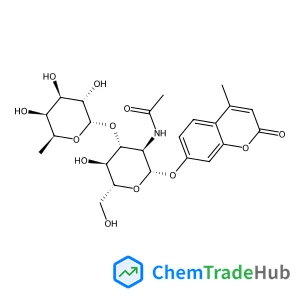
4-Methyl-2-oxo-2H-chromen-7-yl 2-acetamido-2-deoxy-3-O-(6-deoxy-alpha-L-galactopyranosyl)-beta-D-glucopyranoside
CAS Number:
383160-12-1
Molecular Formula:
C24H31NO12
Jian Zhu, Dieqing Zhang, Zhenfeng Bian, Guisheng Li, Yuning Huo, Yunfeng Lu, Hexing Li
Single-crystalline TiOF2 was prepared by HF-etching the SiO2/TiO2 nanocomposite obtained via aerosol-spraying, which exhibited high activity and durability in visible-light driven photocatalysis.
Meng Zhu, Quan Chen, Yanxia Su, Zhijie Zhang, Lei Liu, Yiguang Wang, Linan An, Nanwen Li
DOI: 10.1039/C7PY90053H
Nafeesa Mushtaq, Guofei Chen, Lala Rukh Sidra, Yang Liu, Xingzhong Fang
DOI: 10.1039/C6PY01705C
DOI: 10.1039/C6PY00885B
Pedro Marcelino Dos Santos Filho, Vincent Ladmiral, Thierry Lannuzel, Fabrice Domingues Dos Santos, Bruno Améduri
DOI: 10.1039/C6PY02063A
Nemal S. Gobalasingham, Robert M. Pankow, Barry C. Thompson
DOI: 10.1039/C7PY00181A
Xiaotian Ji, Li Liu
DOI: 10.1039/C7PY00315C
Naoya Kanbayashi, Sou Miyamoto, Yuki Ishido, Taka-aki Okamura, Kiyotaka Onitsuka
DOI: 10.1039/C6PY01946C
Elizabeth M. Nofen, Nicholas Zimmer, Avi Dasgupta, Ryan Gunckel, Bonsung Koo, Aditi Chattopadhyay, Lenore L. Dai
DOI: 10.1039/C6PY01463A
When handling lithium chloride hydrate (1:1:1) (CAS: 16712-20-2), it is importan...
4-(4H-1,2,4-Triazol-4-yl)piperidine is generally considered safe for use in phar...
Waste containing 1,3-Thiazole-2-carboxamide (CAS: 16733-85-0) should be collecte...
5-(Difluoromethyl)-2-fluorobenzonitrile (CAS: 934175-58-3) is subject to regulat...
Methyl 3-acetamido-2-thiophenecarboxylate can be synthesized by the reaction of ...
4-Isoquinolinecarbonitrile is a chemical compound with the CAS number 34846-65-6...
Store Methyl 1H-1,2,3-triazole-4-carboxylate (CAS: 877309-59-6) in a cool, dry p...
6-Bromo[1,3]thiazolo[5,4-b]pyridin-2-amine (CAS: 1160791-13-8) is subject to the...
(2S,3S)-2-Ammonio-3-(3,4-dihydroxyphenyl)-3-hydroxypropanoate (CAS: 23651-95-8) ...
7-Bromo-3-methyl-3,4-dihydroquinazolin-4-one is a solid with a crystalline form....

ChemComm publishes urgent research which is of outstanding significance and interest to experts in the field, while also appealing to the journal’s broad chemistry readership. Our communication format is ideally suited to short, urgent studies that are of such importance that they require accelerated publication. Our scope covers all topics in chemistry, and research at the interface of chemistry and other disciplines (such as materials science, nanoscience, physics, engineering and biology) where there is a significant novelty in the chemistry aspects. Major topic areas covered include: Analytical Chemistry Catalysis Chemical Biology and medicinal chemistry Computational Chemistry and Machine Learning Energy and sustainable chemistry Environmental Chemistry Green Chemistry Inorganic Chemistry Materials Chemistry Nanoscience Organic Chemistry Physical Chemistry Polymer Chemistry Supramolecular Chemistry