


Magnetic response properties of gaudiene – a cavernous and aromatic carbocage‡
Literature Information
Publication Date
2016-06-20
DOI
10.1039/C6CP03808E
Impact Factor
3.676
Authors
M. Rauhalahti, A. Muñoz-Castro, D. Sundholm
View Original
Abstract
A spherical and cavernous carbocage molecule exhibiting faces with larger ring sizes than regular fullerenes is a suitable species for investigating how molecular magnetic properties depend on the structure of the molecular framework. The studied all-carbon gaudiene (C72) is a highly symmetrical molecule with three- and four-fold faces formed by twelve membered rings. Here, we attempt to unravel the magnetic response properties of C72 by performing magnetic shielding and current density calculations with the external magnetic field applied in different directions. The obtained results indicate that the induced current density flows mainly along the chemical bonds that are largely perpendicular to the magnetic field direction. However, the overall current strength for different directions of the magnetic field is nearly isotropic differing by only 10% indicating that C72 can to some extent be considered to be a spherical aromatic molecule, whose current density and magnetic shielding are ideally completely isotropic. The induced magnetic field is found to exhibit long-range shielding cones in the field direction with a small deshielding region located perpendicularly to the field outside the molecule. The magnetic shielding is isotropic inside the molecular framework of C72, whereas an orientation-dependent magnetic response appears mainly at the exterior of the molecular cage.
Recommended Journals

Cement and Concrete Composites

Journal of Physical Organic Chemistry

Journal of Computer-Aided Molecular Design

Bio-Medical Materials and Engineering

Main Group Metal Chemistry

Construction and Building Materials

Applied Composite Materials

Heterocyclic Communications

Diamond and Related Materials

Advanced Composite Materials
Related Literature
An insight into the communication between β-olefin/phenyl olefin-mediated acceptors and porphyrin π-system: a way to establish porphyrin based chemodosimeters and chemosensors
Mandeep K. Chahal, Muniappan Sankar, Ray J. Butcher
2017-01-04
Paper
DOI: 10.1039/C6CP08396J
Mechanism of activated chemiluminescence of cyclic peroxides: 1,2-dioxetanes and 1,2-dioxetanones
Ignacio Fdez. Galván, Daniel Roca-Sanjuán, Erick L. Bastos, Wilhelm J. Baader, Roland Lindh
2017-01-03
Paper
DOI: 10.1039/C6CP08154A
Temperature-dependent ESR and computational studies on antiferromagnetic electron transfer in the yeast NADH dehydrogenase Ndi1
Kaiqi Wu, Wenfei Li, Lu Yu, Wei Tong, Yue Feng, Shenglong Ling, Longhua Zhang, Xiao Zheng, Maojun Yang
2017-01-09
Paper
DOI: 10.1039/C6CP08107J
Kinetics, mechanisms and ionic liquids in the uptake of n-butylamine onto low molecular weight dicarboxylic acids
Michelle C. Fairhurst, Michael J. Ezell, Carla Kidd, Pascale S. J. Lakey, Manabu Shiraiwa, Barbara J. Finlayson-Pitts
2017-01-24
Paper
DOI: 10.1039/C6CP08663B
Ligand non-innocence and strong correlation in manganese superoxide dismutase mimics
Alexandra R. McIsaac, David A. Mazziotti
2017-01-26
Paper
DOI: 10.1039/C6CP07563K
Adsorbing the 3d-transition metal atoms to effectively modulate the electronic and magnetic behaviors of zigzag SiC nanoribbons
Hui Li, Wei Chen, Xiaopeng Shen, Jingwei Liu, Xuri Huang, Guangtao Yu
2017-01-03
Paper
DOI: 10.1039/C6CP06717D
Mechanisms of absorption and desorption of CO2 by molten NaNO3-promoted MgO
Seung-Ik Jo, Young-In An, Kang-Yeong Kim, Seo-Yeong Choi, Jin-Su Kwak, Kyung-Ryul Oh, Young-Uk Kwon
2017-02-01
Paper
DOI: 10.1039/C6CP07787K
Mechanistic insights into CO2 reduction on Cu/Mo-loaded two-dimensional g-C3N4(001)
Penghui Li, Fang Wang, Shiqian Wei, Xinyu Li
2017-01-09
Paper
DOI: 10.1039/C6CP08409E
You might also like
Compound Q&A
What precautions should be taken when handling 4-(2-Furylmethyl)thiomorpholine 1,1-dioxide (CAS: 79206-94-3)?
When handling 4-(2-Furylmethyl)thiomorpholine 1,1-dioxide (CAS: 79206-94-3), it ...
79206-94-34-(2-Furylmethyl)thi...
Compound Q&A
What precautions should be taken when handling 4-Chloro-N-[2-(4-morpholinyl)ethyl]benzamide (CAS: 71320-77-9)?
When handling 4-Chloro-N-[2-(4-morpholinyl)ethyl]benzamide (CAS: 71320-77-9), it...
71320-77-94-Chloro-N-[2-(4-mor...
Compound Q&A
How should waste containing 2-[2-(2-Methoxyethoxy)ethoxy]ethyl 4-methylbenzenesulfonate (CAS: 62921-74-8) be handled?
Waste containing this compound (CAS: 62921-74-8) should be handled according to ...
62921-74-82-[2-(2-Methoxyethox...
Compound Q&A
How should waste containing (S)-Methyl 2-amino-3-cyclohexylpropanoate be handled?
Waste containing (S)-Methyl 2-amino-3-cyclohexylpropanoate should be collected i...
40056-18-6(S)-Methyl 2-amino-3...
Compound Q&A
How is 5-({4-[(2S,4R)-4-Hydroxy-2-methyltetrahydro-2H-pyran-4-yl]-2-thienyl}sulfanyl)-1-methyl-1,3-dihydro-2H-indol-2-one (CAS: 166882-70-8) typically synthesized?
This compound can be synthesized using a multi-step process involving the conjug...
166882-70-85-({4-[(2S,4R)-4-Hyd...
Compound Q&A
Are there alternatives to (2E)-3-(3,4-Dichlorophenyl)acrylic acid (CAS: 7312-27-8) in synthesis?
There are several alternatives to (2E)-3-(3,4-Dichlorophenyl)acrylic acid in syn...
7312-27-8(2E)-3-(3,4-Dichloro...
Compound Q&A
How should Ethyl 6-(2-nitrophenyl)imidazo[2,1-b][1,3]thiazole-3-carboxylate (CAS: 925437-84-9) be stored?
Ethyl 6-(2-nitrophenyl)imidazo[2,1-b][1,3]thiazole-3-carboxylate (CAS: 925437-84...
925437-84-9Ethyl 6-(2-nitrophen...
Compound Q&A
How should waste containing 2-(1,3-Thiazol-2-yl)ethanamine (CAS: 18453-07-1) be handled?
Waste containing 2-(1,3-Thiazol-2-yl)ethanamine (CAS: 18453-07-1) should be coll...
18453-07-12-(1,3-Thiazol-2-yl)...
Compound Q&A
How is Methyl 5-iodo-2-methylbenzoate (CAS: 103440-54-6) typically synthesized?
Methyl 5-iodo-2-methylbenzoate can be synthesized through the iodination of meth...
103440-54-6Methyl 5-iodo-2-meth...
Compound Q&A
How is 5-Chloro[1,2,4]triazolo[1,5-a]pyridine (CAS: 1427399-34-5) typically synthesized?
5-Chloro[1,2,4]triazolo[1,5-a]pyridine is commonly synthesized via the condensat...
1427399-34-55-Chloro[1,2,4]triaz...
Source Journal
Physical Chemistry Chemical Physics

CiteScore:
5.5
Self-citation Rate:
10.3%
Articles per Year:
3036
Physical Chemistry Chemical Physics (PCCP) is an international journal co-owned by 19 physical chemistry and physics societies from around the world. This journal publishes original, cutting-edge research in physical chemistry, chemical physics and biophysical chemistry. To be suitable for publication in PCCP, articles must include significant innovation and/or insight into physical chemistry; this is the most important criterion that reviewers and Editors will judge against when evaluating submissions. The journal has a broad scope and welcomes contributions spanning experiment, theory, computation and data science. Topical coverage includes spectroscopy, dynamics, kinetics, statistical mechanics, thermodynamics, electrochemistry, catalysis, surface science, quantum mechanics, quantum computing and machine learning. Interdisciplinary research areas such as polymers and soft matter, materials, nanoscience, energy, surfaces/interfaces, and biophysical chemistry are welcomed if they demonstrate significant innovation and/or insight into physical chemistry. Joined experimental/theoretical studies are particularly appreciated when complementary and based on up-to-date approaches.
Recommended Compounds

Methyl 2-cyano-3,12-dioxooleana-1,9(11)-dien-28-oate
CAS Number:
218600-53-4
Molecular Formula:
C32H43NO4
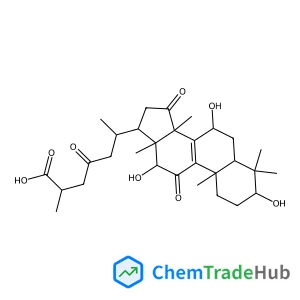
(3beta,7beta,12beta)-3,7,12-Trihydroxy-11,15,23-trioxolanost-8-en-26-oic acid
CAS Number:
98665-22-6
Molecular Formula:
C30H44O8
Recommended Suppliers





Disclaimer
This page provides academic journal information for reference and research purposes only. We are not affiliated with any journal publishers and do not handle publication submissions. For publication-related inquiries, please contact the respective journal publishers directly.
If you notice any inaccuracies in the information displayed, please contact us at support@chemtradehub.com. We will promptly review and address your concerns.