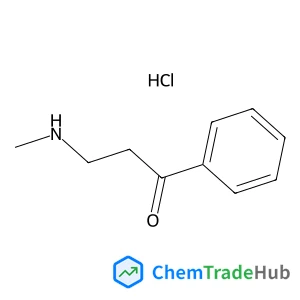
3-(Methylamino)-1-phenyl-1-propanone hydrochloride (1:1)
CAS Number:
2538-50-3
Molecular Formula:
C10H14ClNO
Ignacio Fdez. Galván, Daniel Roca-Sanjuán, Erick L. Bastos, Wilhelm J. Baader, Roland Lindh
Almost all chemiluminescent and bioluminescent reactions involve cyclic peroxides. The structure of the peroxide and reaction conditions determine the quantum efficiency of light emission. Oxidizable fluorophores, the so-called activators, react with 1,2-dioxetanones promoting the former to their first singlet excited state. This transformation is inefficient and does not occur with 1,2-dioxetanes; however, they have been used as models for the efficient firefly bioluminescence. In this work, we use the SA-CASSCF/CASPT2 method to investigate the activated chemiexcitation of the parent 1,2-dioxetane and 1,2-dioxetanone. Our findings suggest that ground state decomposition of the peroxide competes efficiently with the chemiexcitation pathway, in agreement with the available experimental data. The formation of non-emissive triplet excited species is proposed to explain the low emission efficiency of the activated decomposition of 1,2-dioxetanone. Chemiexcitation is rationalized considering a peroxide/activator supermolecule undergoing an electron-transfer reaction followed by internal conversion.
Wei Wen
DOI: 10.1039/D1PY00223F
Anna P. Constantinou, Georgios Patias, Birsen Somuncuoğlu, Toby Brock, Daniel W. Lester, David M. Haddleton, Theoni K. Georgiou
DOI: 10.1039/D1PY00444A
Neha Mulchandani, Kazunari Masutani, Sachin Kumar, Hideki Yamane, Yoshiharu Kimura, Vimal Katiyar
DOI: 10.1039/D1PY00429H
Chao Li, Li Han, Xiping Chen, Xinyu Bao, Qi Sun, Hongwei Ma, Yang Li
DOI: 10.1039/D1PY00416F
Jiaxin Shi, Tianze Zheng, Yao Zhang, Baohua Guo, Jun Xu
DOI: 10.1039/D1PY00157D
When handling 4-(2-Furylmethyl)thiomorpholine 1,1-dioxide (CAS: 79206-94-3), it ...
When handling 4-Chloro-N-[2-(4-morpholinyl)ethyl]benzamide (CAS: 71320-77-9), it...
Waste containing this compound (CAS: 62921-74-8) should be handled according to ...
Waste containing (S)-Methyl 2-amino-3-cyclohexylpropanoate should be collected i...
This compound can be synthesized using a multi-step process involving the conjug...
There are several alternatives to (2E)-3-(3,4-Dichlorophenyl)acrylic acid in syn...
Ethyl 6-(2-nitrophenyl)imidazo[2,1-b][1,3]thiazole-3-carboxylate (CAS: 925437-84...
Waste containing 2-(1,3-Thiazol-2-yl)ethanamine (CAS: 18453-07-1) should be coll...
Methyl 5-iodo-2-methylbenzoate can be synthesized through the iodination of meth...
5-Chloro[1,2,4]triazolo[1,5-a]pyridine is commonly synthesized via the condensat...

Physical Chemistry Chemical Physics (PCCP) is an international journal co-owned by 19 physical chemistry and physics societies from around the world. This journal publishes original, cutting-edge research in physical chemistry, chemical physics and biophysical chemistry. To be suitable for publication in PCCP, articles must include significant innovation and/or insight into physical chemistry; this is the most important criterion that reviewers and Editors will judge against when evaluating submissions. The journal has a broad scope and welcomes contributions spanning experiment, theory, computation and data science. Topical coverage includes spectroscopy, dynamics, kinetics, statistical mechanics, thermodynamics, electrochemistry, catalysis, surface science, quantum mechanics, quantum computing and machine learning. Interdisciplinary research areas such as polymers and soft matter, materials, nanoscience, energy, surfaces/interfaces, and biophysical chemistry are welcomed if they demonstrate significant innovation and/or insight into physical chemistry. Joined experimental/theoretical studies are particularly appreciated when complementary and based on up-to-date approaches.