












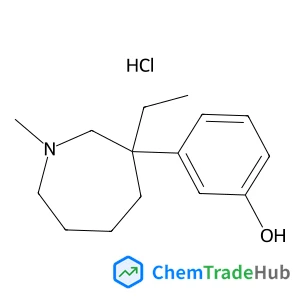
3-(3-Ethyl-1-methyl-3-azepanyl)phenol hydrochloride (1:1)
CAS Number:
59263-76-2
Molecular Formula:
C15H24ClNO
Seung-Ik Jo, Young-In An, Kang-Yeong Kim, Seo-Yeong Choi, Jin-Su Kwak, Kyung-Ryul Oh, Young-Uk Kwon
In order to realize carbon capture and sequestration (CCS), a technology proposed to circumvent the global warming problem while maintaining the present level of economic activity, the development of efficient carbon-capturing agents is of prime importance. In addition to the prevailing amine-based agents that operate at temperatures lower than 200 °C, agents that can operate at higher temperatures are being considered to reduce the cost of CCS. For the mid-temperature (200–500 °C) operation, alkali nitrate-promoted MgO is a promising candidate; whose detailed reaction mechanisms are not yet fully understood, however. In the present study, we have performed a comprehensive investigation on the mechanisms of CO2 absorption and desorption of NaNO3-promoted MgO. Highly efficient CO2 absorbents were obtained by decomposing Mg5(CO3)4(OH)2·4H2O with NaNO3 intimately mixed with it. Our collective data, including isothermal CO2 uptake curves, MgO solubility in molten NaNO3, and observations on the reaction of MgO wafers with CO2, indicate that the absorption takes place in the molten NaNO3 medium in which both CO2 and MgO are dissolved. MgCO3 is formed inside the molten promoter through the nucleation and growth steps. The decomposition of MgCO3 back to MgO, that is desorption of CO2, is also facilitated by molten NaNO3, which we attribute to the decreased relative stability of MgCO3 with respect to MgO when in contact with molten NaNO3. The relative affinity of molten nitrate to MgO and MgCO3 was estimated by measuring the ‘contact angles’ of nitrate on them. Implications of our findings for the real applications of alkali nitrate-promoted MgO absorbents with numerous repeated cycles of absorption and desorption of CO2 are discussed.
DOI: 10.1039/D1PY90044G
Natanel Jarach, Daniel Golani, Ofer Asaf, Hanna Dodiuk, Yoav Shamir, Amir Goldbourt, Samuel Kenig, Naum Naveh
DOI: 10.1039/D1PY00116G
Junle Zhang, Mengya Li, Yanjie He, Xiaomeng Zhang, Zhe Cui, Peng Fu, Minying Liu, Xiaoguang Qiao, Qingxiang Zhao, Xinchang Pang
DOI: 10.1039/D1PY00088H
Huan-Huan Ding, Mu-Han Zhao, Le Zhai, Jian-Bin Zhen, Le-Yun Sun, Jia-Zhu Chigan, Cheng Chen, Jia-Qi Li, Han Gao, Ke-Wu Yang
DOI: 10.1039/D0PY01751E
Yunkai Dai, Zhitao Hu, Xiaoying Wang, Xingliang Liu, Yuanchao Li, Yi Shi, Yongming Chen
DOI: 10.1039/D1PY00106J
Marc Guerre, Cédric Totée, Gilles Silly, Olinda Gimello, Bruno Améduri, Jean-François Tahon, Rinaldo Poli, Sophie Barrau, Vincent Ladmiral
DOI: 10.1039/D0PY01754J
Josina L. Bohlen, Bragavie Kulendran, Hannah Rothfuss, Peter W. Roesky
DOI: 10.1039/D1PY00552A
Simone Lazar, Ruiqing Shen, Yufeng Quan, Bethany Palen, Qingsheng Wang, Christopher J. Ellison
DOI: 10.1039/D1PY00111F
When handling 4-(2-Furylmethyl)thiomorpholine 1,1-dioxide (CAS: 79206-94-3), it ...
When handling 4-Chloro-N-[2-(4-morpholinyl)ethyl]benzamide (CAS: 71320-77-9), it...
Waste containing this compound (CAS: 62921-74-8) should be handled according to ...
Waste containing (S)-Methyl 2-amino-3-cyclohexylpropanoate should be collected i...
This compound can be synthesized using a multi-step process involving the conjug...
There are several alternatives to (2E)-3-(3,4-Dichlorophenyl)acrylic acid in syn...
Ethyl 6-(2-nitrophenyl)imidazo[2,1-b][1,3]thiazole-3-carboxylate (CAS: 925437-84...
Waste containing 2-(1,3-Thiazol-2-yl)ethanamine (CAS: 18453-07-1) should be coll...
Methyl 5-iodo-2-methylbenzoate can be synthesized through the iodination of meth...
5-Chloro[1,2,4]triazolo[1,5-a]pyridine is commonly synthesized via the condensat...

Physical Chemistry Chemical Physics (PCCP) is an international journal co-owned by 19 physical chemistry and physics societies from around the world. This journal publishes original, cutting-edge research in physical chemistry, chemical physics and biophysical chemistry. To be suitable for publication in PCCP, articles must include significant innovation and/or insight into physical chemistry; this is the most important criterion that reviewers and Editors will judge against when evaluating submissions. The journal has a broad scope and welcomes contributions spanning experiment, theory, computation and data science. Topical coverage includes spectroscopy, dynamics, kinetics, statistical mechanics, thermodynamics, electrochemistry, catalysis, surface science, quantum mechanics, quantum computing and machine learning. Interdisciplinary research areas such as polymers and soft matter, materials, nanoscience, energy, surfaces/interfaces, and biophysical chemistry are welcomed if they demonstrate significant innovation and/or insight into physical chemistry. Joined experimental/theoretical studies are particularly appreciated when complementary and based on up-to-date approaches.
![[4-Amino-2-(methylsulfanyl)-5-pyrimidinyl]methanol structure](https://static.chemtradehub.com/structs/588/588-36-3-fc73.webp "[4-Amino-2-(methylsulfanyl)-5-pyrimidinyl]methanol structure")






