












Exploring short intramolecular interactions in alkylaromatic substrates
Literature Information
Publication Date
2016-10-06
DOI
10.1039/C6CP03323G
Impact Factor
3.676
Authors
Alberto Baggioli, Carlo A. Cavallotti, Antonino Famulari
View Original
Abstract
From proteins and peptides to semiconducting polymers, aliphatic chains on aromatic groups are recurring motifs in macromolecules from very diverse application fields. Fields in which molecular folding and packing determine the macroscopic physical properties that make such advanced materials appealing in the first place. Within each macromolecule, the intrinsic structure of each unit defines how it interacts with its neighbours, ultimately opening up or denying certain backbone conformations. This eventually also determines how macromolecules interact with each other. This account deals specifically with the conformational problem of many common alkylaromatic units, examining the features of an intramolecular interaction involving a side chain with as few as three methylene groups. A set of 23 model compounds featuring an intramolecular interaction between an aliphatic X–H (X = C, N, O, and S) bond and an aromatic ring was considered. Quantitative computational analysis was made possible, thanks to complete basis set extrapolated CCSD(T) calculations and NCI topological analysis, the latter of which revealed an elaborate network of dispersive and steric interactions leading to somewhat unintuitive and unexpected results, such as the higher energetic stability of certain twisted conformational isomers over those with extended side chains. Vicinal covalent effects from polarizing groups and various heteroatoms, along with the occurrence of non-dispersive phenomena, were also investigated. The conclusions drawn from the investigation include a comprehensive set of guidelines intended to aid in the prediction of the most stable conformation for this class of building blocks. Our findings affect a variety of different research fields, including the tailoring of functional materials for organic electronics and photovoltaics, with insights into a rational treatment of conformational disorder, and the study of protein- and peptide-folding preferences, putting an emphasis on peculiar interactions between the backbone and aromatic residues.
Recommended Journals
Related Literature
Dissociative photodetachment vs. photodissociation of aromatic carboxylates: the benzoate and naphthoate anions
Juan P. Aranguren-Abrate, Claude Dedonder-Lardeux, Christophe Jouvet
2018-12-26
Paper
DOI: 10.1039/C8CP07162D
Fluorescence measurements of peroxynitrite/peroxynitrous acid in cold air plasma treated aqueous solutions
Barbora Tarabová, Petr Lukeš, Malte U. Hammer, Helena Jablonowski, Thomas von Woedtke, Stephan Reuter, Zdenko Machala
2019-04-01
Paper
DOI: 10.1039/C9CP00871C
Destructive role of oxygen in growth of molybdenum disulfide determined by secondary ion mass spectrometry
Paweł Piotr Michałowski, Piotr Knyps, Paweł Ciepielewski, Piotr Caban, Ewa Dumiszewska, Jacek Baranowski
2019-04-03
Paper
DOI: 10.1039/C9CP00613C
A single boron atom doped boron nitride edge as a metal-free catalyst for N2 fixation
Xin Mao, Cheng Yan, Zhonghua Zhu, Aijun Du
2018-12-11
Paper
DOI: 10.1039/C8CP07064D
Phase stability of intercalated V2O5 battery cathodes elucidated through the Goldschmidt tolerance factor
Kit McColl, Furio Corà
2019-02-12
Paper
DOI: 10.1039/C9CP00170K
Computational models explain how copper binding to amyloid-β peptide oligomers enhances oxidative pathways
2019-04-02
Paper
DOI: 10.1039/C9CP00293F
Electrochemical tuning of Pd100−xAux bimetallics towards ethanol oxidation: effect of an induced d-band center shift and oxophilicity
Sreejith P. Babu, Perumal Elumalai
2019-03-21
Paper
DOI: 10.1039/C8CP07500J
Understanding methane/carbon dioxide partitioning in clay nano- and meso-pores with constant reservoir composition molecular dynamics modeling
Narasimhan Loganathan, Geoffrey M. Bowers, Brice F. Ngouana Wakou, Andrey G. Kalinichev
2019-03-07
Paper
DOI: 10.1039/C9CP00851A
A unified theory of weak-field coherent control of the behavior of a resonance state
2019-03-13
Paper
DOI: 10.1039/C9CP01014A
The dramatic effect of N-methylimidazole on trans axial ligand binding to ferric heme: experiment and theory
Mohammad Aarabi, Reza Omidyan, Satchin Soorkia, Gilles Grégoire, Maria-Elisa Crestoni, Aurélien de la Lande, Benoît Soep, Niloufar Shafizadeh
2018-12-20
Paper
DOI: 10.1039/C8CP06210B
You might also like
Compound Q&A
Are there alternatives to 1-(4-Chlorophenyl)-N-hydroxymethanimine (CAS: 3848-36-0) in synthesis?
When considering alternatives to 1-(4-Chlorophenyl)-N-hydroxymethanimine (CAS: 3...
3848-36-01-(4-Chlorophenyl)-N...
Compound Q&A
How should (1R,9S,10S,12S,14E,16S,19R,20R,21S,22R)-3,9,21-Trihydroxy-5,10,12,14,16,20,22-heptamethyl-23,24-dioxatetracyclo[17.3.1.1~6,9~.0~2,7~]tetracosa-2,5,7,14-tetraen-4-one (CAS: 183202-73-5) be stored?
This compound should be stored in a cool, dry place away from direct sunlight. I...
183202-73-5(1R,9S,10S,12S,14E,1...
Compound Q&A
How is 3-(4-Bromophenyl)-5-(2-fluorophenyl)-1,2,4-oxadiazole (CAS: 419553-16-5) typically synthesized?
3-(4-Bromophenyl)-5-(2-fluorophenyl)-1,2,4-oxadiazole is synthesized through a m...
419553-16-53-(4-Bromophenyl)-5-...
Compound Q&A
How is 5-Chloro-2-(4-chlorophenyl)-4-methyl-6-[3-(1-piperidinyl)propoxy]pyrimidine (CAS: 1639220-19-1) typically synthesized?
5-Chloro-2-(4-chlorophenyl)-4-methyl-6-[3-(1-piperidinyl)propoxy]pyrimidine (CAS...
1639220-19-15-Chloro-2-(4-chloro...
Compound Q&A
What industries use 2-Chloro-4-(difluoromethoxy)pyridine (CAS: 1206978-15-5)?
2-Chloro-4-(difluoromethoxy)pyridine is used in the pharmaceutical industry for ...
1206978-15-52-Chloro-4-(difluoro...
Compound Q&A
What regulatory guidelines apply to 3-Chloro-6-methylpyridazine (CAS: 1121-79-5)?
3-Chloro-6-methylpyridazine (CAS: 1121-79-5) is classified under the Globally Ha...
1121-79-53-Chloro-6-methylpyr...
Compound Q&A
Are there alternatives to Methyl 4,5-dimethyl-2-nitrobenzoate in synthesis?
Several alternatives can be used in the synthesis of Methyl 4,5-dimethyl-2-nitro...
90922-74-0Methyl 4,5-dimethyl-...
Compound Q&A
Are there alternatives to (2E,2'E)-3,3'-(1,4-Phenylene)bisacrylaldehyde in synthesis?
Alternatives to (2E,2'E)-3,3'-(1,4-Phenylene)bisacrylaldehyde include other acry...
63405-68-5(2E,2'E)-3,3'-(1,4-P...
Compound Q&A
What is 3-Amino-5-chloropyridin-2-ol hydrochloride (CAS: 1261906-29-9)?
3-Amino-5-chloropyridin-2-ol hydrochloride is an organic compound with the CAS n...
1261906-29-93-Amino-5-chloropyri...
Compound Q&A
What precautions should be taken when handling 6,7-Difluoro-2,3-dihydro-4H-chromen-4-one (CAS: 1092349-93-3)?
When handling 6,7-Difluoro-2,3-dihydro-4H-chromen-4-one, it is essential to wear...
1092349-93-36,7-Difluoro-2,3-dih...
Source Journal
Physical Chemistry Chemical Physics

CiteScore:
5.5
Self-citation Rate:
10.3%
Articles per Year:
3036
Physical Chemistry Chemical Physics (PCCP) is an international journal co-owned by 19 physical chemistry and physics societies from around the world. This journal publishes original, cutting-edge research in physical chemistry, chemical physics and biophysical chemistry. To be suitable for publication in PCCP, articles must include significant innovation and/or insight into physical chemistry; this is the most important criterion that reviewers and Editors will judge against when evaluating submissions. The journal has a broad scope and welcomes contributions spanning experiment, theory, computation and data science. Topical coverage includes spectroscopy, dynamics, kinetics, statistical mechanics, thermodynamics, electrochemistry, catalysis, surface science, quantum mechanics, quantum computing and machine learning. Interdisciplinary research areas such as polymers and soft matter, materials, nanoscience, energy, surfaces/interfaces, and biophysical chemistry are welcomed if they demonstrate significant innovation and/or insight into physical chemistry. Joined experimental/theoretical studies are particularly appreciated when complementary and based on up-to-date approaches.
Recommended Compounds
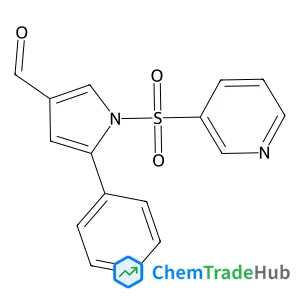
5-Phenyl-1-(pyridin-3-ylsulfonyl)-1H-pyrrole-3-carbaldehyde
CAS Number:
881676-90-0
Molecular Formula:
C16H12N2O3S
![2-{[(1R,2S)-2-Aminocyclohexyl]amino}-4-{[3-(2H-1,2,3-triazol-2-yl)phenyl]amino}-5-pyrimidinecarboxamide structure](https://static.chemtradehub.com/structs/137/1370261-96-3-40df.webp "2-{[(1R,2S)-2-Aminocyclohexyl]amino}-4-{[3-(2H-1,2,3-triazol-2-yl)phenyl]amino}-5-pyrimidinecarboxamide structure")
2-{[(1R,2S)-2-Aminocyclohexyl]amino}-4-{[3-(2H-1,2,3-triazol-2-yl)phenyl]amino}-5-pyrimidinecarboxamide
CAS Number:
1370261-96-3
Molecular Formula:
C19H23N9O
Recommended Suppliers






Disclaimer
This page provides academic journal information for reference and research purposes only. We are not affiliated with any journal publishers and do not handle publication submissions. For publication-related inquiries, please contact the respective journal publishers directly.
If you notice any inaccuracies in the information displayed, please contact us at support@chemtradehub.com. We will promptly review and address your concerns.