












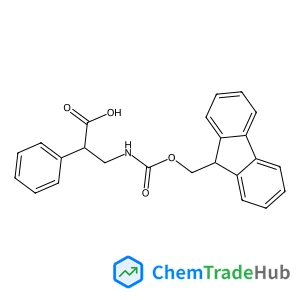
(S)-3-((((9H-Fluoren-9-yl)methoxy)carbonyl)amino)-2-phenylpropanoic acid
CAS Number:
1217663-60-9
Molecular Formula:
C24H21NO4
M. C. P. Lima, G. M. Seabra
The dengue virus (DENV) is the causative agent of the viral infection dengue fever. In spite of all the efforts made to prevent the spread of the disease, once it is contracted, there is no specific treatment for dengue and the WHO guidelines are limited to rest and symptomatic treatment. In its reproductive cycle, DENV utilizes the NS2B-NS3pro, a serine protease, to cleave the viral polyprotein into its constituents. This enzyme is essential for the virus lifecycle, and presents an attractive target for the development of specific dengue treatments. Here we used a hybrid Quantum Mechanics and Molecular Mechanics (QM/MM) Molecular Dynamics approach and Umbrella Sampling to study the first step (acylation) of the reaction catalyzed by NS2B-NS3pro, using the Pairwise Distance Directed Gaussian PM3 (PDDG/PM3) semi-empirical Hamiltonian for the QM subsystem, and Amber ff99SB for the MM subsystem. Our results indicate that the nucleophilic attack on the substrate by Ser135 occurs in a stepwise manner, in which a proton transfer to His51 first activates Ser135, which only later attacks the substrate. The rate-determining step is the Ser135 activation, with a barrier of 24.1 kcal mol−1. Water molecules completing the oxyanion hole stabilize the negative charge formed on the carbonyl oxygen of the substrate. The final step in the process is a proton transfer from His51 to the substrate's nitrogen, which happens with a lower barrier of 5.1 kcal mol−1, and leads directly to the breakage of the peptide bond.
Olaf W. Morawski, Andrzej L. Sobolewski, Daniel T. Gryko
DOI: 10.1039/C9CP00978G
Adebayo A. Adeleke, Yansun Yao
DOI: 10.1039/C8CP07288D
J. T. A. Gilmour, N. Gaston
DOI: 10.1039/C9CP00323A
H. Khani, M. Esmaeilzadeh, F. Kanjouri
DOI: 10.1039/C8CP07395C
Marc Figueras, Carmen Sousa, Francesc Illas
DOI: 10.1039/C9CP01569H
Pablo Pinacho, Susana Blanco, Juan Carlos López
DOI: 10.1039/C8CP06959J
X. Mercier, O. Carrivain, A. Faccinetto, E. Therssen
DOI: 10.1039/C9CP00394K
Rosa Becerra, Robin Walsh
DOI: 10.1039/C8CP06208K
Xin Mao, Cheng Yan, Zhonghua Zhu, Aijun Du
DOI: 10.1039/C8CP07064D
Yi Luo, Sake Wang, Kai Ren, Jyh-Pin Chou, Jin Yu, Zhengming Sun, Minglei Sun
DOI: 10.1039/C8CP06960C
When considering alternatives to 1-(4-Chlorophenyl)-N-hydroxymethanimine (CAS: 3...
This compound should be stored in a cool, dry place away from direct sunlight. I...
3-(4-Bromophenyl)-5-(2-fluorophenyl)-1,2,4-oxadiazole is synthesized through a m...
5-Chloro-2-(4-chlorophenyl)-4-methyl-6-[3-(1-piperidinyl)propoxy]pyrimidine (CAS...
2-Chloro-4-(difluoromethoxy)pyridine is used in the pharmaceutical industry for ...
3-Chloro-6-methylpyridazine (CAS: 1121-79-5) is classified under the Globally Ha...
Several alternatives can be used in the synthesis of Methyl 4,5-dimethyl-2-nitro...
Alternatives to (2E,2'E)-3,3'-(1,4-Phenylene)bisacrylaldehyde include other acry...
3-Amino-5-chloropyridin-2-ol hydrochloride is an organic compound with the CAS n...
When handling 6,7-Difluoro-2,3-dihydro-4H-chromen-4-one, it is essential to wear...

Physical Chemistry Chemical Physics (PCCP) is an international journal co-owned by 19 physical chemistry and physics societies from around the world. This journal publishes original, cutting-edge research in physical chemistry, chemical physics and biophysical chemistry. To be suitable for publication in PCCP, articles must include significant innovation and/or insight into physical chemistry; this is the most important criterion that reviewers and Editors will judge against when evaluating submissions. The journal has a broad scope and welcomes contributions spanning experiment, theory, computation and data science. Topical coverage includes spectroscopy, dynamics, kinetics, statistical mechanics, thermodynamics, electrochemistry, catalysis, surface science, quantum mechanics, quantum computing and machine learning. Interdisciplinary research areas such as polymers and soft matter, materials, nanoscience, energy, surfaces/interfaces, and biophysical chemistry are welcomed if they demonstrate significant innovation and/or insight into physical chemistry. Joined experimental/theoretical studies are particularly appreciated when complementary and based on up-to-date approaches.
![(2S)-2-{[(9H-Fluoren-9-ylmethoxy)carbonyl]amino}-4-(methylselanyl)butanoic acid structure](https://static.chemtradehub.com/structs/121/1217852-49-7-f252.webp "(2S)-2-{[(9H-Fluoren-9-ylmethoxy)carbonyl]amino}-4-(methylselanyl)butanoic acid structure")




