












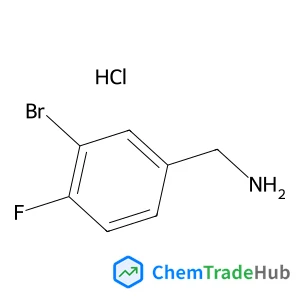
1-(3-Bromo-4-fluorophenyl)methanamine hydrochloride (1:1)
CAS Number:
202865-68-7
Molecular Formula:
C7H8BrClFN
Kela Xiao
Bacillus circulans xylanase (BcX), a family 11 glycoside hydrolase, catalyses the hydrolysis of xylose polymers with a net retention of stereochemistry. Glu172 in BcX is believed to act as a general acid by protonating the aglycone during glycosylation, and then as a general base to facilitate the deglycosylation step. The key to the dual role of this general acid/base lies in its protonation states, which depend on its intrinsic pKa value and the specific environment which it resides within. To fully understand the detailed molecular features in BcX to establish the dual role of Glu172, we present a combined study based on both atomistic simulations and empirical models to calculate pKa shifts for the general acid/base Glu172 in BcX at different functional states. Its pKa values and those of nearby residues, obtained based on QM/MM free energy calculations, MCCE and PROPKA, show a good agreement with available experimental data. Additionally, our study provides additional insights into the effects of structural and electrostatic perturbations caused by mutations and chemical modifications, suggesting that the local solvation environment and mutagenesis of the residues adjacent to Glu172 establish its dual role during hydrolysis. The strengths and limitations of various methods for calculating pKas and pKa shifts have also been discussed.
Olaf W. Morawski, Andrzej L. Sobolewski, Daniel T. Gryko
DOI: 10.1039/C9CP00978G
Jia Liu, Anping Wang, Kaisong Pu, Shaozheng Zhang, Terence Musho, Liang Chen
DOI: 10.1039/C9CP00151D
A. Swiderska-Mocek, E. Rudnicka, A. Lewandowski
DOI: 10.1039/C8CP06638H
Qiang Zhu
DOI: 10.1039/C8CP07202G
J. N. Han, X. He, Z. Q. Fan, Z. H. Zhang
DOI: 10.1039/C8CP06471G
Anne-Laure Barra, Johan van Tol, Sabine Hediger, Daniel Lee, Gaël De Paëpe
DOI: 10.1039/C8CP06819D
Jiawei Wu, Dongxu Dai, Maodu Chen, Xueming Yang
DOI: 10.1039/C9CP00441F
Fei Wang, Wenli Zhang, Xiuwen Zhang
DOI: 10.1039/C9CP00733D
Emilia Olsson, Jonathon Cottom, Xavier Aparicio-Anglès
DOI: 10.1039/C9CP00995G
Elsa Quartapelle Procopio, Thomas Moehl, Kazuteru Nonomura, Anders Hagfeldt
DOI: 10.1039/C9CP00856J
When considering alternatives to 1-(4-Chlorophenyl)-N-hydroxymethanimine (CAS: 3...
This compound should be stored in a cool, dry place away from direct sunlight. I...
3-(4-Bromophenyl)-5-(2-fluorophenyl)-1,2,4-oxadiazole is synthesized through a m...
5-Chloro-2-(4-chlorophenyl)-4-methyl-6-[3-(1-piperidinyl)propoxy]pyrimidine (CAS...
2-Chloro-4-(difluoromethoxy)pyridine is used in the pharmaceutical industry for ...
3-Chloro-6-methylpyridazine (CAS: 1121-79-5) is classified under the Globally Ha...
Several alternatives can be used in the synthesis of Methyl 4,5-dimethyl-2-nitro...
Alternatives to (2E,2'E)-3,3'-(1,4-Phenylene)bisacrylaldehyde include other acry...
3-Amino-5-chloropyridin-2-ol hydrochloride is an organic compound with the CAS n...
When handling 6,7-Difluoro-2,3-dihydro-4H-chromen-4-one, it is essential to wear...

Physical Chemistry Chemical Physics (PCCP) is an international journal co-owned by 19 physical chemistry and physics societies from around the world. This journal publishes original, cutting-edge research in physical chemistry, chemical physics and biophysical chemistry. To be suitable for publication in PCCP, articles must include significant innovation and/or insight into physical chemistry; this is the most important criterion that reviewers and Editors will judge against when evaluating submissions. The journal has a broad scope and welcomes contributions spanning experiment, theory, computation and data science. Topical coverage includes spectroscopy, dynamics, kinetics, statistical mechanics, thermodynamics, electrochemistry, catalysis, surface science, quantum mechanics, quantum computing and machine learning. Interdisciplinary research areas such as polymers and soft matter, materials, nanoscience, energy, surfaces/interfaces, and biophysical chemistry are welcomed if they demonstrate significant innovation and/or insight into physical chemistry. Joined experimental/theoretical studies are particularly appreciated when complementary and based on up-to-date approaches.
![2-{[(1R,2S)-2-Aminocyclohexyl]amino}-4-{[3-(2H-1,2,3-triazol-2-yl)phenyl]amino}-5-pyrimidinecarboxamide structure](https://static.chemtradehub.com/structs/137/1370261-96-3-40df.webp "2-{[(1R,2S)-2-Aminocyclohexyl]amino}-4-{[3-(2H-1,2,3-triazol-2-yl)phenyl]amino}-5-pyrimidinecarboxamide structure")





