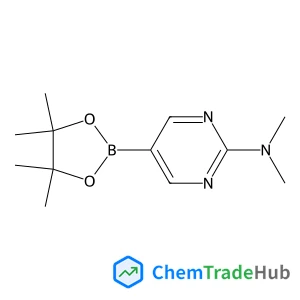
N,N-Dimethyl-5-(4,4,5,5-tetramethyl-1,3,2-dioxaborolan-2-yl)-2-pyrimidinamine
CAS Number:
1032759-30-0
Molecular Formula:
C12H20BN3O2
Jia Liu, Anping Wang, Kaisong Pu, Shaozheng Zhang, Terence Musho, Liang Chen
Fe3GeTe2 is a promising two-dimensional magnetic material that exhibits a high Curie temperature with monolayer geometry. Using the first principles calculation method, the effects of both Fe vacancies and contact with Cu electrodes on the magnetic properties of Fe3GeTe2 are studied. Calculation results determined that Fe vacancies occur preferentially on the FeII site. As a result, the magnetic moment of FeI ions decreases significantly, while the magnetic moment of FeII increases due to the presence of the FeII vacancies. The Cu(111) layers that act as the electrodes have moderately strong bonds with Fe3GeTe2 but they are found not to distort the primary structure of the Fe3GeTe2 monolayers, thus producing a stable Cu(111)/Fe3GeTe2 interface. The magnetic moments of FeI atoms at the Fe3GeTe2 layer surface decrease substantially following the adhesion of Cu(111) layers. The effect for other Fe atoms, however, is relatively weak. These results are useful for experimental studies and can promote the applications of Fe3GeTe2 in spin electronics.
Li Shang, Shaojun Dong
DOI: 10.1039/B717728C
Craig P. Butts, Michael Green, Thomas N. Hooper, Richard J. Kilby, John E. McGrady, Dimitrios A. Pantazis, Christopher A. Russell
DOI: 10.1039/B717204D
Felipe García, Robert J. Less, Vesal Naseri, Mary McPartlin, Jeremy M. Rawson, Maria Sancho Tomas, Dominic S. Wright
DOI: 10.1039/B718425E
Andrew P. Dove, Hongbo Li, Russell C. Pratt, Bas G. G. Lohmeijer, Darcy A. Culkin, Robert M. Waymouth, James L. Hedrick
DOI: 10.1039/B601393G
Masakazu Morimoto, Seiya Kobatake, Masahiro Irie
DOI: 10.1039/B604388G
Wensheng Fu, Hideaki Kaneda, Norio Teramae
DOI: 10.1039/B717094G
S. M. Holmes, B. E. Graniel-Garcia, P. Foran, P. Hill, E. P. L. Roberts, B. H. Sakakini, J. M. Newton
DOI: 10.1039/B600708B
Ruth Rawcliffe, Martin Heeney, Steven Tierney, Iain McCulloch, Alasdair Campbell
DOI: 10.1039/B715536K
Thibault Cantat, Frédéric Biaso, Aurélien Momin, Louis Ricard, Michel Geoffroy, Nicolas Mézailles, Pascal Le Floch
DOI: 10.1039/B715380E
Hyunwoo Kim, Doo Seoung Choi, Cindy Pai-Hui Yen, Alan J. Lough, Choong Eui Song, Jik Chin
DOI: 10.1039/B716253G
When considering alternatives to 1-(4-Chlorophenyl)-N-hydroxymethanimine (CAS: 3...
This compound should be stored in a cool, dry place away from direct sunlight. I...
3-(4-Bromophenyl)-5-(2-fluorophenyl)-1,2,4-oxadiazole is synthesized through a m...
5-Chloro-2-(4-chlorophenyl)-4-methyl-6-[3-(1-piperidinyl)propoxy]pyrimidine (CAS...
2-Chloro-4-(difluoromethoxy)pyridine is used in the pharmaceutical industry for ...
3-Chloro-6-methylpyridazine (CAS: 1121-79-5) is classified under the Globally Ha...
Several alternatives can be used in the synthesis of Methyl 4,5-dimethyl-2-nitro...
Alternatives to (2E,2'E)-3,3'-(1,4-Phenylene)bisacrylaldehyde include other acry...
3-Amino-5-chloropyridin-2-ol hydrochloride is an organic compound with the CAS n...
When handling 6,7-Difluoro-2,3-dihydro-4H-chromen-4-one, it is essential to wear...

Physical Chemistry Chemical Physics (PCCP) is an international journal co-owned by 19 physical chemistry and physics societies from around the world. This journal publishes original, cutting-edge research in physical chemistry, chemical physics and biophysical chemistry. To be suitable for publication in PCCP, articles must include significant innovation and/or insight into physical chemistry; this is the most important criterion that reviewers and Editors will judge against when evaluating submissions. The journal has a broad scope and welcomes contributions spanning experiment, theory, computation and data science. Topical coverage includes spectroscopy, dynamics, kinetics, statistical mechanics, thermodynamics, electrochemistry, catalysis, surface science, quantum mechanics, quantum computing and machine learning. Interdisciplinary research areas such as polymers and soft matter, materials, nanoscience, energy, surfaces/interfaces, and biophysical chemistry are welcomed if they demonstrate significant innovation and/or insight into physical chemistry. Joined experimental/theoretical studies are particularly appreciated when complementary and based on up-to-date approaches.
![6-Bromo-2,3-dihydro-1H-pyrido[2,3-b][1,4]oxazine structure](https://static.chemtradehub.com/structs/120/1203499-17-5-b4d1.webp "6-Bromo-2,3-dihydro-1H-pyrido[2,3-b][1,4]oxazine structure")