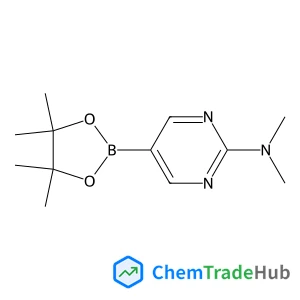
N,N-Dimethyl-5-(4,4,5,5-tetramethyl-1,3,2-dioxaborolan-2-yl)-2-pyrimidinamine
CAS Number:
1032759-30-0
Molecular Formula:
C12H20BN3O2
Anne-Laure Barra, Johan van Tol, Sabine Hediger, Daniel Lee, Gaël De Paëpe
Magic angle spinning dynamic nuclear polarization (MAS-DNP) has become a key approach to boost the intrinsic low sensitivity of NMR in solids. This method relies on the use of both stable radicals as polarizing agents (PAs) and suitable high frequency microwave irradiation to hyperpolarize nuclei of interest. Relating PA chemical structure to DNP efficiency has been, and is still, a long-standing problem. The complexity of the polarization transfer mechanism has so far limited the impact of analytical derivation. However, recent numerical approaches have profoundly improved the basic understanding of the phenomenon and have now evolved to a point where they can be used to help design new PAs. In this work, the potential of advanced MAS-DNP simulations combined with DFT calculations and high-field EPR to qualitatively and quantitatively predict hyperpolarization efficiency of particular PAs is analyzed. This approach is demonstrated on AMUPol and TEKPol, two widely-used bis-nitroxide PAs. The results notably highlight how the PA structure and EPR characteristics affect the detailed shape of the DNP field profile. We also show that refined simulations of this profile using the orientation dependency of the electron spin–lattice relaxation times can be used to estimate the microwave B1 field experienced by the sample. Finally, we show how modelling the nuclear spin–lattice relaxation times of close and bulk nuclei while accounting for PA concentration allows for a prediction of DNP enhancement factors and hyperpolarization build-up times.
Junhui Xu
DOI: 10.1039/B606429A
Felipe García, Robert J. Less, Vesal Naseri, Mary McPartlin, Jeremy M. Rawson, Maria Sancho Tomas, Dominic S. Wright
DOI: 10.1039/B718425E
Paul V. Santacroce, Oluyomi A. Okunola, Peter Y. Zavalij, Jeffery T. Davis
DOI: 10.1039/B607221F
Sensuke Ogoshi, Tomoya Arai, Masato Ohashi, Hideo Kurosawa
DOI: 10.1039/B717261C
Sébastien Royer, Xavier Sécordel, Markus Brandhorst, Franck Dumeignil, Sylvain Cristol, Christophe Dujardin, Mickaël Capron, Edmond Payen, Jean-Luc Dubois
DOI: 10.1039/B714260A
Sebastian Burck, Daniela Förster, Dietrich Gudat
DOI: 10.1039/B605278A
Ezequiel Perez-Inestrosa, Jose-María Montenegro, Daniel Collado, Rafael Suau
DOI: 10.1039/B717690B
Malte C. Gather, Martin Heeney, Weimin Zhang, Katherine S. Whitehead, Donal D. C. Bradley, Iain McCulloch, Alasdair J. Campbell
DOI: 10.1039/B716510B
Sudipta Ray, Apurba Kumar Das, Arindam Banerjee
DOI: 10.1039/B605498F
James E. D. Kirkham, Victor Lee, Jack E. Baldwin
DOI: 10.1039/B607035C
When considering alternatives to 1-(4-Chlorophenyl)-N-hydroxymethanimine (CAS: 3...
This compound should be stored in a cool, dry place away from direct sunlight. I...
3-(4-Bromophenyl)-5-(2-fluorophenyl)-1,2,4-oxadiazole is synthesized through a m...
5-Chloro-2-(4-chlorophenyl)-4-methyl-6-[3-(1-piperidinyl)propoxy]pyrimidine (CAS...
2-Chloro-4-(difluoromethoxy)pyridine is used in the pharmaceutical industry for ...
3-Chloro-6-methylpyridazine (CAS: 1121-79-5) is classified under the Globally Ha...
Several alternatives can be used in the synthesis of Methyl 4,5-dimethyl-2-nitro...
Alternatives to (2E,2'E)-3,3'-(1,4-Phenylene)bisacrylaldehyde include other acry...
3-Amino-5-chloropyridin-2-ol hydrochloride is an organic compound with the CAS n...
When handling 6,7-Difluoro-2,3-dihydro-4H-chromen-4-one, it is essential to wear...

Physical Chemistry Chemical Physics (PCCP) is an international journal co-owned by 19 physical chemistry and physics societies from around the world. This journal publishes original, cutting-edge research in physical chemistry, chemical physics and biophysical chemistry. To be suitable for publication in PCCP, articles must include significant innovation and/or insight into physical chemistry; this is the most important criterion that reviewers and Editors will judge against when evaluating submissions. The journal has a broad scope and welcomes contributions spanning experiment, theory, computation and data science. Topical coverage includes spectroscopy, dynamics, kinetics, statistical mechanics, thermodynamics, electrochemistry, catalysis, surface science, quantum mechanics, quantum computing and machine learning. Interdisciplinary research areas such as polymers and soft matter, materials, nanoscience, energy, surfaces/interfaces, and biophysical chemistry are welcomed if they demonstrate significant innovation and/or insight into physical chemistry. Joined experimental/theoretical studies are particularly appreciated when complementary and based on up-to-date approaches.