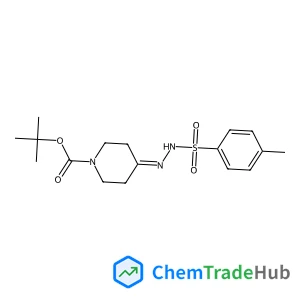
tert-Butyl 4-(2-(p-Tolylsulfonyl)hydrazono)piperidine-1-carboxylate
CAS Number:
1046478-89-0
Molecular Formula:
C17H25N3O4S
Qiang Zhu
We explored the possibility of producing a two-dimensional electron gas (2DEG) in polar/polar (LaAlO3)m/(KNbO3)n perovskite superlattices that have N type and P type interfaces using the first-principles electronic structure calculations. Two different kinds of LaAlO3/KNbO3 superlattices were constructed, namely stoichiometric NP superlattice (NP-SL) and non-stoichiometric NN superlattice (NN-SL). We discovered that the NP-SL undergoes a transition from an insulating to a metallic state when LaAlO3 has more than 3 unit cells. This reveals the completely spin-polarized two-dimensional hole gas (2DHG), as well as 2DEG with an interfacial charge carrier density of n ∼ 1013 cm−2 and an electron effective mass of 0.240me (for 5 unit cells of LaAlO3). In comparison, the NN-SL is intrinsically metallic, and when LaAlO3 has 4.5 unit cells, the structure shows a 2DEG with a larger density (n ∼ 1014 cm−2) and a smaller electron effective mass (0.185me). In addition, the charge carrier properties are highly sensitive to the number of LaAlO3 unit cells in the NP-SL model, while the size effect of LaAlO3 is negligible for the NN-SL one. Our results demonstrate that electronic reconstruction at the interfaces of the stoichiometric structure can produce both the 2DHG and 2DEG, whereas extra electrons are introduced to form solely the 2DEG at the non-stoichiometric structure interfaces. This research provides fundamental insights into the different interfacial electronic properties and the primary mechanism responsible for the formation of polar/polar heterojunction LaAlO3/KNbO3 superlattices.
Dominik Kurzydłowski
DOI: 10.1039/B716705A
Hang-Beom Bu, Günther Götz, Egon Reinold, Astrid Vogt, Sylvia Schmid, Raúl Blanco, Jose L. Segura, Peter Bäuerle
DOI: 10.1039/B718077B
Ruibing Wang, Lina Yuan, Donal H. Macartney
DOI: 10.1039/B605919H
Manolis J. Manos, Joon I. Jang, John B. Ketterson, Mercouri G. Kanatzidis
DOI: 10.1039/B712732D
Sébastien Goeb, Aaron A. Rachford, Felix N. Castellano
DOI: 10.1039/B713285A
Jian Jin, Yukihiro Sugiyama, Keita Mitsui, Hideo Arakawa, Izumi Ichinose
DOI: 10.1039/B717485C
Laurent El Kaïm, Rocio Gamez-Montaño, Laurence Grimaud, Tannya Ibarra-Rivera
DOI: 10.1039/B716849G
Wenting Shen, Sébastien Graule, Jeanne Crassous, Christophe Lescop, Heinz Gornitzka, Régis Réau
DOI: 10.1039/B714340K
Weibin Cui, Yubo Wu, Hongkun Tian, Yanhou Geng, Fosong Wang
DOI: 10.1039/B713463K
When considering alternatives to 1-(4-Chlorophenyl)-N-hydroxymethanimine (CAS: 3...
This compound should be stored in a cool, dry place away from direct sunlight. I...
3-(4-Bromophenyl)-5-(2-fluorophenyl)-1,2,4-oxadiazole is synthesized through a m...
5-Chloro-2-(4-chlorophenyl)-4-methyl-6-[3-(1-piperidinyl)propoxy]pyrimidine (CAS...
2-Chloro-4-(difluoromethoxy)pyridine is used in the pharmaceutical industry for ...
3-Chloro-6-methylpyridazine (CAS: 1121-79-5) is classified under the Globally Ha...
Several alternatives can be used in the synthesis of Methyl 4,5-dimethyl-2-nitro...
Alternatives to (2E,2'E)-3,3'-(1,4-Phenylene)bisacrylaldehyde include other acry...
3-Amino-5-chloropyridin-2-ol hydrochloride is an organic compound with the CAS n...
When handling 6,7-Difluoro-2,3-dihydro-4H-chromen-4-one, it is essential to wear...

Physical Chemistry Chemical Physics (PCCP) is an international journal co-owned by 19 physical chemistry and physics societies from around the world. This journal publishes original, cutting-edge research in physical chemistry, chemical physics and biophysical chemistry. To be suitable for publication in PCCP, articles must include significant innovation and/or insight into physical chemistry; this is the most important criterion that reviewers and Editors will judge against when evaluating submissions. The journal has a broad scope and welcomes contributions spanning experiment, theory, computation and data science. Topical coverage includes spectroscopy, dynamics, kinetics, statistical mechanics, thermodynamics, electrochemistry, catalysis, surface science, quantum mechanics, quantum computing and machine learning. Interdisciplinary research areas such as polymers and soft matter, materials, nanoscience, energy, surfaces/interfaces, and biophysical chemistry are welcomed if they demonstrate significant innovation and/or insight into physical chemistry. Joined experimental/theoretical studies are particularly appreciated when complementary and based on up-to-date approaches.