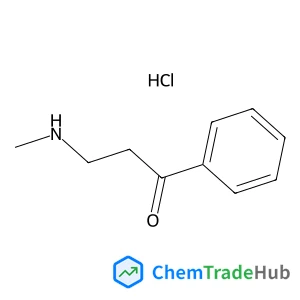
3-(Methylamino)-1-phenyl-1-propanone hydrochloride (1:1)
CAS Number:
2538-50-3
Molecular Formula:
C10H14ClNO
Sami Emre Küçük, Deniz Sezer
Dynamic nuclear polarization (DNP) enables the substantial enhancement of the NMR signal intensity in liquids. While proton DNP is dominated by the dipolar interaction between the electron and nuclear spins, the Fermi contact (scalar) interaction is equally important for heavier nuclei. The impossibility to predict the magnitude and field dependence of the scalar contribution hampers the application of high-field DNP to nuclei other than 1H. We demonstrate that molecular dynamics (MD) simulations followed by density functional calculations of the Fermi contacts along the MD trajectory lead to quantitative agreement with the DNP coupling factors of the methyl and carbonyl carbons of acetone in water at 0.35 T. Thus, the accurate calculation of scalar-dominated DNP enhancement at a desired magnetic field is demonstrated for the first time. For liquid chloroform at fields above 9 T, our methodology predicts direct 13C DNP enhancements that are two orders of magnitude larger than those of 1H.
Alexei Bagrets
DOI: 10.1039/C3CP44286A
Chuan Shi, Christopher P. O'Grady, Andrew A. Peterson, Heine A. Hansen
DOI: 10.1039/C3CP50645B
Ye Zhang, Bai Cui, Chunsong Zhao, Hong Lin
DOI: 10.1039/C3CP50202C
Marc-Oliver Winghart, Michael Kühn, Andreas-Neil Unterreiner, Thomas J. A. Wolf, Phuong D. Dau, Hong-Tao Liu, Dao-Ling Huang, Lai-Sheng Wang
DOI: 10.1039/C3CP50497B
Luis Gómez-Hortigüela, Furio Corà, C. Richard A. Catlow
DOI: 10.1039/C3CP51079D
Rebecca C. Quardokus, Natalie A. Wasio, Ryan P. Forrest, Craig S. Lent, Steven A. Corcelli, John A. Christie, Kenneth W. Henderson, S. Alex Kandel
DOI: 10.1039/C3CP50225B
Dong Jun Kim, Sang Jin Kim, Dong Kyu Roh, Jong Hak Kim
DOI: 10.1039/C3CP44308F
Ying Hua, Pascale Changenet-Barret, Thomas Gustavsson, Dimitra Markovitsi
DOI: 10.1039/C3CP00060E
Xiao Lin, Zhi-Tao Wang, Igor Lyubinetsky, Bruce D. Kay, Zdenek Dohnálek
DOI: 10.1039/C3CP44040K
Jamie D. Young, Dave Townsend, Justyna M. Żurek, Martin J. Paterson, Gareth M. Roberts, Vasilios G. Stavros
DOI: 10.1039/C3CP51108A
When handling 4-(2-Furylmethyl)thiomorpholine 1,1-dioxide (CAS: 79206-94-3), it ...
When handling 4-Chloro-N-[2-(4-morpholinyl)ethyl]benzamide (CAS: 71320-77-9), it...
Waste containing this compound (CAS: 62921-74-8) should be handled according to ...
Waste containing (S)-Methyl 2-amino-3-cyclohexylpropanoate should be collected i...
This compound can be synthesized using a multi-step process involving the conjug...
There are several alternatives to (2E)-3-(3,4-Dichlorophenyl)acrylic acid in syn...
Ethyl 6-(2-nitrophenyl)imidazo[2,1-b][1,3]thiazole-3-carboxylate (CAS: 925437-84...
Waste containing 2-(1,3-Thiazol-2-yl)ethanamine (CAS: 18453-07-1) should be coll...
Methyl 5-iodo-2-methylbenzoate can be synthesized through the iodination of meth...
5-Chloro[1,2,4]triazolo[1,5-a]pyridine is commonly synthesized via the condensat...

Physical Chemistry Chemical Physics (PCCP) is an international journal co-owned by 19 physical chemistry and physics societies from around the world. This journal publishes original, cutting-edge research in physical chemistry, chemical physics and biophysical chemistry. To be suitable for publication in PCCP, articles must include significant innovation and/or insight into physical chemistry; this is the most important criterion that reviewers and Editors will judge against when evaluating submissions. The journal has a broad scope and welcomes contributions spanning experiment, theory, computation and data science. Topical coverage includes spectroscopy, dynamics, kinetics, statistical mechanics, thermodynamics, electrochemistry, catalysis, surface science, quantum mechanics, quantum computing and machine learning. Interdisciplinary research areas such as polymers and soft matter, materials, nanoscience, energy, surfaces/interfaces, and biophysical chemistry are welcomed if they demonstrate significant innovation and/or insight into physical chemistry. Joined experimental/theoretical studies are particularly appreciated when complementary and based on up-to-date approaches.