


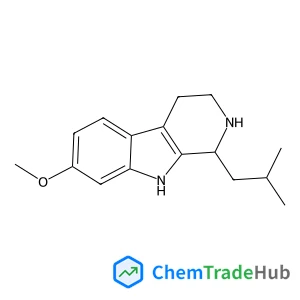
1-Isobutyl-7-methoxy-2,3,4,9-tetrahydro-1H-beta-carboline
CAS Number:
175975-76-5
Molecular Formula:
C16H22N2O
Jamie D. Young, Dave Townsend, Justyna M. Żurek, Martin J. Paterson, Gareth M. Roberts, Vasilios G. Stavros
Ultrafast time-resolved velocity map ion imaging (TR-VMI) and time-resolved ion-yield (TR-IY) methods are utilised to reveal a comprehensive picture of the electronic state relaxation dynamics in photoexcited catechol (1,2-dihydroxybenzene). After excitation to the S1 (1ππ*) state between 280.5 (the S1 origin band, S1(v = 0)) to 243 nm, the population in this state is observed to decay through coupling onto the S2 (1πσ*) state, which is dissociative with respect to the non-hydrogen bonded ‘free’ O–H bond (labelled O1–H). This process occurs via tunnelling under an S1/S2 conical intersection (CI) on a timeframe of 5–11 ps, resulting in O1–H bond fission along S2. Concomitant formation of ground state catechoxyl radicals (C6H5O2(X)), in coincidence with translationally excited H-atoms, occurs over the same timescale as the S1 state population decays. Between 254–237 nm, direct excitation to the S2 state is also observed, manifesting in the ultrafast (∼100 fs) formation of H-atoms with high kinetic energy release. From these measurements we determine that the S1/S2 CI lies ∼3700–5500 cm−1 above the S1(v = 0) level, indicating that the barrier height to tunnelling from S1(v = 0) → S2 is comparable to that observed in the related ‘benchmark’ species phenol (hydroxybenzene). We discuss how a highly ‘vibrationally-enhanced’ tunnelling mechanism is responsible for the two orders of magnitude enhancement to the tunnelling rate in catechol, relative to that previously determined in phenol (>1.2 ns), despite similar barrier heights. This phenomenon is a direct consequence of the non-planar S1 excited state minimum structure (C1 symmetry) in catechol, which in turn yields relaxed symmetry constraints for vibronic coupling from S1(v = 0) → S2 – a scenario which does not exist for phenol. These findings offer an elegant example of how even simple chemical modifications (ortho-hydroxy substitution) to a fundamental, biologically relevant, UV chromophore, such as phenol, can have profound effects on the ensuing excited state dynamics.

Russian Chemical Reviews

Nature

Organic Preparations and Procedures International

Proceedings of the National Academy of Sciences of the United States of America

Helvetica Chimica Acta

Israel Journal of Chemistry

Pure and Applied Chemistry

Pharmacological Reviews

Fibre Chemistry

European Journal of Wood and Wood Products
Sergey Sirotin, Philippe Bazin, Françoise Maugé, Arnaud Travert
DOI: 10.1039/C3CP51146D
Maxim F. Gelin, Dassia Egorova, Wolfgang Domcke
DOI: 10.1039/C3CP44454F
V. Petkov, Y. Ren, S. Kabekkodu, D. Murphy
DOI: 10.1039/C2CP43378H
Jonathon Duay, Eleanor Gillette, Junkai Hu
DOI: 10.1039/C3CP50724F
Paola D'Angelo, Valentina Migliorati, Riccardo Spezia, Simone De Panfilis, Ingmar Persson, Andrea Zitolo
DOI: 10.1039/C3CP50842K
Gabriel J. Cuello, Shinji Kohara, Chris J. Benmore, David L. Price, Eugene Bychkov
DOI: 10.1039/C3CP50536G
Mark Wilson, Chris J. Benmore, J. K. R. Weber, Paul F. McMillan
DOI: 10.1039/C3CP51209F
Zhifeng Liu, Xinqiang Wang, Gaobin Liu, Jian Sui, Xuefang Wang, Hengjiang Zhu, Zhilin Hou
DOI: 10.1039/C3CP50814E
Małgorzata Wierzbowska, Adam Dominiak, Kamil Tokar
DOI: 10.1039/C3CP44378G
N-(4-Methoxybenzyl)-2-pyridinamine (CAS: 52818-63-0) is increasingly being used ...
When handling Ethyl 4-(2-chlorophenyl)-1,3-thiazole-2-carboxylate, appropriate p...
Diethyldiselane (CAS: 628-39-7) is classified under the Globally Harmonized Syst...
The market for oxocopper (CAS: 12053-18-8) is primarily driven by its use in cat...
The market for 5-{[(2-Methyl-2-propanyl)oxy]carbonyl}-5-azaspiro[2.4]heptane-7-c...
2-(1-Pyrrolidinyl)-4-pyridinamine is a chemical compound with the CAS number 359...
2-(3-Pyridinyl)-1-azabicyclo[2.2.2]octane (CAS: 91556-75-1) is a crystalline sol...
(S)-Alpha-allyl-proline hydrochloride is usually synthesized via a Wittig reacti...
3-Methyl-1,2-oxazole-5-carboxylic acid (CAS: 4857-42-5) is an organic compound w...
Lys-SMCC-DM1 is synthesized via a multi-step process involving the coupling of S...

Physical Chemistry Chemical Physics (PCCP) is an international journal co-owned by 19 physical chemistry and physics societies from around the world. This journal publishes original, cutting-edge research in physical chemistry, chemical physics and biophysical chemistry. To be suitable for publication in PCCP, articles must include significant innovation and/or insight into physical chemistry; this is the most important criterion that reviewers and Editors will judge against when evaluating submissions. The journal has a broad scope and welcomes contributions spanning experiment, theory, computation and data science. Topical coverage includes spectroscopy, dynamics, kinetics, statistical mechanics, thermodynamics, electrochemistry, catalysis, surface science, quantum mechanics, quantum computing and machine learning. Interdisciplinary research areas such as polymers and soft matter, materials, nanoscience, energy, surfaces/interfaces, and biophysical chemistry are welcomed if they demonstrate significant innovation and/or insight into physical chemistry. Joined experimental/theoretical studies are particularly appreciated when complementary and based on up-to-date approaches.
![1-[6-(1H-Imidazol-1-yl)-3-pyridinyl]methanamine structure](https://static.chemtradehub.com/structs/914/914637-08-4-8825.webp "1-[6-(1H-Imidazol-1-yl)-3-pyridinyl]methanamine structure")
![(2R,6S)-6-[(Benzyloxy)methyl]-4-{[(2-methyl-2-propanyl)oxy]carbonyl}-2-morpholinecarboxylic acid structure](https://static.chemtradehub.com/structs/109/1093085-91-6-3382.webp "(2R,6S)-6-[(Benzyloxy)methyl]-4-{[(2-methyl-2-propanyl)oxy]carbonyl}-2-morpholinecarboxylic acid structure")





