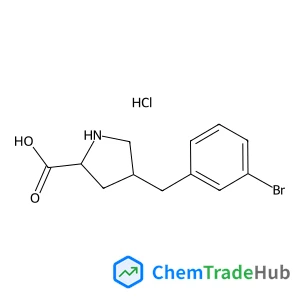
(2S,4R)-4-(3-Bromobenzyl)pyrrolidine-2-carboxylic acid hydrochloride
CAS Number:
1049734-10-2
Molecular Formula:
C12H15BrClNO2
Kaushik Chakraborty, Prabir Khatua, Sanjoy Bandyopadhyay
One crucial issue in DNA hydration is the effect of salts on its conformational features. This has relevance in biology as cations present in the cellular environment shield the negative charges on the DNA backbone, thereby reducing the repulsive force between them. By screening the negative charges along the backbone, cations stabilize the folded structure of DNA. To study the effect of the added salt on single-stranded DNA (ss-DNA) conformations, we have performed room temperature molecular dynamics simulations of an aqueous solution containing the ss-DNA dodecamer with the 5′-CGCGAATTCGCG-3′ sequence in the presence of 0.2, 0.5, and 0.8 M NaCl. Our calculations reveal that in the presence of the salt, the DNA molecule forms more collapsed coil-like conformations due to the screening of negative charges along the backbone. Additionally, we demonstrated that the formation of an octahedral inner-sphere complex by the strongly bound ion plays an important role in the stabilization of such folded conformation of DNA. Importantly, it is found that ion–DNA interactions can also explain the formation of non-sequential base stackings with longer lifetimes. Such non-sequential base stackings further stabilize the collapsed coil-like folded form of the DNA oligomer.
Youkang Zhou, Zhiming Xing, Jiali Guan, Zhibin Song, Yiyuan Peng
DOI: 10.1039/D0QO00663G
Shan-Shan Zhu, Jiang-Nan Zhou, Quan-Long Wu, Wen-Juan Hao, Shu-Jiang Tu, Bo Jiang
DOI: 10.1039/D0QO00917B
Bo Cao, Yin Wei
DOI: 10.1039/C9OB00585D
Eloi P. Coutant, Sophie Goyard, Vincent Hervin, Racha Baatallah, Yves Jacob, Thierry Rose, Yves L. Janin
DOI: 10.1039/C9OB00459A
Noelia Bernardo-García, Pedro A. Sánchez-Murcia, Akbar Espaillat, Siseth Martínez-Caballero, Felipe Cava, Juan A. Hermoso, Federico Gago
DOI: 10.1039/C9OB00223E
Stefan Rubner, Sabine Schubert, Thorsten Berg
DOI: 10.1039/C9OB00080A
Xiu-Jin Meng, Yong-Zhou Pan, Shi-Kun Mo, Heng-Shan Wang, Hai-Tao Tang, Ying-Ming Pan
DOI: 10.1039/D0QO00593B
Hye Im Jung, Yubin Kim, Dae Young Kim
DOI: 10.1039/C9OB00373H
2-(2-Chloroacetamido)-3-phenylpropanoic acid (CAS: 7765-11-9) is generally consi...
2-(Benzyloxy)-5-bromobenzoic acid can be handled safely if appropriate precautio...
(4-Methyl-1,2,5-oxadiazol-3-yl)methanamine hydrochloride is a chemical compound ...
2-(5-Hexylthiophen-2-yl)-4,4,5,5-tetramethyl-1,3,2-dioxaborolane (CAS: 917985-54...
While 4-(8-Methyl-9H-1,3-dioxolo[4,5-h][2,3]benzodiazepin-5-yl)benzenamine (CAS:...
The market for tert-butyl 3-hydroxy-4,5,7,8-tetrahydro-2H-pyrazolo[3,4-d]azepine...
Waste containing 3,5-Diamino-1H-pyrazole-4-carbonitrile (CAS: 6844-58-2) should ...
(6-Fluoro-3-pyridinyl)boronic acid can be synthesized through the reaction of 6-...
Dibenzyl carbonimidoylbiscarbamate (CAS: 10065-79-9) finds applications in vario...
The market for (beta,beta,2,3,4,5,6-~2~H_7_)Phenylalanine (CAS: 74228-83-4) is g...

Physical Chemistry Chemical Physics (PCCP) is an international journal co-owned by 19 physical chemistry and physics societies from around the world. This journal publishes original, cutting-edge research in physical chemistry, chemical physics and biophysical chemistry. To be suitable for publication in PCCP, articles must include significant innovation and/or insight into physical chemistry; this is the most important criterion that reviewers and Editors will judge against when evaluating submissions. The journal has a broad scope and welcomes contributions spanning experiment, theory, computation and data science. Topical coverage includes spectroscopy, dynamics, kinetics, statistical mechanics, thermodynamics, electrochemistry, catalysis, surface science, quantum mechanics, quantum computing and machine learning. Interdisciplinary research areas such as polymers and soft matter, materials, nanoscience, energy, surfaces/interfaces, and biophysical chemistry are welcomed if they demonstrate significant innovation and/or insight into physical chemistry. Joined experimental/theoretical studies are particularly appreciated when complementary and based on up-to-date approaches.
![(1R)-N-((1R)-1-Phenylethyl)-1-[4-(tert-butyldimethylsilyloxymethyl)cyclohexyl]ethan-1-amine structure](https://static.chemtradehub.com/structs/672/672314-45-3-47ef.webp "(1R)-N-((1R)-1-Phenylethyl)-1-[4-(tert-butyldimethylsilyloxymethyl)cyclohexyl]ethan-1-amine structure")