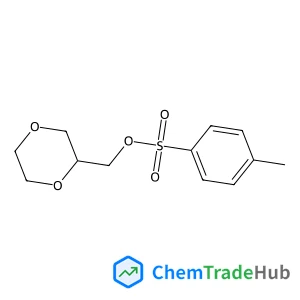
(S)-(1,4-Dioxan-2-yl)methyl 4-methylbenzenesulfonate
CAS Number:
917882-64-5
Molecular Formula:
C12H16O5S
Hye Im Jung, Yubin Kim, Dae Young Kim
Electrochemical oxidative radical trifluoromethylation/semipinacol rearrangement sequences of alkenyl alcohols were developed in this study. This approach is environmentally benign and uses the shelf-stable Langlois reagent as a trifluoromethyl radical precursor and electrons as the oxidizing reagents. The present protocol offers a facile route to prepare β-trifluoromethylated ketone derivatives.
Zhenhai Yu, Yong Wang, John Schneeloch, Chunyu Li, Ruidan Zhong, Zhiguo Liu, Genda Gu
DOI: 10.1039/C6CP07324G
Alejandro Cadranel, Jaired E. Tate, Paola S. Oviedo, Shiori Yamazaki, José H. Hodak, Luis M. Baraldo, Valeria D. Kleiman
DOI: 10.1039/C6CP06562G
Chun-Jern Pan, Ali Haider, Rami Al-Oweini, Ming-Hsien Lin, Ulrich Kortz
DOI: 10.1039/C6CP05768C
Hongqin Li, Haijun Ye, Zheng Xu, Chuanyi Wang, Jiao Yin
DOI: 10.1039/C6CP07569J
Jakob Fester, Alex Walton, Zheshen Li, Jeppe V. Lauritsen
DOI: 10.1039/C6CP07901F
Junran Lu, Lin Li, Hongxiao Cao, Yi Li, Jihong Yu
DOI: 10.1039/C6CP06217B
G. Meneses, C. Widmann, T. Cunha, A. Gil, F. Ferreira da Silva, M. J. Calhorda, P. Limão-Vieira
DOI: 10.1039/C6CP06375F
Facundo C. Herrera, Martín Mizrahi, Cristina Navío, Ramón Bernardo-Gavito, Daniel Granados, Félix G. Requejo
DOI: 10.1039/C6CP06982G
K. Bader, S. H. Schlindwein, D. Gudat
DOI: 10.1039/C6CP08161D
Manuel Šarić, Jan Rossmeisl, Poul Georg Moses
DOI: 10.1039/C6CP06881B
2-(2-Chloroacetamido)-3-phenylpropanoic acid (CAS: 7765-11-9) is generally consi...
2-(Benzyloxy)-5-bromobenzoic acid can be handled safely if appropriate precautio...
(4-Methyl-1,2,5-oxadiazol-3-yl)methanamine hydrochloride is a chemical compound ...
2-(5-Hexylthiophen-2-yl)-4,4,5,5-tetramethyl-1,3,2-dioxaborolane (CAS: 917985-54...
While 4-(8-Methyl-9H-1,3-dioxolo[4,5-h][2,3]benzodiazepin-5-yl)benzenamine (CAS:...
The market for tert-butyl 3-hydroxy-4,5,7,8-tetrahydro-2H-pyrazolo[3,4-d]azepine...
Waste containing 3,5-Diamino-1H-pyrazole-4-carbonitrile (CAS: 6844-58-2) should ...
(6-Fluoro-3-pyridinyl)boronic acid can be synthesized through the reaction of 6-...
Dibenzyl carbonimidoylbiscarbamate (CAS: 10065-79-9) finds applications in vario...
The market for (beta,beta,2,3,4,5,6-~2~H_7_)Phenylalanine (CAS: 74228-83-4) is g...

Organic & Biomolecular Chemistry (OBC) publishes original and high impact research and reviews in organic chemistry. We welcome research that shows new or significantly improved protocols or methodologies in total synthesis, synthetic methodology or physical and theoretical organic chemistry as well as research that shows a significant advance in the organic chemistry or molecular design aspects of chemical biology, catalysis, supramolecular and macromolecular chemistry, theoretical chemistry, mechanism-oriented physical organic chemistry, medicinal chemistry or natural products. Articles published in the journal should report new work which makes a highly-significant impact in the field. Routine and incremental work is generally not suitable for publication in the journal. More details about key areas of our scope are below. In all cases authors should include in their article clear rationale for why their research has been carried out.