












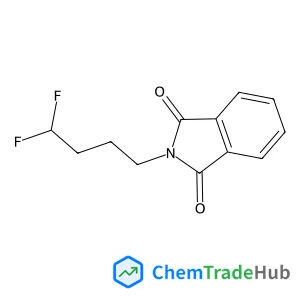
2-(4,4-Difluorobutyl)-1H-isoindole-1,3(2H)-dione
CAS Number:
1265341-14-7
Molecular Formula:
C12H11F2NO2
Yan Zhang, Dechun Li, Lin Wu, Liang Zhou, Yanan Du, Meng Wang, Ying Li
This paper reports a novel approach for achieving an intensive dispersion and synchronous assembly of single-walled carbon nanotubes (SWNTs) using a surfactant–oil–water association system as medium. A kind of nonionic surfactant N,N-bis(2-hydroxyethyl)dodecanamide (DDA) which could form a bi-continuous network structure not only in water but also in dodecane was used. The SWNTs were infiltrated into the dodecane–DDA mixture instead of DDA aqueous solution, and the attractive van der Waals forces between the pristine SWNT agglomerates were decreased in the first place; the thorough dispersion of the SWNTs was completed in the subsequent phase transformation by adjusting the oil/water ratio, along with mild sonication stirring. The individual SWNTs with different chiralities, such as (6,5), (7,5), (7,6), and (9,4), are all separated well after mild centrifugation treatment, which was confirmed by the well-resolved UV-Vis-NIR absorption and sharp fluorescence spectra. In particular, the self-assembly of DDA drove the separated individual SWNTs forming a large scale spatial network architecture. We believe that the SOW–SWNT suspension has high potential in constructing new functional materials by introducing diverse desirable components through the oil phase and also the water phase medium.
Lin Ma, Mengyue Zhang, Aijun Yang, Qin Wang, Fei Qu, Fengli Qu, Rong-Mei Kong
DOI: 10.1039/C8AN01556B
DaeHan Ahn, JiYeong Lee, SangJun Moon, Taejoon Park
DOI: 10.1039/C8AN01056K
Yinghong Zhang, Lijuan Li, Tao Li, Ying Xin, Junxiu Liu, Furong Ma, Lanqun Mao
DOI: 10.1039/C8AN01300D
C. Taglang, C. von Morze, J. E. Blecha, J. W. Gordon, R. Sriram, D. B. Vigneron, H. F. VanBrocklin, D. M. Wilson, R. R. Flavell
DOI: 10.1039/C7AN00076F
Jay G. Tarolli, Benjamin E. Naes, Lamar Butler, Keeyahna Foster, Caleb M. Gumbs, Andrea L. Howard, David Willingham
DOI: 10.1039/C7AN00175D
Si Wang, Zhiqin Yuan, Lijuan Zhang, Yanjun Lin, Chao Lu
DOI: 10.1039/C7AN00091J
M. R. Johnston, J. R. Gascooke, A. V. Ellis, S. C. Leterme
DOI: 10.1039/C8AN00948A
Philip J. R. Roche, Mohamed Najih, Seung S. Lee, Lenore K. Beitel, Matthew L. Carnevale, Andrew G. Kirk
DOI: 10.1039/C7AN00304H
N-(4-Methoxybenzyl)-2-pyridinamine (CAS: 52818-63-0) is increasingly being used ...
When handling Ethyl 4-(2-chlorophenyl)-1,3-thiazole-2-carboxylate, appropriate p...
Diethyldiselane (CAS: 628-39-7) is classified under the Globally Harmonized Syst...
The market for oxocopper (CAS: 12053-18-8) is primarily driven by its use in cat...
The market for 5-{[(2-Methyl-2-propanyl)oxy]carbonyl}-5-azaspiro[2.4]heptane-7-c...
2-(1-Pyrrolidinyl)-4-pyridinamine is a chemical compound with the CAS number 359...
2-(3-Pyridinyl)-1-azabicyclo[2.2.2]octane (CAS: 91556-75-1) is a crystalline sol...
(S)-Alpha-allyl-proline hydrochloride is usually synthesized via a Wittig reacti...
3-Methyl-1,2-oxazole-5-carboxylic acid (CAS: 4857-42-5) is an organic compound w...
Lys-SMCC-DM1 is synthesized via a multi-step process involving the coupling of S...

Physical Chemistry Chemical Physics (PCCP) is an international journal co-owned by 19 physical chemistry and physics societies from around the world. This journal publishes original, cutting-edge research in physical chemistry, chemical physics and biophysical chemistry. To be suitable for publication in PCCP, articles must include significant innovation and/or insight into physical chemistry; this is the most important criterion that reviewers and Editors will judge against when evaluating submissions. The journal has a broad scope and welcomes contributions spanning experiment, theory, computation and data science. Topical coverage includes spectroscopy, dynamics, kinetics, statistical mechanics, thermodynamics, electrochemistry, catalysis, surface science, quantum mechanics, quantum computing and machine learning. Interdisciplinary research areas such as polymers and soft matter, materials, nanoscience, energy, surfaces/interfaces, and biophysical chemistry are welcomed if they demonstrate significant innovation and/or insight into physical chemistry. Joined experimental/theoretical studies are particularly appreciated when complementary and based on up-to-date approaches.
![1-(1-Benzyl-1,2,3,6-tetrahydropyridin-4-yl)-1H-benzo[d]imidazol-2(3H)-one structure](https://static.chemtradehub.com/structs/603/60373-71-9-7dfb.webp "1-(1-Benzyl-1,2,3,6-tetrahydropyridin-4-yl)-1H-benzo[d]imidazol-2(3H)-one structure")





