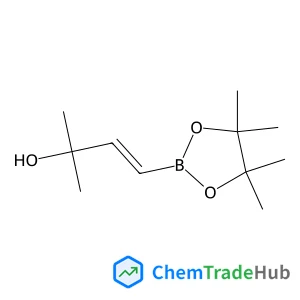
(E)-2-methyl-4-(4,4,5,5-tetramethyl-1,3,2-dioxaborolan-2-yl)but-3-en-2-ol
CAS Number:
581802-26-8
Molecular Formula:
C11H21BO3
We present theoretical modelling, ion mobility spectrometry and action-FRET experiments for chromophore-grafted amyloid-β12–28 dimers. A first-principles global minimum search based on replica-exchange molecular dynamics (REMD) leads to a compact structure with strong interstrand interactions. We use REMD with a distance restraint that implements an adaptive effective bias upon average FRET-efficiencies and thus guides the sampling by the action-FRET measurement. This procedure leads to a pair of weakly interacting peptides. Ion-mobility confirms that the weakly interacting structure and not the global minimum with strongly interacting peptides is populated in the experiment. The presence of a high energy barrier between the two structural families, as evidenced from the MD data, suggests that a kinetically trapped structure is observed in the experiment.
Bo-Sheng Zhang, Hui-Liang Hua, Lu-Yao Gao, Ce Liu, Yi-Feng Qiu, Ping-Xin Zhou, Zhao-Zhao Zhou, Jia-Hui Zhao, Yong-Min Liang
DOI: 10.1039/C7QO00164A
Konstantin N. Gavrilov, Igor S. Mikhel, Sergey V. Zheglov, Vladislav K. Gavrilov, Ilya V. Chuchelkin, Ilya D. Firsin, Kirill P. Birin, Ivan S. Pytskii, Ksenia A. Paseshnichenko, Victor A. Tafeenko, Alexei A. Shiryaev
DOI: 10.1039/C9QO00237E
Yoram Cohen, Sarit Slovak
DOI: 10.1039/C9QO00329K
Meng Yan, Xu-Bo Liu, Zhong-Zheng Gao, Yi-Peng Wu, Jun-Li Hou, Hui Wang, Dan-Wei Zhang, Yi Liu, Zhan-Ting Li
DOI: 10.1039/C9QO00382G
Jose R. Correa, Karen L. R. Paiva, Michele Baril, Daniel F. S. Machado, Jackson D. Scholten, Paulo E. N. de Souza, Fabiane H. Veiga-Souza, John Spencer
DOI: 10.1039/C9QO00428A
Xiao-Rui Ren, Jun-Bing Lin, Xiu-Qin Hu, Peng-Fei Xu
DOI: 10.1039/C9QO00357F
Wenju Chang, Jie Dai, Jingfu Li, Yuan Shi, Wenlong Ren
DOI: 10.1039/C7QO00111H
Kouya Uchiyama, Hiroshi Ueno, Hiroshi Okada, Hiroshi Moriyama
DOI: 10.1039/C9QO00056A
When considering alternatives to 1-(4-Chlorophenyl)-N-hydroxymethanimine (CAS: 3...
This compound should be stored in a cool, dry place away from direct sunlight. I...
3-(4-Bromophenyl)-5-(2-fluorophenyl)-1,2,4-oxadiazole is synthesized through a m...
5-Chloro-2-(4-chlorophenyl)-4-methyl-6-[3-(1-piperidinyl)propoxy]pyrimidine (CAS...
2-Chloro-4-(difluoromethoxy)pyridine is used in the pharmaceutical industry for ...
3-Chloro-6-methylpyridazine (CAS: 1121-79-5) is classified under the Globally Ha...
Several alternatives can be used in the synthesis of Methyl 4,5-dimethyl-2-nitro...
Alternatives to (2E,2'E)-3,3'-(1,4-Phenylene)bisacrylaldehyde include other acry...
3-Amino-5-chloropyridin-2-ol hydrochloride is an organic compound with the CAS n...
When handling 6,7-Difluoro-2,3-dihydro-4H-chromen-4-one, it is essential to wear...

Physical Chemistry Chemical Physics (PCCP) is an international journal co-owned by 19 physical chemistry and physics societies from around the world. This journal publishes original, cutting-edge research in physical chemistry, chemical physics and biophysical chemistry. To be suitable for publication in PCCP, articles must include significant innovation and/or insight into physical chemistry; this is the most important criterion that reviewers and Editors will judge against when evaluating submissions. The journal has a broad scope and welcomes contributions spanning experiment, theory, computation and data science. Topical coverage includes spectroscopy, dynamics, kinetics, statistical mechanics, thermodynamics, electrochemistry, catalysis, surface science, quantum mechanics, quantum computing and machine learning. Interdisciplinary research areas such as polymers and soft matter, materials, nanoscience, energy, surfaces/interfaces, and biophysical chemistry are welcomed if they demonstrate significant innovation and/or insight into physical chemistry. Joined experimental/theoretical studies are particularly appreciated when complementary and based on up-to-date approaches.