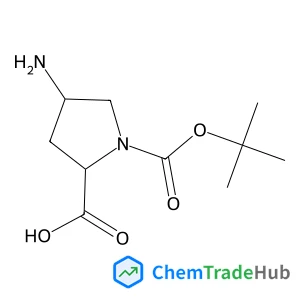
(2R,4R)-1-Boc-4-Aminopyrrolidine-2-carboxylic acid
CAS Number:
132622-98-1
Molecular Formula:
C10H18N2O4
Jose R. Correa, Karen L. R. Paiva, Michele Baril, Daniel F. S. Machado, Jackson D. Scholten, Paulo E. N. de Souza, Fabiane H. Veiga-Souza, John Spencer
This work describes a series of fluorescent 2,1,3-benzothiadiazole derivatives (neutral, singly-charged and doubly-charged) to act as bioprobes for mitochondria. The results showed the flaws in the molecular architecture of this class of fluorophores and our attempts to direct the synthesized derivatives to the organelle. Unexpected results also showed a need for new strategies to predict the cellular selectivity of these derivatives. One of the singly-charged derivatives could stain mitochondria selectively whereas the doubly-charged stained the plasma membrane in an unexpected but highly selective manner. Co-staining experiments confirmed the cellular localization of the new derivatives. EPR experiments demonstrated the fluorescent marker that is selective for mitochondria does not interfere in the ROS production of the cells.
Yan Guo, Ying Jin, Zhaohui Su
DOI: 10.1039/C2PY00582D
Xingfen Liu, Lan Ouyang, Yanqin Huang, Xiaomiao Feng, Quli Fan, Wei Huang
DOI: 10.1039/C2PY00499B
Radovan Vukićević, Ivana Vukovic, Hristiyan Stoyanov, Andreas Korwitz, Doris Pospiech, Guggi Kofod, Katja Loos, Gerrit ten Brinke, Sabine Beuermann
DOI: 10.1039/C2PY20166F
Bas G. P. van Ravensteijn, Robbert Duchateau, Johan P. A. Heuts
DOI: 10.1039/C2PY20195J
Harry R. Allcock, Nicole L. Morozowich
DOI: 10.1039/C1PY00468A
Chunying Gao, Han Zhang, Ming Wu, Yang Liu, Yipan Wu, Xinlin Yang, Xizeng Feng
DOI: 10.1039/C2PY20012K
Yukiya Kitayama, Hirotaka Moribe, Kazuya Kishida
DOI: 10.1039/C2PY20105D
When considering alternatives to 1-(4-Chlorophenyl)-N-hydroxymethanimine (CAS: 3...
This compound should be stored in a cool, dry place away from direct sunlight. I...
3-(4-Bromophenyl)-5-(2-fluorophenyl)-1,2,4-oxadiazole is synthesized through a m...
5-Chloro-2-(4-chlorophenyl)-4-methyl-6-[3-(1-piperidinyl)propoxy]pyrimidine (CAS...
2-Chloro-4-(difluoromethoxy)pyridine is used in the pharmaceutical industry for ...
3-Chloro-6-methylpyridazine (CAS: 1121-79-5) is classified under the Globally Ha...
Several alternatives can be used in the synthesis of Methyl 4,5-dimethyl-2-nitro...
Alternatives to (2E,2'E)-3,3'-(1,4-Phenylene)bisacrylaldehyde include other acry...
3-Amino-5-chloropyridin-2-ol hydrochloride is an organic compound with the CAS n...
When handling 6,7-Difluoro-2,3-dihydro-4H-chromen-4-one, it is essential to wear...

Organic Chemistry Frontiers publishes high-quality research from across organic chemistry. Emphases are placed on studies that make significant contributions to the field of organic chemistry by reporting either new or significantly improved protocols or methodologies. Topics include, but are not limited to the following: Organic synthesis Development of synthetic methodologies Catalysis Natural products Functional organic materials Supramolecular and macromolecular chemistry Physical and computational organic chemistry