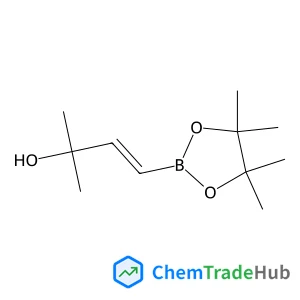
(E)-2-methyl-4-(4,4,5,5-tetramethyl-1,3,2-dioxaborolan-2-yl)but-3-en-2-ol
CAS Number:
581802-26-8
Molecular Formula:
C11H21BO3
Konstantin N. Gavrilov, Igor S. Mikhel, Sergey V. Zheglov, Vladislav K. Gavrilov, Ilya V. Chuchelkin, Ilya D. Firsin, Kirill P. Birin, Ivan S. Pytskii, Ksenia A. Paseshnichenko, Victor A. Tafeenko, Alexei A. Shiryaev
A series of easy-to-prepare and modular chiral bisdiamidophosphites with oxalamide linkers were synthesized. The structures of the novel ligands were elucidated by means of 2D-NMR and confirmed by single-crystal X-ray diffraction. The reactions of such ligands with [Pd(Cod)Cl2] at molar ratios of L/Pd = 1 and 0.5 were studied by 1H, 13C, 13C DEPT, 31P, 1H–13C HSQC, 1H–13C HMBC, 1H–1H COSY, 1H–1H ROESY, 1H–15N HMBC and DOSY spectroscopy, as well as by DFT calculations. Stereoselectors of this type exhibited high enantioselectivities in the Pd-catalyzed allylic substitution reactions of (E)-1,3-diphenylallyl acetate with pTolSO2Na (up to 92% ee), CH2(CO2Me)2 (up to 97% ee), (CH2)4NH (up to 96% ee), (EtO)2P(O)CH2NH2 (up to 96% ee) and (CH2)4N(CCH(CH2)4) (up to 92% ee). ee values of up to 90%, 97% and 83% were obtained in the Pd-mediated allylic alkylation of cinnamyl acetate with ethyl 2-oxocyclohexane-1-carboxylate, allylic amination of cyclohex-2-en-1-yl ethyl carbonate with dibenzylamine and desymmetrization of N,N’-ditosyl-meso-cyclopent-4-ene-1,3-diol biscarbamate, respectively. In addition, ee values of up to >99% were achieved in the Rh-catalyzed asymmetric hydrogenation of methyl esters of unsaturated acids.
Shaojian Lin, Anindita Das, Patrick Theato
DOI: 10.1039/C6PY01996J
Nana Sun, Dongdong Qi, Jianzhuang Jiang
DOI: 10.1039/C4PY00512K
Ran Yu, Klaus Tauer
DOI: 10.1039/C4PY00458B
Niklas Lucht, Steffen Eggers
DOI: 10.1039/C6PY01751G
Yilin Zhang, Liguo Xu, Rongrong Hu, Kam Sing Wong, William A. Goddard, III
DOI: 10.1039/C7PY00154A
Hien The Ho, Sagrario Pascual, Véronique Montembault, Nathalie Casse, Laurent Fontaine
DOI: 10.1039/C4PY00585F
Khama Rani Ghosh, Sukanta Kumar Saha
DOI: 10.1039/C4PY00673A
T. Suzuki, T. Moriya, R. Endo, N. Iwasaki
DOI: 10.1039/C6PY02036D
Stephanie M. Barbon, Joe B. Gilroy
DOI: 10.1039/C6PY00441E
Anna Isakova, Christian Burton, Daniel J. Nowakowski, Paul D. Topham
DOI: 10.1039/C7PY00394C
When considering alternatives to 1-(4-Chlorophenyl)-N-hydroxymethanimine (CAS: 3...
This compound should be stored in a cool, dry place away from direct sunlight. I...
3-(4-Bromophenyl)-5-(2-fluorophenyl)-1,2,4-oxadiazole is synthesized through a m...
5-Chloro-2-(4-chlorophenyl)-4-methyl-6-[3-(1-piperidinyl)propoxy]pyrimidine (CAS...
2-Chloro-4-(difluoromethoxy)pyridine is used in the pharmaceutical industry for ...
3-Chloro-6-methylpyridazine (CAS: 1121-79-5) is classified under the Globally Ha...
Several alternatives can be used in the synthesis of Methyl 4,5-dimethyl-2-nitro...
Alternatives to (2E,2'E)-3,3'-(1,4-Phenylene)bisacrylaldehyde include other acry...
3-Amino-5-chloropyridin-2-ol hydrochloride is an organic compound with the CAS n...
When handling 6,7-Difluoro-2,3-dihydro-4H-chromen-4-one, it is essential to wear...

Organic Chemistry Frontiers publishes high-quality research from across organic chemistry. Emphases are placed on studies that make significant contributions to the field of organic chemistry by reporting either new or significantly improved protocols or methodologies. Topics include, but are not limited to the following: Organic synthesis Development of synthetic methodologies Catalysis Natural products Functional organic materials Supramolecular and macromolecular chemistry Physical and computational organic chemistry
![(2S)-2-{[(9H-Fluoren-9-ylmethoxy)carbonyl]amino}-4-(methylselanyl)butanoic acid structure](https://static.chemtradehub.com/structs/121/1217852-49-7-f252.webp "(2S)-2-{[(9H-Fluoren-9-ylmethoxy)carbonyl]amino}-4-(methylselanyl)butanoic acid structure")