


![(4-Methyl-1H-benzo[d]imidazol-2-yl)methanamine structure](https://static.chemtradehub.com/structs/933/933756-31-1-7b0b.webp "(4-Methyl-1H-benzo[d]imidazol-2-yl)methanamine structure")
Synthesis and in-depth characterization of reactive, uniform, crosslinked microparticles based on free radical copolymerization of 4-vinylbenzyl azide
Literature Information
Publication Date
2016-01-06
DOI
10.1039/C5PY01848J
Impact Factor
5.582
Authors
Marco Albuszis, Peter J. Roth, Franziska Exnowitz, Doris Locsin Wong, Werner Pauer, Hans-Ulrich Moritz
View Original
Abstract
The introduction of functional groups into microparticles is commonly accomplished through, at times, low-yielding post-synthesis modification. In this detailed study, the introduction of azide functionality into uniform, crosslinked, macroporous microparticles through direct copolymerization of styrene, divinylbenzene (DVB), and 4-vinylbenzyl azide (VBA) in varying ratios inside swollen polystyrene seed (template) particles is investigated. Formulations contained up to 40 wt% of VBA in the monomer mixture. Resulting microspheres were characterised by SEM, porosimetry, FT-IR spectroscopy, and CHN elemental analysis. Uniform spherical particles with diameters ranging from 7.3 to 10.8 μm with diameter dispersities typically below 1.01 and with tuneable azide loadings from 0.11 to 1.17 mmol g−1 were obtained. Interestingly, severe effects of VBA addition on porosity, surface smoothness, and particle shape were observed. Specific surface areas and cumulative pore volumes increased with the amount of DVB in feed, decreased with increasing VBA feed ratio, and increased drastically for the use of azide-functional template particles with measured cumulative pore volumes reaching up to 0.60 cm3 g−1. With increasing VBA feed, formation of smaller, secondary particles was observed and attributed to an incomplete swelling of VBA into seed particles, which is discussed as a main reason for lower-than-expected azide contents in product particles. For high VBA feed ratios (>25 wt%), dented, hollow, or hollow collapsed azide-functional particles were found, presumably due to immiscibility of the growing azide-functional copolymer with the polystyrene seeds. Finally, successful click-modification is demonstrated with phenylacetylene and an alkyne-functional Rhodamine B dye allowing for mapping of functionalization density through confocal fluorescence microscopy.
Recommended Journals

Molecular Diversity

Environmental Toxicology and Pharmacology

Current Pharmaceutical Biotechnology

Journal of Enzyme inhibition and Medicinal Chemistry

Advanced Engineering Materials

Photochemical & Photobiological Sciences

Mini-Reviews in Medicinal Chemistry

Angewandte Chemie International Edition

Coloration Technology

Journal of Medical Biochemistry
Related Literature
Diffusion in Li2O studied by non-equilibrium molecular dynamics for 873 < T/K < 1603
Alexander D. Mulliner, Philippe C. Aeberhard, Peter D. Battle
2015-07-29
Paper
DOI: 10.1039/C5CP02628H
Stability, equilibrium morphology and hydration of ZrC(111) and (110) surfaces with H2O: a combined periodic DFT and atomistic thermodynamic study
Eric Osei-Agyemang, Jean-Francois Paul, Romain Lucas, Sylvie Foucaud, Sylvain Cristol
2015-07-16
Paper
DOI: 10.1039/C5CP03031E
An in situ high-temperature scanning electron microscopy study of acanthite–argentite phase transformation in nanocrystalline silver sulfide powder
S. I. Sadovnikov, A. I. Gusev
2015-07-24
Communication
DOI: 10.1039/C5CP02499D
Different behaviour of molecules in dark SERS state on colloidal Ag nanoparticles estimated by truncated power law analysis of blinking SERS
Daichi Araki, Tamitake Itoh, Yukihiro Ozaki
2014-12-16
Paper
DOI: 10.1039/C4CP05070C
Strength order and nature of the π-hole bond of cyanuric chloride and 1,3,5-triazine with halide
Hui Wang, Chen Li, Weizhou Wang, Wei Jun Jin
2015-07-07
Paper
DOI: 10.1039/C5CP03076E
Theoretical study on interactions of fluorinated organomercurials with arene and gold fragments
Sebastián Miranda-Rojas
2015-09-14
Paper
DOI: 10.1039/C5CP04503G
The adsorption of thiophenol on gold – a spectroelectrochemical study
2015-03-05
Paper
DOI: 10.1039/C5CP00884K
Waveguide-coupled directional Raman radiation for surface analysis
Chen Chen, Jin-Yang Li, Li Wang, Dan-Feng Lu, Zhi-Mei Qi
2015-01-30
Paper
DOI: 10.1039/C4CP05092D
An integrated superhydrophobic-plasmonic biosensor for mid-infrared protein detection at the femtomole level
Adele De Ninno, Gabriele Ciasca, Annamaria Gerardino, Eugenio Calandrini, Massimiliano Papi, Marco De Spirito, Alessandro Nucara, Luca Businaro, Leonetta Baldassarre
2015-02-12
Paper
DOI: 10.1039/C4CP05023A
Enhanced-fluorescence correlation spectroscopy at micro-molar dye concentration around a single gold nanorod
Saumyakanti Khatua, Haifeng Yuan, Michel Orrit
2014-09-01
Paper
DOI: 10.1039/C4CP03057E
You might also like
Compound Q&A
Is 2-(2-chloroacetamido)-3-phenylpropanoic acid (CAS: 7765-11-9) safe?
2-(2-Chloroacetamido)-3-phenylpropanoic acid (CAS: 7765-11-9) is generally consi...
7765-11-92-(2-chloroacetamido...
Compound Q&A
Is 2-(Benzyloxy)-5-bromobenzoic acid (CAS: 62176-31-2) safe?
2-(Benzyloxy)-5-bromobenzoic acid can be handled safely if appropriate precautio...
62176-31-22-(Benzyloxy)-5-brom...
Compound Q&A
What is (4-Methyl-1,2,5-oxadiazol-3-yl)methanamine hydrochloride (CAS: 1159825-48-5)?
(4-Methyl-1,2,5-oxadiazol-3-yl)methanamine hydrochloride is a chemical compound ...
1159825-48-5(4-Methyl-1,2,5-oxad...
Compound Q&A
What is 2-(5-Hexylthiophen-2-yl)-4,4,5,5-tetramethyl-1,3,2-dioxaborolane (CAS: 917985-54-7)?
2-(5-Hexylthiophen-2-yl)-4,4,5,5-tetramethyl-1,3,2-dioxaborolane (CAS: 917985-54...
917985-54-72-(5-Hexylthiophen-2...
Compound Q&A
Are there alternatives to 4-(8-Methyl-9H-1,3-dioxolo[4,5-h][2,3]benzodiazepin-5-yl)benzenamine (CAS: 102771-26-6) in synthesis?
While 4-(8-Methyl-9H-1,3-dioxolo[4,5-h][2,3]benzodiazepin-5-yl)benzenamine (CAS:...
102771-26-64-(8-Methyl-9H-1,3-d...
Compound Q&A
What is the market or research trend for tert-butyl 3-hydroxy-4,5,7,8-tetrahydro-2H-pyrazolo[3,4-d]azepine-6-carboxylate (CAS: 851376-80-2)?
The market for tert-butyl 3-hydroxy-4,5,7,8-tetrahydro-2H-pyrazolo[3,4-d]azepine...
851376-80-2tert-butyl 3-hydroxy...
Compound Q&A
How should waste containing 3,5-Diamino-1H-pyrazole-4-carbonitrile (CAS: 6844-58-2) be handled?
Waste containing 3,5-Diamino-1H-pyrazole-4-carbonitrile (CAS: 6844-58-2) should ...
6844-58-23,5-Diamino-1H-pyraz...
Compound Q&A
How is (6-Fluoro-3-pyridinyl)boronic acid (CAS: 351019-18-6) typically synthesized?
(6-Fluoro-3-pyridinyl)boronic acid can be synthesized through the reaction of 6-...
351019-18-6(6-Fluoro-3-pyridiny...
Compound Q&A
What industries use Dibenzyl carbonimidoylbiscarbamate (CAS: 10065-79-9)?
Dibenzyl carbonimidoylbiscarbamate (CAS: 10065-79-9) finds applications in vario...
10065-79-9Dibenzyl carbonimido...
Compound Q&A
What is the market or research trend for (beta,beta,2,3,4,5,6-~2~H_7_)Phenylalanine (CAS: 74228-83-4)?
The market for (beta,beta,2,3,4,5,6-~2~H_7_)Phenylalanine (CAS: 74228-83-4) is g...
74228-83-4(beta,beta,2,3,4,5,6...
Source Journal
Polymer Chemistry

CiteScore:
8.6
Self-citation Rate:
7.3%
Articles per Year:
457
Polymer Chemistry welcomes submissions in all areas of polymer science that have a strong focus on macromolecular chemistry. Manuscripts may cover a broad range of fields, yet no direct application focus is required.
Recommended Compounds
![2-Methyl-2-propanyl 4-oxo-3,9-diazabicyclo[4.2.1]nonane-9-carboxylate structure](https://static.chemtradehub.com/structs/131/1312456-05-5-9a15.webp "2-Methyl-2-propanyl 4-oxo-3,9-diazabicyclo[4.2.1]nonane-9-carboxylate structure")
2-Methyl-2-propanyl 4-oxo-3,9-diazabicyclo[4.2.1]nonane-9-carboxylate
CAS Number:
1312456-05-5
Molecular Formula:
C12H20N2O3
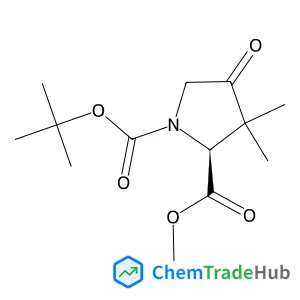
2-Methyl 1-(2-methyl-2-propanyl) (2S)-3,3-dimethyl-4-oxo-1,2-pyrrolidinedicarboxylate
CAS Number:
478698-30-5
Molecular Formula:
C13H21NO5
![2-Azaspiro[4.5]decane-3,8-dione structure](https://static.chemtradehub.com/structs/914/914780-96-4-e94b.webp "2-Azaspiro[4.5]decane-3,8-dione structure")

Recommended Suppliers





Disclaimer
This page provides academic journal information for reference and research purposes only. We are not affiliated with any journal publishers and do not handle publication submissions. For publication-related inquiries, please contact the respective journal publishers directly.
If you notice any inaccuracies in the information displayed, please contact us at support@chemtradehub.com. We will promptly review and address your concerns.