












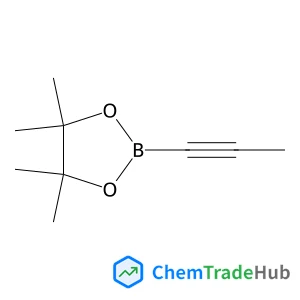
4,4,5,5-Tetramethyl-2-(1-propyn-1-YL)-1,3,2-dioxaborolane
CAS Number:
347389-75-7
Molecular Formula:
C9H15BO2
Sebastián Miranda-Rojas
The electronic structure and spectroscopic properties of [Hg(C6F5)2]2–{L}, [Hg3(o-C6F4)3]2·{L} (L = naphthalene, biphenyl, fluorene) and [Hg3(o-C6F4)3]{Au3(μ-C(OEt)NC6H4CH3)3}n (n = 1, 2) adducts were studied at the HF, MP2, SCS-MP2, DFT and DFT-D3 levels. The intermolecular interactions among the fragments were analyzed using the levels of calculations proposed. The energy decomposition analysis at the TPSS-D3 level was used to define the dominant components of the interaction. The van der Waals interactions between mercury and arene (Hg–arene) were found to be the main short-range stability contribution in the [Hg(C6F5)2]2–{L} and [Hg3(o-C6F4)3]2·{L} complexes. At the MP2, SCS-MP2 and DFT-D3 levels, equilibrium Hg–C distances are between 360 and 310 pm. The pair-wise energies were found to be between 18.0 and 6.0 kJ mol−1. In the [Hg3(o-C6F4)3]{Au3(μ-C(OEt)NC6H4CH3)3}n (n = 1, 2) complexes the metallophilic intermolecular interaction is Hg–Au. Pair-wise energies of 85.7, 39.4, 78.1 and 57.9 kJ mol−1 were found at the MP2, SCS-MP2, TPSS-D3 and PBE-D3 levels using the [Hg3(o-C6F4)3]{Au3(μ-C(OEt)NC6H4CH3)3} model. The same trend is maintained for the [Hg3(o-C6F4)3]{Au3(μ-C(OEt)NC6H4CH3)3}2 model: 73.4, 29.3, 70.6 and 61.3 kJ mol−1 by MP2, SCS-MP2, TPSS-D3 and PBE-D3, respectively. The absorption spectra of these complexes were calculated using the single excitation time-dependent method at the TPSS-D3 level to validate the models against the experimental data.
Jun Peng, Kai Xu, Mingcai Chen
DOI: 10.1039/C7CP03325G
Wei Pan, Hao Wen, Dehai Liang
DOI: 10.1039/C7CP04066K
Abhishek Ghosh, S. B. Majumder
DOI: 10.1039/C7CP04241H
Zheng Xing, Yeap Hung Ng, Siok-Wei Tay, Rachel Pek Har Oon, Liang Hong
DOI: 10.1039/C7CP03973E
Qun Zeng, Xianggui Xue, Zengming Zhang, Fude Nie, Chaoyang Zhang
DOI: 10.1039/C7CP04015F
Jing Chen, Zhixun Luo, Jiannian Yao
DOI: 10.1039/C7CP02538F
M. M. Maitani, K. Tanaka, Q. Shen, T. Toyoda, Y. Wada
DOI: 10.1039/C7CP03593D
M. Oujja, S. Psilodimitrakopoulos, E. Carrasco, M. Sanz, A. Philippidis, A. Selimis, P. Pouli, G. Filippidis, M. Castillejo
DOI: 10.1039/C7CP02509B
Ting Hu, Jian Zhou, Jinming Dong
DOI: 10.1039/C7CP03558F
Cuiping Wang, Cong Li, Jiajia Han, Lihui Yan, Bin Deng, Xingjun Liu
DOI: 10.1039/C7CP03775A
6-(3-Fluorophenyl)picolinic acid is generally considered safe for laboratory use...
(3R)-3-Pyrrolidinol is used in the pharmaceutical industry as a precursor for dr...
When handling (4R,5R)-4,5-Diethoxycarbonyl-2,2-dimethyldioxolane (CAS: 59779-75-...
1-(6-Chloroimidazo[1,2-b]pyridazin-3-yl)ethanone is often synthesized via a mult...
The market for N-Ethyl-3,4-dimethylbenzylamine (CAS: 39180-83-1) remains steady,...
Tert-butyl 3-(pyrrolidin-1-yl)azetidine-1-carboxylate is a chemical compound wit...
1-Bromo-3-chloro-2,4-dimethoxybenzene (CAS: 1228956-93-1) falls under the classi...
The safety of 8-Bromo-2-methyl-3,4-dihydroisoquinolin-1(2H)-one (CAS: 1368622-07...
Benzyl [(3S)-2,6-dioxo-3-piperidinyl]carbamate is generally safe when handled wi...
1-{[4-(4,4,5,5-Tetramethyl-1,3,2-dioxaborolan-2-yl)phenyl]sulfonyl}pyrrolidine s...

Physical Chemistry Chemical Physics (PCCP) is an international journal co-owned by 19 physical chemistry and physics societies from around the world. This journal publishes original, cutting-edge research in physical chemistry, chemical physics and biophysical chemistry. To be suitable for publication in PCCP, articles must include significant innovation and/or insight into physical chemistry; this is the most important criterion that reviewers and Editors will judge against when evaluating submissions. The journal has a broad scope and welcomes contributions spanning experiment, theory, computation and data science. Topical coverage includes spectroscopy, dynamics, kinetics, statistical mechanics, thermodynamics, electrochemistry, catalysis, surface science, quantum mechanics, quantum computing and machine learning. Interdisciplinary research areas such as polymers and soft matter, materials, nanoscience, energy, surfaces/interfaces, and biophysical chemistry are welcomed if they demonstrate significant innovation and/or insight into physical chemistry. Joined experimental/theoretical studies are particularly appreciated when complementary and based on up-to-date approaches.
![[1-(5-Methyl-2-pyridinyl)-1H-pyrazol-4-yl]methanol structure](https://static.chemtradehub.com/structs/143/1439822-99-7-6cc9.webp "[1-(5-Methyl-2-pyridinyl)-1H-pyrazol-4-yl]methanol structure")





