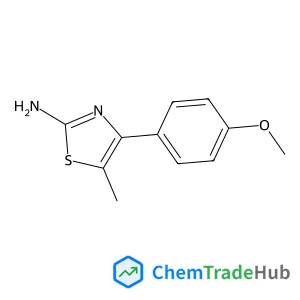
4-(4-Methoxyphenyl)-5-methyl-1,3-thiazol-2-amine
CAS Number:
105512-88-7
Molecular Formula:
C11H12N2OS
Junpeng Zhao, Nikos Hadjichristidis
Organocatalytic ring-opening polymerization (ROP) reactions of three renewable 5-alkyl δ-lactones, namely δ-hexalactone (HL), δ-nonalactone (NL) and δ-decalactone (DL), using diphenyl phosphate (DPP) were investigated. Room temperature, together with a relatively high monomer concentration (≥3 M), was demonstrated to be suitable for achieving a living ROP behavior, a high conversion of the lactone, a controlled molecular weight and a low dispersity of the polyester. HL, containing a 5-methyl substituent, showed a much higher reactivity (polymerization rate) and a slightly higher equilibrium conversion than the compounds with longer alkyl substituents (NL and DL). The effectiveness of DPP-catalyzed ROP of 5-alkyl δ-lactones facilitated the one-pot performance following the t-BuP4-promoted ROP of monosubstituted epoxides. It has been shown in an earlier study that substituted polyethers acted as “slow initiators” for non-substituted lactones. However, efficient initiations were observed in the present study as substituted lactones were polymerized from the substituted polyethers. Therefore, this reinforces the previously developed “catalyst switch” strategy, making it a more versatile tool for the synthesis of well-defined polyether–polyester block copolymers from a large variety of epoxide and lactone monomers.
Chiun-Yan Lin, Jhao-Ying Wu, Yih-Jon Ou, Yu-Huang Chiu, Ming-Fa Lin
DOI: 10.1039/C5CP05013H
Alexander D. Mulliner, Philippe C. Aeberhard, Peter D. Battle
DOI: 10.1039/C5CP02628H
Saumyakanti Khatua, Haifeng Yuan, Michel Orrit
DOI: 10.1039/C4CP03057E
Hai-Chou Chang, Jyh-Chiang Jiang, Meng-Hsiu Kuo, Ding-Tsai Hsu, Sheng Hsien Lin
DOI: 10.1039/C4CP04768K
R. R. Wu, Bo Yang, C. E. Frieler, G. Berden, M. T. Rodgers
DOI: 10.1039/C5CP02227D
Zhen Zhu, Jiamin Xiao, Haibin Sun, Yue Hu, Ronggen Cao, Yin Wang, Li Zhao, Jun Zhuang
DOI: 10.1039/C5CP02558C
Nicolò Azzaroli, Maria Grazia Lobello, Laura Bussotti, Giuseppe Calogero, Mariachiara Pastore, Filippo De Angelis
DOI: 10.1039/C5CP03314D
Mahshid Firouzi, Qibin Li, Kang Peng
DOI: 10.1039/C5CP03050A
B. Loganathan, V. L. Chandraboss, S. Senthilvelan, B. Karthikeyan
DOI: 10.1039/C4CP05170J
2-(2-Chloroacetamido)-3-phenylpropanoic acid (CAS: 7765-11-9) is generally consi...
2-(Benzyloxy)-5-bromobenzoic acid can be handled safely if appropriate precautio...
(4-Methyl-1,2,5-oxadiazol-3-yl)methanamine hydrochloride is a chemical compound ...
2-(5-Hexylthiophen-2-yl)-4,4,5,5-tetramethyl-1,3,2-dioxaborolane (CAS: 917985-54...
While 4-(8-Methyl-9H-1,3-dioxolo[4,5-h][2,3]benzodiazepin-5-yl)benzenamine (CAS:...
The market for tert-butyl 3-hydroxy-4,5,7,8-tetrahydro-2H-pyrazolo[3,4-d]azepine...
Waste containing 3,5-Diamino-1H-pyrazole-4-carbonitrile (CAS: 6844-58-2) should ...
(6-Fluoro-3-pyridinyl)boronic acid can be synthesized through the reaction of 6-...
Dibenzyl carbonimidoylbiscarbamate (CAS: 10065-79-9) finds applications in vario...
The market for (beta,beta,2,3,4,5,6-~2~H_7_)Phenylalanine (CAS: 74228-83-4) is g...

Polymer Chemistry welcomes submissions in all areas of polymer science that have a strong focus on macromolecular chemistry. Manuscripts may cover a broad range of fields, yet no direct application focus is required.
![2-(5-Bromo-1H-pyrrolo[2,3-B]pyridin-3-YL)acetic acid structure](https://static.chemtradehub.com/structs/106/1060795-03-0-0589.webp "2-(5-Bromo-1H-pyrrolo[2,3-B]pyridin-3-YL)acetic acid structure")
![2-Methyl-2-propanyl 4-oxo-3,9-diazabicyclo[4.2.1]nonane-9-carboxylate structure](https://static.chemtradehub.com/structs/131/1312456-05-5-9a15.webp "2-Methyl-2-propanyl 4-oxo-3,9-diazabicyclo[4.2.1]nonane-9-carboxylate structure")