












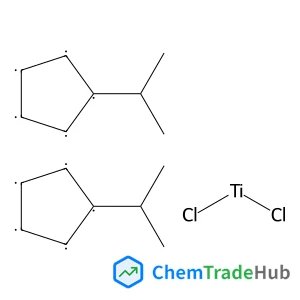
BIS(I-PROPYLCYCLOPENTADIENYL)TITANIUM DICHLORIDE
CAS Number:
12130-65-3
Molecular Formula:
C16H22Cl2Ti
Nicolò Azzaroli, Maria Grazia Lobello, Laura Bussotti, Giuseppe Calogero, Mariachiara Pastore, Filippo De Angelis
We have analyzed the excited state dynamics of the heteroleptic [(NCS)2Ru(bpy-(COOH)2)(bpy-(C6H13)2)] Z907 solar cell sensitizer in solution and when adsorbed onto thin TiO2 films, by combining transient visible and infrared (IR) spectroscopies with ab initio Density Functional Theory (DFT) and Time-Dependent DFT (TDDFT) calculations. Upon excitation with ultra-short pulses in ethanol and dimethyl-sulphoxide solutions, the visible spectra show the appearance of a positive signal around 650 nm, within the instrumental time resolution (<100 fs), which in ethanol undergoes a red-shift in about 20 ps. Measurements in the IR indicate that, upon excitation, both the CN and CO marker bands, associated with the NCS and COOH groups, downshift in frequency, in response to intramolecular ligand + metal (Ru-NCS) to ligand' (bpy-COOH2) charge transfer (LML'CT). Vibrational cooling is observed in both solvents; in ethanol it is overtaken by the hydrogen bond dynamics. On the basis of DFT/TDDFT calculations, explicitly modeling the interaction of the NCS and COOH groups with solvent (ethanol) molecules, we rationalize the observed IR and visible spectral evolution as arising from the change in the hydrogen-bond network, which accompanies the transition to the lowest-energy triplet state. This interpretation provides a consistent explanation of what is also observed in the transient visible spectra. Transient IR measurements repeated for molecules adsorbed on TiO2 and ZrO2 films, allow us to identify the structural changes signaling the dye triplet excited state formation and evidence multiexponential electron injection rates into the semiconductor TiO2 film.
Charusheela Ramanan, Marco Ferretti, Henny van Roon, Vladimir I. Novoderezhkin, Rienk van Grondelle
DOI: 10.1039/C7CP03038J
Manuel Salado, Ramesh K. Kokal, Laura Calio, Samrana Kazim, Melepurath Deepa, Shahzada Ahmad
DOI: 10.1039/C7CP03760K
Jie Yang, Zhijun Xu, Xiaoning Yang
DOI: 10.1039/C7CP04236A
Katrin Peckelsen, Jonathan Martens, Lisa Czympiel, Giel Berden, Dirk Gründemann, Anthony J. H. M. Meijer, Mathias Schäfer
DOI: 10.1039/C7CP03843G
Shi-Dong Feng, Jun-Wei Qiao, Wei-Min Wang, Jing-Yu Qin
DOI: 10.1039/C7CP03475J
I. Palacio, A. L. Pinardi, J. I. Martínez, A. Preobrajenski, A. Cossaro, A. Jancarik, I. Stará, I. Starý, J. Méndez, J. A. Martín-Gago, M. F. López
DOI: 10.1039/C7CP03955G
O. O. Taiwo, D. P. Finegan, J. M. Paz-Garcia, A. J. Bodey, C. Rau, S. A. Hall, D. J. L. Brett, P. R. Shearing
DOI: 10.1039/C7CP02872E
O. Kuzmina, D. Godfrey, T. Albrecht, T. Welton
DOI: 10.1039/C7CP03540C
Johannes R. Klein, Mirko Scholz, Kawon Oum, Thomas Lenzer
DOI: 10.1039/C7CP01718A
Ting Hu, Jian Zhou, Jinming Dong
DOI: 10.1039/C7CP03558F
6-(3-Fluorophenyl)picolinic acid is generally considered safe for laboratory use...
(3R)-3-Pyrrolidinol is used in the pharmaceutical industry as a precursor for dr...
When handling (4R,5R)-4,5-Diethoxycarbonyl-2,2-dimethyldioxolane (CAS: 59779-75-...
1-(6-Chloroimidazo[1,2-b]pyridazin-3-yl)ethanone is often synthesized via a mult...
The market for N-Ethyl-3,4-dimethylbenzylamine (CAS: 39180-83-1) remains steady,...
Tert-butyl 3-(pyrrolidin-1-yl)azetidine-1-carboxylate is a chemical compound wit...
1-Bromo-3-chloro-2,4-dimethoxybenzene (CAS: 1228956-93-1) falls under the classi...
The safety of 8-Bromo-2-methyl-3,4-dihydroisoquinolin-1(2H)-one (CAS: 1368622-07...
Benzyl [(3S)-2,6-dioxo-3-piperidinyl]carbamate is generally safe when handled wi...
1-{[4-(4,4,5,5-Tetramethyl-1,3,2-dioxaborolan-2-yl)phenyl]sulfonyl}pyrrolidine s...

Physical Chemistry Chemical Physics (PCCP) is an international journal co-owned by 19 physical chemistry and physics societies from around the world. This journal publishes original, cutting-edge research in physical chemistry, chemical physics and biophysical chemistry. To be suitable for publication in PCCP, articles must include significant innovation and/or insight into physical chemistry; this is the most important criterion that reviewers and Editors will judge against when evaluating submissions. The journal has a broad scope and welcomes contributions spanning experiment, theory, computation and data science. Topical coverage includes spectroscopy, dynamics, kinetics, statistical mechanics, thermodynamics, electrochemistry, catalysis, surface science, quantum mechanics, quantum computing and machine learning. Interdisciplinary research areas such as polymers and soft matter, materials, nanoscience, energy, surfaces/interfaces, and biophysical chemistry are welcomed if they demonstrate significant innovation and/or insight into physical chemistry. Joined experimental/theoretical studies are particularly appreciated when complementary and based on up-to-date approaches.

![5-Bromo-3-isopropyl-1H-pyrrolo[2,3-b]pyridine structure](https://static.chemtradehub.com/structs/125/1256819-54-1-8620.webp "5-Bromo-3-isopropyl-1H-pyrrolo[2,3-b]pyridine structure")




