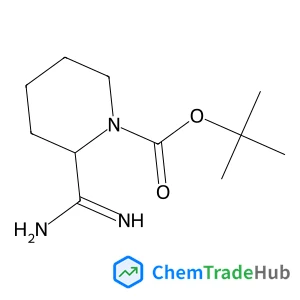
2-Methyl-2-propanyl 2-carbamimidoyl-1-piperidinecarboxylate
CAS Number:
1258640-98-0
Molecular Formula:
C11H21N3O2
Umme Salma, Paolo Ballirano, Marianna Usula, Ruggero Caminiti, Natalia V. Plechkova, Kenneth R. Seddon, Lorenzo Gontrani
In this paper, small angle X-ray scattering has been used to study a series of ionic liquids, alkylammonium alkanoates ([N0 0 0 n][CmCO2]), with varying alkyl chain lengths in the cation and the anion. We investigate the behaviour and the structure of such ionic liquids in their neat state, and in binary mixtures with water. To the best of our knowledge, this is the first structural study dealing with the behaviour of propylammonium propanoate [N0 0 0 3][C2CO2], butylammonium propanoate [N0 0 0 4][C2CO2], propylammonium butanoate [N0 0 0 3][C3CO2] and butylammonium butanoate [N0 0 0 4][C3CO2] when mixed in water. Generally, in the ionic liquids containing alkyl chains on both the cation and the anion, the correlation distance and the resulting scattering peak, which signal intermediate range order, are affected equally by both of the chains. The interesting result obtained regarding these systems is that the shift of the pre- and principal peaks with the addition of water depends on the overall molar concentration of the chains and is generally cumulative. Although, for a given sum of cation and anion chain lengths, the shift is reliant on the cation–anion combination in the neat state, it is not the case in their mixtures with water. In some recent papers, it has been reported that with addition of water, the pre-peak position remains constant, but our results show a shift in both pre- and principal Q peaks.
Arnošt Mládek, Miroslav Krepl, Michal Otyepka, Pavel Banáš, Marie Zgarbová, Petr Jurečka
DOI: 10.1039/C3CP44383C
Jamie D. Young, Dave Townsend, Justyna M. Żurek, Martin J. Paterson, Gareth M. Roberts, Vasilios G. Stavros
DOI: 10.1039/C3CP51108A
Martin Thomas, Martin Brehm, Reinhold Fligg, Peter Vöhringer, Barbara Kirchner
DOI: 10.1039/C3CP44302G
Ryusuke Futamura, Miguel Jorge, José R. B. Gomes
DOI: 10.1039/C3CP50193K
Yi Yang, Dan Xie, Tian-Ling Ren, Yi Shu, Hui Sun, Chang-Jian Zhou, Xuan Liu, Lu-Qi Tao, Jie Ge, Cang-Hai Zhang, Yuegang Zhang
DOI: 10.1039/C3CP50538C
Panteleimon G. Takis, Konstantinos D. Papavasileiou, Loukas D. Peristeras, Vasilios S. Melissas, Anastassios N. Troganis
DOI: 10.1039/C3CP44606A
Yuuki Mogami, Yasuto Noda, Hiroto Ishikawa, K. Takegoshi
DOI: 10.1039/C3CP43778G
Venkata Bharat Ram Boppana, Feng Jiao, Dave Newby, Jr., Jude Laverock, Kevin E. Smith, Jean Claude Jumas, Greg Hutchings, Raul F. Lobo
DOI: 10.1039/C3CP44635B
N-(4-Methoxybenzyl)-2-pyridinamine (CAS: 52818-63-0) is increasingly being used ...
When handling Ethyl 4-(2-chlorophenyl)-1,3-thiazole-2-carboxylate, appropriate p...
Diethyldiselane (CAS: 628-39-7) is classified under the Globally Harmonized Syst...
The market for oxocopper (CAS: 12053-18-8) is primarily driven by its use in cat...
The market for 5-{[(2-Methyl-2-propanyl)oxy]carbonyl}-5-azaspiro[2.4]heptane-7-c...
2-(1-Pyrrolidinyl)-4-pyridinamine is a chemical compound with the CAS number 359...
2-(3-Pyridinyl)-1-azabicyclo[2.2.2]octane (CAS: 91556-75-1) is a crystalline sol...
(S)-Alpha-allyl-proline hydrochloride is usually synthesized via a Wittig reacti...
3-Methyl-1,2-oxazole-5-carboxylic acid (CAS: 4857-42-5) is an organic compound w...
Lys-SMCC-DM1 is synthesized via a multi-step process involving the coupling of S...

Physical Chemistry Chemical Physics (PCCP) is an international journal co-owned by 19 physical chemistry and physics societies from around the world. This journal publishes original, cutting-edge research in physical chemistry, chemical physics and biophysical chemistry. To be suitable for publication in PCCP, articles must include significant innovation and/or insight into physical chemistry; this is the most important criterion that reviewers and Editors will judge against when evaluating submissions. The journal has a broad scope and welcomes contributions spanning experiment, theory, computation and data science. Topical coverage includes spectroscopy, dynamics, kinetics, statistical mechanics, thermodynamics, electrochemistry, catalysis, surface science, quantum mechanics, quantum computing and machine learning. Interdisciplinary research areas such as polymers and soft matter, materials, nanoscience, energy, surfaces/interfaces, and biophysical chemistry are welcomed if they demonstrate significant innovation and/or insight into physical chemistry. Joined experimental/theoretical studies are particularly appreciated when complementary and based on up-to-date approaches.
![(2R,6S)-6-[(Benzyloxy)methyl]-4-{[(2-methyl-2-propanyl)oxy]carbonyl}-2-morpholinecarboxylic acid structure](https://static.chemtradehub.com/structs/109/1093085-91-6-3382.webp "(2R,6S)-6-[(Benzyloxy)methyl]-4-{[(2-methyl-2-propanyl)oxy]carbonyl}-2-morpholinecarboxylic acid structure")
![1-{3-[4-Amino-3-(4-phenoxyphenyl)-1H-pyrazolo[3,4-d]pyrimidin-1-yl]-1-piperidinyl}-2,3-dihydroxy-1-propanone structure](https://static.chemtradehub.com/structs/122/1226872-27-0-e037.webp "1-{3-[4-Amino-3-(4-phenoxyphenyl)-1H-pyrazolo[3,4-d]pyrimidin-1-yl]-1-piperidinyl}-2,3-dihydroxy-1-propanone structure")