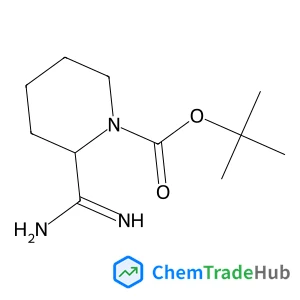
2-Methyl-2-propanyl 2-carbamimidoyl-1-piperidinecarboxylate
CAS Number:
1258640-98-0
Molecular Formula:
C11H21N3O2
Venkatesan Srinivasan, Murugesan Panneer, Madhavan Jaccob, Nagaraj Pavithra, Sambandam Anandan, Arunkumar Kathiravan
An electron rich donor moiety plays an important role in dye sensitized solar cells (DSCs). In order to attain a suitable donor moiety for DSCs, a deeper understanding of the role of a donor moiety in the dye excited state is significant. In this context, different arylamine dye-based electron donor moieties (TRA, CRA and PyRA) were successfully synthesized and well characterized using 1H-NMR, 13C-NMR and EI-MS spectrometry. Their photophysical properties and solvatochromic behavior were studied using UV-visible absorption, steady state and time resolved fluorescence spectroscopic techniques. The absorption of arylamine dyes is due to intramolecular charge transfer (ICT) between the donor and rhodanine-3-acetic acid via a π-bridge, which is further confirmed by DFT calculations. Lippert–Mataga analysis on the solvatochromic data implies that these molecules are more polar in the excited state, which is additional support for ICT. Furthermore, nanocrystalline TiO2-based dye sensitized solar cells (DSCs) were fabricated using these dyes to investigate the influence of donor moieties on their photovoltaic performance. The overall power conversion efficiencies of 2.57%, 1.68% and 1.25% were obtained for the TRA, PyRA and CRA dyes, respectively. The enhanced power conversion efficiency of TRA is due to a longer lifetime of injected electrons as demonstrated by the electrochemical impedance spectroscopy (EIS) measurements.
Ru Dong, Qi Chen, Xuediao Cai, Qi Zhang, Zhike Liu
DOI: 10.1039/D0PY00680G
Antxon Martínez de Ilarduya, Sebastián Muñoz Guerra
DOI: 10.1039/D0PY00258E
Julien Cretenoud, Sandor Balog, Véronique Michaud, Jean-Marc Chenal, Olivier Lame, Christopher J. G. Plummer, Holger Frauenrath
DOI: 10.1039/D1PY01225H
Priscila Quiñonez-Angulo, Robin A. Hutchinson, Ángel Licea-Claveríe, Enrique Saldívar-Guerra, Iván Zapata-González
DOI: 10.1039/D1PY00750E
Hu Zhang, Ru Xiao, Zhengguo Cai
DOI: 10.1039/D0PY00857E
Bilal Özen, Nicolas Candau, Cansel Temiz, Ferdinand C. Grozema, Grégory Stoclet, Christopher J. G. Plummer, Holger Frauenrath
DOI: 10.1039/D1PY01203G
Lei Zhang, Fangyuan Zhou, Zhenjiang Li, Bo Liu, Rui Yan, Jie Li, Yongzhu Hu, Chan Zhang, Zikun Luo, Kai Guo
DOI: 10.1039/D0PY00812E
Sandeep Sharma, Konstantinos Ntetsikas, Viko Ladelta, Saibal Bhaumik, Nikos Hadjichristidis
DOI: 10.1039/D1PY01337H
Wanan Cai, Zhicheng Wang, Zhaohui Shu, Wenbin Liu, Jun Wang, Jian Qiu
DOI: 10.1039/D1PY01451J
Mahammad Anas, Priyanka Dinda, Mahuya Kar, Tarun K. Mandal
DOI: 10.1039/D1PY01187A
N-(4-Methoxybenzyl)-2-pyridinamine (CAS: 52818-63-0) is increasingly being used ...
When handling Ethyl 4-(2-chlorophenyl)-1,3-thiazole-2-carboxylate, appropriate p...
Diethyldiselane (CAS: 628-39-7) is classified under the Globally Harmonized Syst...
The market for oxocopper (CAS: 12053-18-8) is primarily driven by its use in cat...
The market for 5-{[(2-Methyl-2-propanyl)oxy]carbonyl}-5-azaspiro[2.4]heptane-7-c...
2-(1-Pyrrolidinyl)-4-pyridinamine is a chemical compound with the CAS number 359...
2-(3-Pyridinyl)-1-azabicyclo[2.2.2]octane (CAS: 91556-75-1) is a crystalline sol...
(S)-Alpha-allyl-proline hydrochloride is usually synthesized via a Wittig reacti...
3-Methyl-1,2-oxazole-5-carboxylic acid (CAS: 4857-42-5) is an organic compound w...
Lys-SMCC-DM1 is synthesized via a multi-step process involving the coupling of S...

Physical Chemistry Chemical Physics (PCCP) is an international journal co-owned by 19 physical chemistry and physics societies from around the world. This journal publishes original, cutting-edge research in physical chemistry, chemical physics and biophysical chemistry. To be suitable for publication in PCCP, articles must include significant innovation and/or insight into physical chemistry; this is the most important criterion that reviewers and Editors will judge against when evaluating submissions. The journal has a broad scope and welcomes contributions spanning experiment, theory, computation and data science. Topical coverage includes spectroscopy, dynamics, kinetics, statistical mechanics, thermodynamics, electrochemistry, catalysis, surface science, quantum mechanics, quantum computing and machine learning. Interdisciplinary research areas such as polymers and soft matter, materials, nanoscience, energy, surfaces/interfaces, and biophysical chemistry are welcomed if they demonstrate significant innovation and/or insight into physical chemistry. Joined experimental/theoretical studies are particularly appreciated when complementary and based on up-to-date approaches.