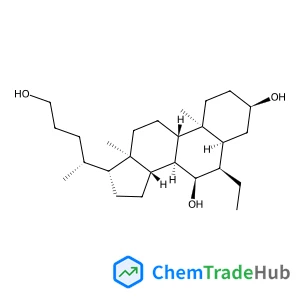
(3alpha,5beta,6alpha,7alpha)-6-Ethylcholane-3,7,24-triol
CAS Number:
1537866-49-1
Molecular Formula:
C26H46O3
Brandon Bukowski, N. Aaron Deskins
TiO2/graphene composites have shown promise as photocatalysts, leading to improved electronic properties. We have modeled using density functional theory TiO2/graphene interfaces formed between graphene with various defects/functional groups (C vacancy, epoxide, and hydroxyl) and TiO2 clusters of various sizes. We considered clusters from 3 to 45 atoms, the latter a nanoparticle of ∼1 nm in size. Our results show that binding to pristine graphene is dominated by van der Waals forces, and that C vacancies or epoxide groups lead to much stronger binding between the graphene and TiO2. Such sites may serve to anchor TiO2 to graphene. Graphene surfaces with hydroxyls however lead to OH transfer to TiO2 and weak interactions between the graphene and the hydroxylated TiO2 cluster. Charge transfer may occur between TiO2 and graphene in various directions (graphene to TiO2 or TiO2 to graphene), depending on the state of the graphene surface, based on overlap of the density of states. Our work indicates that graphene surface defects or functional groups may have a significant effect on the stability, structure, and photoactivity of these materials.
Yufeng Zhou, Yali Yu, Longlong Gao, Yifan Fei, Ting Ye, Qiusha Li, Xiaoshun Zhou, Ning Gan, Yong Shao
DOI: 10.1039/C8AN01561A
Chen Zeng, Fanghao Hu, Rong Long, Wei Min
DOI: 10.1039/C8AN00910D
Sudkate Chaiyo, Kurt Kalcher, Amara Apilux, Orawon Chailapakul, Weena Siangproh
DOI: 10.1039/C8AN01122B
Xiaoning Kai, Yiran Zhang, Youguang Zheng, Yunsheng Xue, Xiaoxing Yin, Jing Zhao
DOI: 10.1039/C8AN00765A
A. F. Payam, W. Trewby, K. Voïtchovsky
DOI: 10.1039/C6AN02674E
Anthony J. Lucio, Scott K. Shaw
DOI: 10.1039/C8AN01085D
M. R. Siddique, A. V. Rutter, K. Wehbe, G. Cinque, G. Bellisola
DOI: 10.1039/C6AN01914E
David T. Buckley, Christopher J. Hogan, Jr.
DOI: 10.1039/C7AN00328E
Shivani Sathish, Sébastien G. Ricoult, Kazumi Toda-Peters, Amy Q. Shen
DOI: 10.1039/C7AN00273D
N-(4-Methoxybenzyl)-2-pyridinamine (CAS: 52818-63-0) is increasingly being used ...
When handling Ethyl 4-(2-chlorophenyl)-1,3-thiazole-2-carboxylate, appropriate p...
Diethyldiselane (CAS: 628-39-7) is classified under the Globally Harmonized Syst...
The market for oxocopper (CAS: 12053-18-8) is primarily driven by its use in cat...
The market for 5-{[(2-Methyl-2-propanyl)oxy]carbonyl}-5-azaspiro[2.4]heptane-7-c...
2-(1-Pyrrolidinyl)-4-pyridinamine is a chemical compound with the CAS number 359...
2-(3-Pyridinyl)-1-azabicyclo[2.2.2]octane (CAS: 91556-75-1) is a crystalline sol...
(S)-Alpha-allyl-proline hydrochloride is usually synthesized via a Wittig reacti...
3-Methyl-1,2-oxazole-5-carboxylic acid (CAS: 4857-42-5) is an organic compound w...
Lys-SMCC-DM1 is synthesized via a multi-step process involving the coupling of S...

Physical Chemistry Chemical Physics (PCCP) is an international journal co-owned by 19 physical chemistry and physics societies from around the world. This journal publishes original, cutting-edge research in physical chemistry, chemical physics and biophysical chemistry. To be suitable for publication in PCCP, articles must include significant innovation and/or insight into physical chemistry; this is the most important criterion that reviewers and Editors will judge against when evaluating submissions. The journal has a broad scope and welcomes contributions spanning experiment, theory, computation and data science. Topical coverage includes spectroscopy, dynamics, kinetics, statistical mechanics, thermodynamics, electrochemistry, catalysis, surface science, quantum mechanics, quantum computing and machine learning. Interdisciplinary research areas such as polymers and soft matter, materials, nanoscience, energy, surfaces/interfaces, and biophysical chemistry are welcomed if they demonstrate significant innovation and/or insight into physical chemistry. Joined experimental/theoretical studies are particularly appreciated when complementary and based on up-to-date approaches.
![1,10-bis(3,5-dimethylphenyl)-12-hydroxy-4,5,6,7-tetrahydroiindeno[7,1-de:1',7'-fg][1,3,2]dioxaphosphocine 12-oxide structure](https://static.chemtradehub.com/structs/141/1412439-82-7-b9a9.webp "1,10-bis(3,5-dimethylphenyl)-12-hydroxy-4,5,6,7-tetrahydroiindeno[7,1-de:1',7'-fg][1,3,2]dioxaphosphocine 12-oxide structure")