


Effects of nilotinib on leukaemia cells using vibrational microspectroscopy and cell cloning
Literature Information
Publication Date
2016-12-08
DOI
10.1039/C6AN01914E
Impact Factor
4.616
Authors
M. R. Siddique, A. V. Rutter, K. Wehbe, G. Cinque, G. Bellisola
View Original
Abstract
Over the last few years, both synchrotron-based FTIR (S-FTIR) and Raman microspectroscopies have helped to better understand the effects of drugs on cancer cells. However, cancer is a mixture of cells with different sensitivity/resistance to drugs. Furthermore, the effects of drugs on cells produce both chemical and morphological changes, the latter could affect the spectra of cells incubated with drugs. Here, we successfully cloned sensitive and resistant leukaemia cells to nilotinib, a drug used in the management of leukaemia. This allowed both the study of a more uniform population and the study of sensitive and resistant cells prior to the addition of the drug with both S-FTIR and Raman microspectroscopies. The incubation with nilotinib produced changes in the S-FTIR and Raman spectra of both sensitive and resistant clones to nilotinib. Principal component analysis was able to distinguish between cells incubated in the absence or presence of the drug, even in the case of resistant clones. The latter would confirm that the spectral differences between the so-called resistant clonal cells prior to and after adding a drug might reside on those more or less sensitive cells that have been able to remain alive when they were collected to be studied with S-FTIR or Raman microspectroscopies. The data presented here indicate that the methodology of cell cloning can be applied to different types of malignant cells. This should facilitate the identification of spectral biomarkers of sensitivity/resistance to drugs. The next step would be a better assessment of sensitivity/resistance of leukaemia cells from patients which could guide clinicians to better tailor treatments to each individual patient.
Recommended Journals

Molecular Pharmacology

Fibre Chemistry

Russian Chemical Reviews

European Journal of Wood and Wood Products

Journal of Organometallic Chemistry

Journal of Catalysis

Pure and Applied Chemistry

Journal of Physics and Chemistry of Solids

Journal of Heterocyclic Chemistry

Proceedings of the National Academy of Sciences of the United States of America
Related Literature
Adsorption of N/S heterocycles in the flexible metal–organic framework MIL-53(FeIII) studied by in situ energy dispersive X-ray diffraction
Ben Van de Voorde, Alexis S. Munn, Nathalie Guillou, Franck Millange, Dirk E. De Vos, Richard I. Walton
2013-02-14
Paper
DOI: 10.1039/C3CP44349C
Reversibility in protein folding: effect of β-cyclodextrin on bovine serum albumin unfolded by sodium dodecyl sulphate
Uttam Anand, Saptarshi Mukherjee
2013-04-16
Paper
DOI: 10.1039/C3CP50207D
Insights into the polymorphism of glycine: membrane crystallization in an electric field
Gianluca Di Profio, Mika T. Reijonen, Rocco Caliandro, Antonietta Guagliardi, Efrem Curcio, Enrico Drioli
2013-05-09
Paper
DOI: 10.1039/C3CP50664A
Dissecting the structural determinants for the difference in mechanical stability of silk and amyloid beta-sheet stacks
Senbo Xiao, Shijun Xiao
2013-04-11
Paper
DOI: 10.1039/C3CP00067B
Tandem cathode for proton exchange membrane fuel cells
Samira Siahrostami, Mårten E. Björketun, Peter Strasser, Jeff Greeley, Jan Rossmeisl
2013-04-22
Paper
DOI: 10.1039/C3CP51479J
Atomic pair distribution functions analysis of disordered low-Z materials
V. Petkov, Y. Ren, S. Kabekkodu, D. Murphy
2012-12-13
Paper
DOI: 10.1039/C2CP43378H
New Li2FeSiO4–carbon monoliths with controlled macropores: effects of pore properties on electrode performance
George Hasegawa, Mai Sannohe, Yuya Ishihara, Kazuyoshi Kanamori, Kazuki Nakanishi, Takeshi Abe
2013-04-09
Paper
DOI: 10.1039/C3CP50352F
Unraveling the atomic structure of Ge-rich sulfide glasses
Gabriel J. Cuello, Shinji Kohara, Chris J. Benmore, David L. Price, Eugene Bychkov
2013-04-08
Paper
DOI: 10.1039/C3CP50536G
You might also like
Compound Q&A
What is the market or research trend for N-(4-Methoxybenzyl)-2-pyridinamine (CAS: 52818-63-0)?
N-(4-Methoxybenzyl)-2-pyridinamine (CAS: 52818-63-0) is increasingly being used ...
52818-63-0N-(4-Methoxybenzyl)-...
Compound Q&A
What precautions should be taken when handling Ethyl 4-(2-chlorophenyl)-1,3-thiazole-2-carboxylate (CAS: 1050507-06-6)?
When handling Ethyl 4-(2-chlorophenyl)-1,3-thiazole-2-carboxylate, appropriate p...
1050507-06-6Ethyl 4-(2-chlorophe...
Compound Q&A
What regulatory guidelines apply to diethyldiselane (CAS: 628-39-7)?
Diethyldiselane (CAS: 628-39-7) is classified under the Globally Harmonized Syst...
628-39-7Diethyldiselane
Compound Q&A
What is the market or research trend for oxocopper (CAS: 12053-18-8)?
The market for oxocopper (CAS: 12053-18-8) is primarily driven by its use in cat...
12053-18-8oxocopper; oxo-(oxoc...
Compound Q&A
What is the market or research trend for 5-{[(2-Methyl-2-propanyl)oxy]carbonyl}-5-azaspiro[2.4]heptane-7-carboxylic acid?
The market for 5-{[(2-Methyl-2-propanyl)oxy]carbonyl}-5-azaspiro[2.4]heptane-7-c...
1268519-54-55-{[(2-Methyl-2-prop...
Compound Q&A
What is 2-(1-Pyrrolidinyl)-4-pyridinamine (CAS: 35981-63-6)?
2-(1-Pyrrolidinyl)-4-pyridinamine is a chemical compound with the CAS number 359...
35981-63-62-(1-Pyrrolidinyl)-4...
Compound Q&A
What are the physical and chemical properties of 2-(3-Pyridinyl)-1-azabicyclo[2.2.2]octane (CAS: 91556-75-1)?
2-(3-Pyridinyl)-1-azabicyclo[2.2.2]octane (CAS: 91556-75-1) is a crystalline sol...
91556-75-12-(3-Pyridinyl)-1-az...
Compound Q&A
How is (S)-Alpha-allyl-proline hydrochloride (CAS: 129704-91-2) typically synthesized?
(S)-Alpha-allyl-proline hydrochloride is usually synthesized via a Wittig reacti...
129704-91-2(S)-Alpha-allyl-prol...
Compound Q&A
What is 3-Methyl-1,2-oxazole-5-carboxylic acid (CAS: 4857-42-5)?
3-Methyl-1,2-oxazole-5-carboxylic acid (CAS: 4857-42-5) is an organic compound w...
4857-42-53-Methyl-1,2-oxazole...
Compound Q&A
How is Lys-SMCC-DM1 (CAS: 1281816-04-3) typically synthesized?
Lys-SMCC-DM1 is synthesized via a multi-step process involving the coupling of S...
1281816-04-3Lys-SMCC-DM1
Source Journal
Analyst

CiteScore:
7.8
Self-citation Rate:
5.6%
Articles per Year:
653
Analyst publishes analytical and bioanalytical research that reports premier fundamental discoveries and inventions, and the applications of those discoveries, unconfined by traditional discipline barriers.
Recommended Compounds
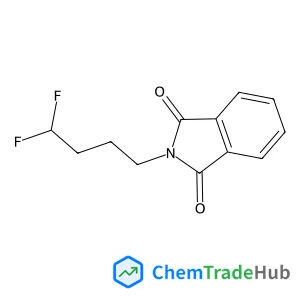
2-(4,4-Difluorobutyl)-1H-isoindole-1,3(2H)-dione
CAS Number:
1265341-14-7
Molecular Formula:
C12H11F2NO2
Recommended Suppliers





Disclaimer
This page provides academic journal information for reference and research purposes only. We are not affiliated with any journal publishers and do not handle publication submissions. For publication-related inquiries, please contact the respective journal publishers directly.
If you notice any inaccuracies in the information displayed, please contact us at support@chemtradehub.com. We will promptly review and address your concerns.