


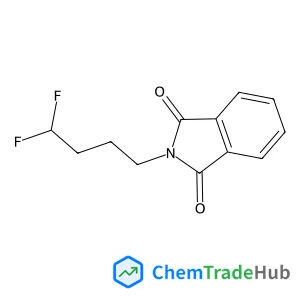
2-(4,4-Difluorobutyl)-1H-isoindole-1,3(2H)-dione
CAS Number:
1265341-14-7
Molecular Formula:
C12H11F2NO2
L. Shi, A. Xu, T. S. Zhao
Density functional theory calculations are made for bulk thermodynamic properties and surface energies of Li2O2, a primary discharge product, and Li3O4, a possible byproduct in the discharge products, of the non-aqueous lithium–oxygen batteries. Results show that the standard formation Gibbs free energy of bulk Li3O4 is marginally higher than that of Li2O2, but the surface energy of Li3O4 is much lower. Low surface energy results in both lowered nucleation energy and formation Gibbs free energy in the nanometer regime, allowing the Li3O4 nano particles to nucleate ahead of Li2O2 during the discharge process and to exist stably when particle sizes are smaller than about 40 nm. The scanning transmission electron microscopy (STEM) image of Li3O4 crystals is simulated and compared with the measured STEM image of the discharge product particles. The consistency between the simulated and measured STEM images suggests that the Li3O4 phase can exist stably as a discharge product. The energy profile of the oxygen evolution reaction (OER) occurring on the most abundant surfaces of Li3O4 is also calculated. The predicted overpotential for the OER on the {0001} surface (0.30 V) shows a good agreement with experimental data. The presence of more electronically conductive Li3O4 nano particles in the primary discharge product Li2O2 tends to decrease the charge overvoltage of the batteries, explaining why the lower voltage area (<3.5 V) was widely observed during the charging of the batteries. An increase in the oxygen pressure or a decrease in temperature enhances the stability of the Li3O4 phase and increase the proportion of the Li3O4 phase in the discharge products, consequently leading to a lower overall charge overvoltage.

New Journal of Chemistry

Organic Process Research & Development

Russian Journal of Applied Chemistry

Journal of Saudi Chemical Society

Crystallography Reports

Current Opinion in Colloid & Interface Science

Russian Journal of Bioorganic Chemistry

Drug Discovery Today

Acta Materialia

Journal of Natural Medicines
Yi-Shen Huang, Han-Yu Hsueh, Junko Aimi, Li-Chieh Chou, Yu-Chi Lu, Chung-Chi Wang, Kuo-Yu Chen, Chih-Feng Huang
DOI: 10.1039/D0PY00658K
Julien Cretenoud, Sandor Balog, Véronique Michaud, Jean-Marc Chenal, Olivier Lame, Christopher J. G. Plummer, Holger Frauenrath
DOI: 10.1039/D1PY01225H
Zhaofan Yang, Shijie Liang, Baiqiao Liu, Jing Wang, Fan Yang, Qiaomei Chen, Chengyi Xiao, Zheng Tang, Weiwei Li
DOI: 10.1039/D1PY01188J
Jiraya Kiriratnikom, Xin-Chen Yue, Jia-Liang Yang, Ying Wang, Shuo-Hong Chen, Ke-Ke Zhang, Cheng-Jian Zhang, Munir Ullah Khan
DOI: 10.1039/D1PY01013A
Hiroki Nishiyama, Feng Zheng, Shinsuke Inagi, Hiroyuki Fueno, Ikuyoshi Tomita
DOI: 10.1039/D0PY00724B
Katya Kapilov-Buchman, Tslil Bialystocki, Danna Niezni, Luba Perry, Shulamit Levenberg, Michael S. Silverstein
DOI: 10.1039/D1PY01106E
Kostas Parkatzidis, Manon Rolland, Nghia P. Truong, Athina Anastasaki
DOI: 10.1039/D1PY01044A
Oliver B. Penrhyn-Lowe, Sean Flynn, Savannah R. Cassin, Samuel Mckeating, Sarah Lomas, Stephen Wright, Pierre Chambon, Steve P. Rannard
DOI: 10.1039/D1PY01103K
Yahe Wu, Yan Ji
DOI: 10.1039/D0PY00075B
N-(4-Methoxybenzyl)-2-pyridinamine (CAS: 52818-63-0) is increasingly being used ...
When handling Ethyl 4-(2-chlorophenyl)-1,3-thiazole-2-carboxylate, appropriate p...
Diethyldiselane (CAS: 628-39-7) is classified under the Globally Harmonized Syst...
The market for oxocopper (CAS: 12053-18-8) is primarily driven by its use in cat...
The market for 5-{[(2-Methyl-2-propanyl)oxy]carbonyl}-5-azaspiro[2.4]heptane-7-c...
2-(1-Pyrrolidinyl)-4-pyridinamine is a chemical compound with the CAS number 359...
2-(3-Pyridinyl)-1-azabicyclo[2.2.2]octane (CAS: 91556-75-1) is a crystalline sol...
(S)-Alpha-allyl-proline hydrochloride is usually synthesized via a Wittig reacti...
3-Methyl-1,2-oxazole-5-carboxylic acid (CAS: 4857-42-5) is an organic compound w...
Lys-SMCC-DM1 is synthesized via a multi-step process involving the coupling of S...

Physical Chemistry Chemical Physics (PCCP) is an international journal co-owned by 19 physical chemistry and physics societies from around the world. This journal publishes original, cutting-edge research in physical chemistry, chemical physics and biophysical chemistry. To be suitable for publication in PCCP, articles must include significant innovation and/or insight into physical chemistry; this is the most important criterion that reviewers and Editors will judge against when evaluating submissions. The journal has a broad scope and welcomes contributions spanning experiment, theory, computation and data science. Topical coverage includes spectroscopy, dynamics, kinetics, statistical mechanics, thermodynamics, electrochemistry, catalysis, surface science, quantum mechanics, quantum computing and machine learning. Interdisciplinary research areas such as polymers and soft matter, materials, nanoscience, energy, surfaces/interfaces, and biophysical chemistry are welcomed if they demonstrate significant innovation and/or insight into physical chemistry. Joined experimental/theoretical studies are particularly appreciated when complementary and based on up-to-date approaches.
![(2R,6S)-6-[(Benzyloxy)methyl]-4-{[(2-methyl-2-propanyl)oxy]carbonyl}-2-morpholinecarboxylic acid structure](https://static.chemtradehub.com/structs/109/1093085-91-6-3382.webp "(2R,6S)-6-[(Benzyloxy)methyl]-4-{[(2-methyl-2-propanyl)oxy]carbonyl}-2-morpholinecarboxylic acid structure")


