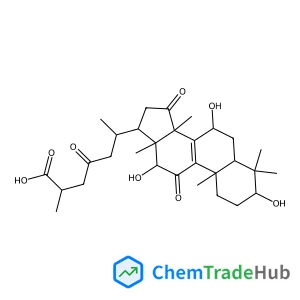
(3beta,7beta,12beta)-3,7,12-Trihydroxy-11,15,23-trioxolanost-8-en-26-oic acid
CAS Number:
98665-22-6
Molecular Formula:
C30H44O8
Sahn Nahm, Won Il Cho, Chongmok Lee
A ZnO–MnO composite was synthesized using a simple solvothermal method combined with a high-temperature treatment. To observe the phase change during the heating process, in situ high-temperature XRD analysis was performed under vacuum conditions. The results indicated that ZnMn2O4 transformed into the ZnO–MnO composite phase starting from 500 °C and that this composite structure was retained until 700 °C. The electrochemical performances of the ZnO–MnO composite electrode were evaluated through galvanostatic discharge–charge tests and cyclic voltammetry analysis. Its initial coulombic efficiency was significantly improved to 68.3% compared to that of ZnMn2O4 at 54.7%. Furthermore, the ZnO–MnO composite exhibited improved cycling performance and enhanced rate capability compared with untreated ZnMn2O4. To clarify the discharge–charge mechanism of the ZnO–MnO composite electrode, the structural changes during the charge and discharge processes were also investigated using ex situ XRD and TEM.
Ignacio Fdez. Galván, Daniel Roca-Sanjuán, Erick L. Bastos, Wilhelm J. Baader, Roland Lindh
DOI: 10.1039/C6CP08154A
Bason Clancy, Joshua Salafsky
DOI: 10.1039/C6CP07708K
Dharmendar Kumar Sharma, Shuzo Hirata, Lukasz Bujak, Vasudevanpillai Biju, Tatsuya Kameyama, Marino Kishi, Tsukasa Torimoto, Martin Vacha
DOI: 10.1039/C6CP07550A
Wook Lee, Spiridoula Matsika
DOI: 10.1039/C6CP05604K
Penghui Li, Fang Wang, Shiqian Wei, Xinyu Li
DOI: 10.1039/C6CP08409E
Sergio Giuffrida, Lorenzo Cordone
DOI: 10.1039/C6CP06848K
Arunkumar Kathiravan, Rajadurai Vijay Solomon
DOI: 10.1039/C6CP07768D
Z. J. Li, H. Y. Yu, G. Y. Song, J. Zhao, H. Zhang, M. Zhang, A. L. Meng, Q. D. Li
DOI: 10.1039/C6CP07457J
Hua-Bin Sun, Ying-Xian Zhou, Lu-Lu Zhang, Xue-Lin Yang, Xing-Zhong Cao, Hanu Arave, Hui Fang, Gan Liang
DOI: 10.1039/C6CP07760A
Stanley Udochukwu Ofoegbu, Tiago L. P. Galvão, José R. B. Gomes, João Tedim, Helena I. S. Nogueira, M. G. S. Ferreira
DOI: 10.1039/C7CP00241F
When handling 4-(2-Furylmethyl)thiomorpholine 1,1-dioxide (CAS: 79206-94-3), it ...
When handling 4-Chloro-N-[2-(4-morpholinyl)ethyl]benzamide (CAS: 71320-77-9), it...
Waste containing this compound (CAS: 62921-74-8) should be handled according to ...
Waste containing (S)-Methyl 2-amino-3-cyclohexylpropanoate should be collected i...
This compound can be synthesized using a multi-step process involving the conjug...
There are several alternatives to (2E)-3-(3,4-Dichlorophenyl)acrylic acid in syn...
Ethyl 6-(2-nitrophenyl)imidazo[2,1-b][1,3]thiazole-3-carboxylate (CAS: 925437-84...
Waste containing 2-(1,3-Thiazol-2-yl)ethanamine (CAS: 18453-07-1) should be coll...
Methyl 5-iodo-2-methylbenzoate can be synthesized through the iodination of meth...
5-Chloro[1,2,4]triazolo[1,5-a]pyridine is commonly synthesized via the condensat...

Physical Chemistry Chemical Physics (PCCP) is an international journal co-owned by 19 physical chemistry and physics societies from around the world. This journal publishes original, cutting-edge research in physical chemistry, chemical physics and biophysical chemistry. To be suitable for publication in PCCP, articles must include significant innovation and/or insight into physical chemistry; this is the most important criterion that reviewers and Editors will judge against when evaluating submissions. The journal has a broad scope and welcomes contributions spanning experiment, theory, computation and data science. Topical coverage includes spectroscopy, dynamics, kinetics, statistical mechanics, thermodynamics, electrochemistry, catalysis, surface science, quantum mechanics, quantum computing and machine learning. Interdisciplinary research areas such as polymers and soft matter, materials, nanoscience, energy, surfaces/interfaces, and biophysical chemistry are welcomed if they demonstrate significant innovation and/or insight into physical chemistry. Joined experimental/theoretical studies are particularly appreciated when complementary and based on up-to-date approaches.