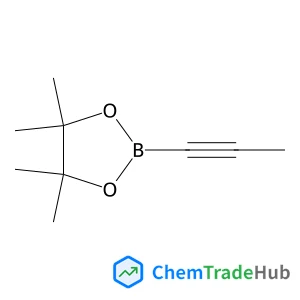
4,4,5,5-Tetramethyl-2-(1-propyn-1-YL)-1,3,2-dioxaborolane
CAS Number:
347389-75-7
Molecular Formula:
C9H15BO2
Jordy Bouwman, Andras Bodi, Patrick Hemberger
The reaction between the allyl radical (C3H5˙) and acetylene (C2H2) in a heated microtubular reactor has been studied at the VUV beamline of the Swiss Light Source. The reaction products are sampled from the reactor and identified by their photoion mass-selected threshold photoelectron spectra (ms-TPES) by means of imaging photoelectron photoion coincidence spectroscopy. Cyclopentadiene is identified as the sole reaction product by comparison of the measured photoelectron spectrum with that of cyclopentadiene. With the help of quantum-chemical computations of the C5H7 potential energy surface, the C2H2 + C3H5˙ association reaction is confirmed to be the rate determining step, after which H-elimination to form C5H6 is prompt in the absence of re-thermalization at low pressures. The formation of cyclopentadiene as the sole product from the allyl + acetylene reaction offers a direct path to the formation of cyclic hydrocarbons under combustion relevant conditions. Subsequent reactions of cyclopentadiene may lead to the formation of the smallest polycyclic aromatic molecule, naphthalene.

Nature Medicine

Journal of Peptide Science

Chemistry Education Research and Practice

Russian Chemical Bulletin

Organic Process Research & Development

Russian Journal of Applied Chemistry

Journal of Natural Medicines

Current Opinion in Colloid & Interface Science

Saudi Pharmaceutical Journal

Journal of Saudi Chemical Society
DOI: 10.1039/D0CP00241K
Amit Kumar, Pradeep Kumar
DOI: 10.1039/D0CP00027B
Skandar Taj, Diane Baird, Alexander Rosu-Finsen, Martin R. S. McCoustra
DOI: 10.1039/C9CP90226K
Emmanuelle M. M. Weber, Dennis Kurzbach, Daniel Abergel
DOI: 10.1039/C9CP03334C
Karl N. Blodgett, Dewei Sun, Joshua L. Fischer, Edwin L. Sibert, III, Timothy S. Zwier
DOI: 10.1039/C9CP04556B
Lucian Chan, Geoffrey R. Hutchison, Garrett M. Morris
DOI: 10.1039/C9CP06688H
Björn Drobot, Moritz Schmidt, Takaya Abe, Koji Okuwaki, Florian Brulfert, Sven Falke, Sergey A. Samsonov, Yuto Komeiji, Christian Betzel, Thorsten Stumpf, Johannes Raff
DOI: 10.1039/C9CP03750K
Xiaojun Lv, Chaohong Guan, Zexun Han, Chang Chen, Qidong Sun
DOI: 10.1039/C9CP03673C
Lisa Warczinski, Christof Hättig
DOI: 10.1039/C9CP04606B
Karima Bouras, Guy Schmerber, Damien Aureau, Hervé Rinnert, Jean-Luc Rehspringer, Dris Ihiawakrim, Aziz Dinia, Abdelilah Slaoui, Silviu Colis
DOI: 10.1039/C9CP01993F
6-(3-Fluorophenyl)picolinic acid is generally considered safe for laboratory use...
(3R)-3-Pyrrolidinol is used in the pharmaceutical industry as a precursor for dr...
When handling (4R,5R)-4,5-Diethoxycarbonyl-2,2-dimethyldioxolane (CAS: 59779-75-...
1-(6-Chloroimidazo[1,2-b]pyridazin-3-yl)ethanone is often synthesized via a mult...
The market for N-Ethyl-3,4-dimethylbenzylamine (CAS: 39180-83-1) remains steady,...
Tert-butyl 3-(pyrrolidin-1-yl)azetidine-1-carboxylate is a chemical compound wit...
1-Bromo-3-chloro-2,4-dimethoxybenzene (CAS: 1228956-93-1) falls under the classi...
The safety of 8-Bromo-2-methyl-3,4-dihydroisoquinolin-1(2H)-one (CAS: 1368622-07...
Benzyl [(3S)-2,6-dioxo-3-piperidinyl]carbamate is generally safe when handled wi...
1-{[4-(4,4,5,5-Tetramethyl-1,3,2-dioxaborolan-2-yl)phenyl]sulfonyl}pyrrolidine s...

Physical Chemistry Chemical Physics (PCCP) is an international journal co-owned by 19 physical chemistry and physics societies from around the world. This journal publishes original, cutting-edge research in physical chemistry, chemical physics and biophysical chemistry. To be suitable for publication in PCCP, articles must include significant innovation and/or insight into physical chemistry; this is the most important criterion that reviewers and Editors will judge against when evaluating submissions. The journal has a broad scope and welcomes contributions spanning experiment, theory, computation and data science. Topical coverage includes spectroscopy, dynamics, kinetics, statistical mechanics, thermodynamics, electrochemistry, catalysis, surface science, quantum mechanics, quantum computing and machine learning. Interdisciplinary research areas such as polymers and soft matter, materials, nanoscience, energy, surfaces/interfaces, and biophysical chemistry are welcomed if they demonstrate significant innovation and/or insight into physical chemistry. Joined experimental/theoretical studies are particularly appreciated when complementary and based on up-to-date approaches.
![5-Bromo-3-isopropyl-1H-pyrrolo[2,3-b]pyridine structure](https://static.chemtradehub.com/structs/125/1256819-54-1-8620.webp "5-Bromo-3-isopropyl-1H-pyrrolo[2,3-b]pyridine structure")