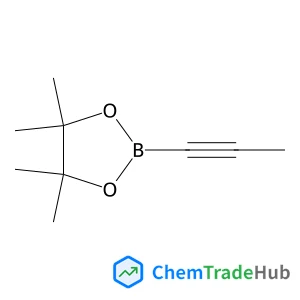
4,4,5,5-Tetramethyl-2-(1-propyn-1-YL)-1,3,2-dioxaborolane
CAS Number:
347389-75-7
Molecular Formula:
C9H15BO2
Sergio Romero-Romero, Miguel Costas, Adela Rodríguez-Romero, D. Alejandro Fernández-Velasco
Temperature is one of the main variables that modulate protein function and stability. Thermodynamic studies of oligomeric proteins, the dominant protein natural form, have been often hampered because irreversible aggregation and/or slow reactions are common. There are no reports on the reversible equilibrium thermal unfolding of proteins composed of (β/α)8 barrel subunits, albeit this “TIM barrel” topology is one of the most abundant and versatile in nature. We studied the eponymous TIM barrel, triosephosphate isomerase (TIM), belonging to five species of different bacterial taxa. All of them were found to be catalytically efficient dimers. The three-dimensional structure of four enzymes was solved at high/medium resolution. Irreversibility and kinetic control were observed in the thermal unfolding of two TIMs, while for the other three the thermal unfolding was found to follow a two-state equilibrium reversible process. Shifts in the global stability curves of these three proteins are related to the organismal temperature range of optimal growth and modulated by variations in maximum stability temperature and in the enthalpy change at that temperature. Reversibility appears to correlate with the low isoelectric point, the absence of a residual structure in the unfolded state, small cavity volume in the native state, low conformational stability and a low melting temperature. Furthermore, the strong coupling between dimer dissociation and monomer unfolding may reduce aggregation and favour reversibility. It is therefore very thought-provoking to find that a common topological ensemble, such as the TIM barrel, can unfold/refold in the Anfinsen way, i.e. without the help of the cellular machinery.

Russian Journal of Applied Chemistry

Journal of Natural Medicines

Chemistry Education Research and Practice

Organic Process Research & Development

Russian Journal of Coordination Chemistry

Crystallography Reports

Drug Discovery Today

Russian Chemical Bulletin

Chemical Communications

Current Opinion in Solid State & Materials Science
P. S. Miedema, I. Alonso Calafell, C. Schüßler-Langeheine, M. Beye
DOI: 10.1039/C9CP03593A
Zhihui Zhang, Zifeng Xie, Jian Liu, Ye Tian, Yan Zhang, Xing Wei, Tingting Guo, Lei Ni, Jibin Fan, Yijun Weng, Zhengdi Zha, Li Duan
DOI: 10.1039/C9CP06696A
Dhananjay Bhattacharyya
DOI: 10.1039/C9CP03253C
Andrea Gardin, Alberta Ferrarini
DOI: 10.1039/D0CP90053B
Ming-Hsiu Wu, Wan-Jou Chou, Jian-Syun Huang, Darwin Barayang Putungan, Shi-Hsin Lin
DOI: 10.1039/C9CP03893K
Shijie Zhou, Lei Tong, Yinjie Liao, Juxia Yi, Yao Qi
DOI: 10.1039/C9CP02703C
Adriana Alieva, Cinzia Casiraghi
DOI: 10.1039/D0CP00592D
Misong Ju, Ouk Hyun Cho, Jaehun Lee, Mani Balamurugan, Ki Tae Nam
DOI: 10.1039/C9CP05581A
P. S. Rukin, K. G. Komarova, B. Fresch, E. Collini, F. Remacle
DOI: 10.1039/D0CP00223B
Wenyi Shao, Yang Li, Xiang Wang, Xiao Ouyang, Jiafa Cai, Chen Li, Zhengyun Wu, Qiang Xu
DOI: 10.1039/C9CP06259A
6-(3-Fluorophenyl)picolinic acid is generally considered safe for laboratory use...
(3R)-3-Pyrrolidinol is used in the pharmaceutical industry as a precursor for dr...
When handling (4R,5R)-4,5-Diethoxycarbonyl-2,2-dimethyldioxolane (CAS: 59779-75-...
1-(6-Chloroimidazo[1,2-b]pyridazin-3-yl)ethanone is often synthesized via a mult...
The market for N-Ethyl-3,4-dimethylbenzylamine (CAS: 39180-83-1) remains steady,...
Tert-butyl 3-(pyrrolidin-1-yl)azetidine-1-carboxylate is a chemical compound wit...
1-Bromo-3-chloro-2,4-dimethoxybenzene (CAS: 1228956-93-1) falls under the classi...
The safety of 8-Bromo-2-methyl-3,4-dihydroisoquinolin-1(2H)-one (CAS: 1368622-07...
Benzyl [(3S)-2,6-dioxo-3-piperidinyl]carbamate is generally safe when handled wi...
1-{[4-(4,4,5,5-Tetramethyl-1,3,2-dioxaborolan-2-yl)phenyl]sulfonyl}pyrrolidine s...

Physical Chemistry Chemical Physics (PCCP) is an international journal co-owned by 19 physical chemistry and physics societies from around the world. This journal publishes original, cutting-edge research in physical chemistry, chemical physics and biophysical chemistry. To be suitable for publication in PCCP, articles must include significant innovation and/or insight into physical chemistry; this is the most important criterion that reviewers and Editors will judge against when evaluating submissions. The journal has a broad scope and welcomes contributions spanning experiment, theory, computation and data science. Topical coverage includes spectroscopy, dynamics, kinetics, statistical mechanics, thermodynamics, electrochemistry, catalysis, surface science, quantum mechanics, quantum computing and machine learning. Interdisciplinary research areas such as polymers and soft matter, materials, nanoscience, energy, surfaces/interfaces, and biophysical chemistry are welcomed if they demonstrate significant innovation and/or insight into physical chemistry. Joined experimental/theoretical studies are particularly appreciated when complementary and based on up-to-date approaches.