


Gradient heterostructure perovskite single crystals enable the improvement of radiative recombination for scintillator application
Literature Information
Publication Date
2020-02-25
DOI
10.1039/C9CP06259A
Impact Factor
3.676
Authors
Wenyi Shao, Yang Li, Xiang Wang, Xiao Ouyang, Jiafa Cai, Chen Li, Zhengyun Wu, Qiang Xu
View Original
Abstract
Recently, organic–inorganic hybrid perovskites (OIHPs) are rising as promising candidates for light-emitting applications, due to their superior optical properties. High performance light-emitting applications such as scintillators require minimum non-radiative recombination and high fractions of radiative recombination. Here, we report a simple solution-processing strategy for the synthesis of funnel-type CH3NH3(MA)PbCl3/CH3NH3(MA)PbBrxCl3−x heterostructure perovskite materials that improve the light emission performances. The single crystal X-ray diffraction pattern indicates that the lattice mismatch is only ∼3.24% in the heterointerface. The halide gradient is helpful for driving the photoexcited carriers from the internal high bandgap material to the low bandgap light-emitter layer. The steady-state photoluminescence (PL) and radioluminescence (RL) spectra show that the luminescence intensity has been significantly improved by this heterostructure perovskite. Time-resolved photoluminescence (TRPL) exhibits carrier transport along the halide gradient. Our research suggests that the gradient halide perovskite heterostructure with specific optical properties could be a prospect for commercial scintillator applications.
Recommended Journals

Acta Materialia

Russian Journal of Organic Chemistry

Current Opinion in Solid State & Materials Science

Current Opinion in Colloid & Interface Science

Chemical Communications

Journal of Peptide Science

Chemistry Education Research and Practice

Organic Process Research & Development

Russian Journal of Bioorganic Chemistry

Russian Journal of Coordination Chemistry
Related Literature
Characterizing the nanoclay induced constrained amorphous region in model segmented polyurethane–urea/clay nanocomposites and its implications on gas barrier properties
Sangram K. Rath, Kathi Sudarshan, Rupesh S. Bhavsar, Ulhas K. Kharul, Pradeep K. Pujari, Manoranjan Patri, Devang V. Khakhar
2015-11-17
Paper
DOI: 10.1039/C5CP05260B
Fabrication of superhydrophilic–underwater superoleophobic inorganic anti-corrosive membranes for high-efficiency oil/water separation
Luyan Liu, Chen Chen, Siyu Yang, Hua Xie, MaoGang Gong, Xiaoliang Xu
2015-11-24
Paper
DOI: 10.1039/C5CP06305A
Growth mechanisms of Pd nanofilms electrodeposited onto Au(111): an in situ grazing incidence X-ray diffraction study
Maurizio De Santis
2015-12-07
Paper
DOI: 10.1039/C5CP05985B
Light harvesting in photonic crystals revisited: why do slow photons at the blue edge enhance absorption?
O. Deparis, S. R. Mouchet, B.-L. Su
2015-10-26
Paper
DOI: 10.1039/C5CP04983K
Measurement and modelling of reactive transport in geological barriers for nuclear waste containment
Qingrong Xiong, Claudia Joseph, Katja Schmeide, Andrey P. Jivkov
2015-10-26
Paper
DOI: 10.1039/C5CP05243B
Anomalous partitioning of water in coexisting liquid phases of lipid multilayers near 100% relative humidity
Yicong Ma, Sajal K. Ghosh, Sambhunath Bera, Zhang Jiang, Christian M. Schlepütz, Evguenia Karapetrova, Laurence B. Lurio, Sunil K. Sinha
2015-11-30
Paper
DOI: 10.1039/C5CP04703J
The general base in the thymidylate synthase catalyzed proton abstraction
Ananda K. Ghosh, Zahidul Islam, Jonathan Krueger, Thelma Abeysinghe, Amnon Kohen
2015-04-15
Paper
DOI: 10.1039/C5CP01246E
Spontaneous transition of a water droplet from the Wenzel state to the Cassie state: a molecular dynamics simulation study
Jiadao Wang, Shuai Chen, Darong Chen
2015-10-22
Paper
DOI: 10.1039/C5CP05045F
You might also like
Compound Q&A
Is 6-(3-Fluorophenyl)picolinic acid (CAS: 887982-40-3) safe?
6-(3-Fluorophenyl)picolinic acid is generally considered safe for laboratory use...
887982-40-36-(3-Fluorophenyl)pi...
Compound Q&A
What industries use (3R)-3-Pyrrolidinol (CAS: 2799-21-5)?
(3R)-3-Pyrrolidinol is used in the pharmaceutical industry as a precursor for dr...
2799-21-5(3R)-3-Pyrrolidinol
Compound Q&A
What precautions should be taken when handling (4R,5R)-4,5-Diethoxycarbonyl-2,2-dimethyldioxolane (CAS: 59779-75-8)?
When handling (4R,5R)-4,5-Diethoxycarbonyl-2,2-dimethyldioxolane (CAS: 59779-75-...
59779-75-8(4R,5R)-4,5-Diethoxy...
Compound Q&A
How is 1-(6-Chloroimidazo[1,2-b]pyridazin-3-yl)ethanone (CAS: 90734-71-7) typically synthesized?
1-(6-Chloroimidazo[1,2-b]pyridazin-3-yl)ethanone is often synthesized via a mult...
90734-71-71-(6-Chloroimidazo[1...
Compound Q&A
What is the market or research trend for N-Ethyl-3,4-dimethylbenzylamine (CAS: 39180-83-1)?
The market for N-Ethyl-3,4-dimethylbenzylamine (CAS: 39180-83-1) remains steady,...
39180-83-1N-Ethyl-3,4-dimethyl...
Compound Q&A
What is Tert-butyl 3-(pyrrolidin-1-yl)azetidine-1-carboxylate (CAS: 1019008-21-9)?
Tert-butyl 3-(pyrrolidin-1-yl)azetidine-1-carboxylate is a chemical compound wit...
1019008-21-9Tert-butyl 3-(pyrrol...
Compound Q&A
What regulatory guidelines apply to 1-Bromo-3-chloro-2,4-dimethoxybenzene (CAS: 1228956-93-1)?
1-Bromo-3-chloro-2,4-dimethoxybenzene (CAS: 1228956-93-1) falls under the classi...
1228956-93-11-Bromo-3-chloro-2,4...
Compound Q&A
Is 8-Bromo-2-methyl-3,4-dihydroisoquinolin-1(2H)-one (CAS: 1368622-07-4) safe?
The safety of 8-Bromo-2-methyl-3,4-dihydroisoquinolin-1(2H)-one (CAS: 1368622-07...
1368622-07-48-Bromo-2-methyl-3,4...
Compound Q&A
Is Benzyl [(3S)-2,6-dioxo-3-piperidinyl]carbamate (CAS: 22785-43-9) safe?
Benzyl [(3S)-2,6-dioxo-3-piperidinyl]carbamate is generally safe when handled wi...
22785-43-9Benzyl [(3S)-2,6-dio...
Compound Q&A
How should 1-{[4-(4,4,5,5-Tetramethyl-1,3,2-dioxaborolan-2-yl)phenyl]sulfonyl}pyrrolidine (CAS: 928657-21-0) be stored?
1-{[4-(4,4,5,5-Tetramethyl-1,3,2-dioxaborolan-2-yl)phenyl]sulfonyl}pyrrolidine s...
928657-21-01-{[4-(4,4,5,5-Tetra...
Source Journal
Physical Chemistry Chemical Physics

CiteScore:
5.5
Self-citation Rate:
10.3%
Articles per Year:
3036
Physical Chemistry Chemical Physics (PCCP) is an international journal co-owned by 19 physical chemistry and physics societies from around the world. This journal publishes original, cutting-edge research in physical chemistry, chemical physics and biophysical chemistry. To be suitable for publication in PCCP, articles must include significant innovation and/or insight into physical chemistry; this is the most important criterion that reviewers and Editors will judge against when evaluating submissions. The journal has a broad scope and welcomes contributions spanning experiment, theory, computation and data science. Topical coverage includes spectroscopy, dynamics, kinetics, statistical mechanics, thermodynamics, electrochemistry, catalysis, surface science, quantum mechanics, quantum computing and machine learning. Interdisciplinary research areas such as polymers and soft matter, materials, nanoscience, energy, surfaces/interfaces, and biophysical chemistry are welcomed if they demonstrate significant innovation and/or insight into physical chemistry. Joined experimental/theoretical studies are particularly appreciated when complementary and based on up-to-date approaches.
Recommended Compounds
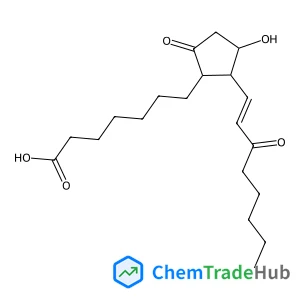
(11alpha,13E)-11-Hydroxy-9,15-dioxoprost-13-en-1-oic acid
CAS Number:
22973-19-9
Molecular Formula:
C20H32O5
Recommended Suppliers






Disclaimer
This page provides academic journal information for reference and research purposes only. We are not affiliated with any journal publishers and do not handle publication submissions. For publication-related inquiries, please contact the respective journal publishers directly.
If you notice any inaccuracies in the information displayed, please contact us at support@chemtradehub.com. We will promptly review and address your concerns.