


Intercalation, decomposition, entrapment – a new route to graphene nanobubbles
Literature Information
Publication Date
2020-03-17
DOI
10.1039/D0CP00592D
Impact Factor
3.676
Authors
Adriana Alieva, Cinzia Casiraghi
View Original
Abstract
Graphene nanobubbles (GNBs) have become the subject of recent research due to their novel physical properties. However, present methods to create them involve either extreme conditions or complex sample fabrication. We present a novel approach which relies on the intercalation of small molecules (NH3), their surface-mediated decomposition and the formation of larger molecules (N2) which are then entrapped beneath the graphene in bubbles. Our hypothesised reaction mechanism requires the copper substrate, on which our graphene is grown via chemical vapour deposition (CVD), to be oxidised before the reaction can occur. This was confirmed through X-ray photoelectron spectroscopy (XPS) data of both oxidised and reduced Cu substrate samples. The GNBs have been analysed through atomic force microscopy (AFM, after NH3 treatment) and XPS, which reveals the formation of five distinct N 1s peaks, attributed to N2 entrapment, N doping species and atomic nitrogen bonded with the Cu within the substrate. This method is simple, occurs at low temperatures (520 K) and integrates very easily with conventional CVD graphene growth, so presents an opportunity to open up this field of research further.
Recommended Journals

Journal of Peptide Science

Current Opinion in Solid State & Materials Science

Current Opinion in Colloid & Interface Science

Organic Process Research & Development

Acta Materialia

Russian Journal of Organic Chemistry

Russian Chemical Bulletin

Drug Discovery Today

Russian Journal of Applied Chemistry

Russian Journal of Bioorganic Chemistry
Related Literature
The pH dependence of OH radical formation in photo-electrochemical water oxidation with rutile TiO2 single crystals
Yukihiro Nakabayashi, Yoshio Nosaka
2015-10-23
Paper
DOI: 10.1039/C5CP04531B
How exciton-vibrational coherences control charge separation in the photosystem II reaction center
Vladimir I. Novoderezhkin, Elisabet Romero, Rienk van Grondelle
2015-03-31
Paper
DOI: 10.1039/C5CP00582E
The general base in the thymidylate synthase catalyzed proton abstraction
Ananda K. Ghosh, Zahidul Islam, Jonathan Krueger, Thelma Abeysinghe, Amnon Kohen
2015-04-15
Paper
DOI: 10.1039/C5CP01246E
S-doped mesoporous nanocomposite of HTiNbO5 nanosheets and TiO2 nanoparticles with enhanced visible light photocatalytic activity
Ruirui Han, Hongmei Ji, Tao Sun, Jin Zhao, Ningna Chen, Jing Chen, Xuefeng Guo, Wenhua Hou, Weiping Ding
2015-11-23
Paper
DOI: 10.1039/C5CP06555K
Enhancement of near-infrared luminescence of ytterbium in triple-stranded binuclear helicates
Bing Li, Hongfeng Li, Peng Chen, Wenbin Sun, Cheng Wang, Ting Gao, Pengfei Yan
2015-10-21
Paper
DOI: 10.1039/C5CP05888K
Pressure-dependent formation of i-motif and G-quadruplex DNA structures
S. Takahashi
2015-09-03
Paper
DOI: 10.1039/C5CP04727G
Alkali subhalides: high-pressure stability and interplay between metallic and ionic bonds
G. Saleh
2015-12-02
Paper
DOI: 10.1039/C5CP06026E
Chemical and photochemical properties of chloroharmine derivatives in aqueous solutions
Federico A. O. Rasse-Suriani, M. Paula Denofrio, Juan G. Yañuk, M. Micaela Gonzalez, Ezequiel Wolcan, Marco Seifermann, Rosa Erra-Balsells, Franco M. Cabrerizo
2015-11-23
Paper
DOI: 10.1039/C5CP05866J
Effect of hydration on the organo-noble gas molecule HKrCCH: role of krypton in the stabilization of hydrated HKrCCH complexes
Biswajit Biswas, Prashant Chandra Singh
2015-10-20
Paper
DOI: 10.1039/C5CP04744G
Reactive symbol sequences for a model of hydrogen combustion
Mohammad Alaghemandi
2015-11-26
Paper
DOI: 10.1039/C5CP05125H
You might also like
Compound Q&A
Is 6-(3-Fluorophenyl)picolinic acid (CAS: 887982-40-3) safe?
6-(3-Fluorophenyl)picolinic acid is generally considered safe for laboratory use...
887982-40-36-(3-Fluorophenyl)pi...
Compound Q&A
What industries use (3R)-3-Pyrrolidinol (CAS: 2799-21-5)?
(3R)-3-Pyrrolidinol is used in the pharmaceutical industry as a precursor for dr...
2799-21-5(3R)-3-Pyrrolidinol
Compound Q&A
What precautions should be taken when handling (4R,5R)-4,5-Diethoxycarbonyl-2,2-dimethyldioxolane (CAS: 59779-75-8)?
When handling (4R,5R)-4,5-Diethoxycarbonyl-2,2-dimethyldioxolane (CAS: 59779-75-...
59779-75-8(4R,5R)-4,5-Diethoxy...
Compound Q&A
How is 1-(6-Chloroimidazo[1,2-b]pyridazin-3-yl)ethanone (CAS: 90734-71-7) typically synthesized?
1-(6-Chloroimidazo[1,2-b]pyridazin-3-yl)ethanone is often synthesized via a mult...
90734-71-71-(6-Chloroimidazo[1...
Compound Q&A
What is the market or research trend for N-Ethyl-3,4-dimethylbenzylamine (CAS: 39180-83-1)?
The market for N-Ethyl-3,4-dimethylbenzylamine (CAS: 39180-83-1) remains steady,...
39180-83-1N-Ethyl-3,4-dimethyl...
Compound Q&A
What is Tert-butyl 3-(pyrrolidin-1-yl)azetidine-1-carboxylate (CAS: 1019008-21-9)?
Tert-butyl 3-(pyrrolidin-1-yl)azetidine-1-carboxylate is a chemical compound wit...
1019008-21-9Tert-butyl 3-(pyrrol...
Compound Q&A
What regulatory guidelines apply to 1-Bromo-3-chloro-2,4-dimethoxybenzene (CAS: 1228956-93-1)?
1-Bromo-3-chloro-2,4-dimethoxybenzene (CAS: 1228956-93-1) falls under the classi...
1228956-93-11-Bromo-3-chloro-2,4...
Compound Q&A
Is 8-Bromo-2-methyl-3,4-dihydroisoquinolin-1(2H)-one (CAS: 1368622-07-4) safe?
The safety of 8-Bromo-2-methyl-3,4-dihydroisoquinolin-1(2H)-one (CAS: 1368622-07...
1368622-07-48-Bromo-2-methyl-3,4...
Compound Q&A
Is Benzyl [(3S)-2,6-dioxo-3-piperidinyl]carbamate (CAS: 22785-43-9) safe?
Benzyl [(3S)-2,6-dioxo-3-piperidinyl]carbamate is generally safe when handled wi...
22785-43-9Benzyl [(3S)-2,6-dio...
Compound Q&A
How should 1-{[4-(4,4,5,5-Tetramethyl-1,3,2-dioxaborolan-2-yl)phenyl]sulfonyl}pyrrolidine (CAS: 928657-21-0) be stored?
1-{[4-(4,4,5,5-Tetramethyl-1,3,2-dioxaborolan-2-yl)phenyl]sulfonyl}pyrrolidine s...
928657-21-01-{[4-(4,4,5,5-Tetra...
Source Journal
Physical Chemistry Chemical Physics

CiteScore:
5.5
Self-citation Rate:
10.3%
Articles per Year:
3036
Physical Chemistry Chemical Physics (PCCP) is an international journal co-owned by 19 physical chemistry and physics societies from around the world. This journal publishes original, cutting-edge research in physical chemistry, chemical physics and biophysical chemistry. To be suitable for publication in PCCP, articles must include significant innovation and/or insight into physical chemistry; this is the most important criterion that reviewers and Editors will judge against when evaluating submissions. The journal has a broad scope and welcomes contributions spanning experiment, theory, computation and data science. Topical coverage includes spectroscopy, dynamics, kinetics, statistical mechanics, thermodynamics, electrochemistry, catalysis, surface science, quantum mechanics, quantum computing and machine learning. Interdisciplinary research areas such as polymers and soft matter, materials, nanoscience, energy, surfaces/interfaces, and biophysical chemistry are welcomed if they demonstrate significant innovation and/or insight into physical chemistry. Joined experimental/theoretical studies are particularly appreciated when complementary and based on up-to-date approaches.
Recommended Compounds
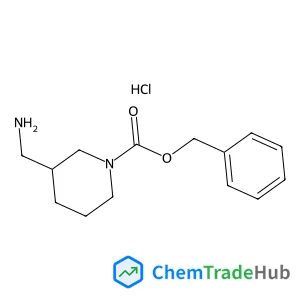
Benzyl 3-(aminomethyl)piperidine-1-carboxylate hydrochloride
CAS Number:
1186663-23-9
Molecular Formula:
C14H21ClN2O2
![(2E)-4-[(1R,2S,8R,19S,21R)-14-Hydroxy-11-isopropenyl-8,23,23-trimethyl-5-(3-methyl-2-buten-1-yl)-16,20-dioxo-3,7,22-trioxaheptacyclo[17.4.1.1~8,12~.0~2,17~.0~2,21~.0~4,15~.0~6,13~]pentacosa-4(15),5,13
,17-tetraen-21-yl]-2-methyl-2-butenoic acid structure](https://static.chemtradehub.com/structs/173/173867-04-4-d2d3.webp "(2E)-4-[(1R,2S,8R,19S,21R)-14-Hydroxy-11-isopropenyl-8,23,23-trimethyl-5-(3-methyl-2-buten-1-yl)-16,20-dioxo-3,7,22-trioxaheptacyclo[17.4.1.1~8,12~.0~2,17~.0~2,21~.0~4,15~.0~6,13~]pentacosa-4(15),5,13
,17-tetraen-21-yl]-2-methyl-2-butenoic acid structure")
![4-[(2,4-Dihydroxyphenyl)diazenyl]-5-hydroxy-2,7-naphthalenedisulfonic acid structure](https://static.chemtradehub.com/structs/362/3627-01-8-79ac.webp "4-[(2,4-Dihydroxyphenyl)diazenyl]-5-hydroxy-2,7-naphthalenedisulfonic acid structure")
4-[(2,4-Dihydroxyphenyl)diazenyl]-5-hydroxy-2,7-naphthalenedisulfonic acid
CAS Number:
3627-01-8
Molecular Formula:
C16H12N2O9S2
Recommended Suppliers





Disclaimer
This page provides academic journal information for reference and research purposes only. We are not affiliated with any journal publishers and do not handle publication submissions. For publication-related inquiries, please contact the respective journal publishers directly.
If you notice any inaccuracies in the information displayed, please contact us at support@chemtradehub.com. We will promptly review and address your concerns.