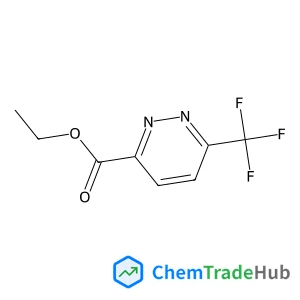
Ethyl 6-(trifluoromethyl)pyridazine-3-carboxylate
CAS Number:
1192155-06-8
Molecular Formula:
C8H7F3N2O2
A. de la Lande, C. Meier
The quantum dynamics of electron transfer in mixed-valence organic compounds is investigated using a reaction path model calibrated by constrained density functional theory (cDFT). Constrained DFT is used to define diabatic states relevant for describing the electron transfer, to obtain equilibrium structures for each of these states and to estimate the electronic coupling between them. The harmonic analysis at the diabatic minima yields normal modes forming the dissipative bath coupled to the electronic states. In order to decrease the system-bath coupling, an effective one dimensional vibronic Hamiltonian is constructed by partitioning the modes into a linear reaction path which connects both equilibrium positions and a set of secondary vibrational modes, coupled to this reaction coordinate. Using this vibronic model Hamiltonian, dissipative quantum dynamics is carried out using Redfield theory, based on a spectral density which is determined from the cDFT results. In a first benchmark case, the model is applied to a series of mixed-valence organic compounds formed by two 1,4-dimethoxy-3-methylphenylene fragments linked by an increasing number of phenylene bridges. This allows us to examine the coherent electron transfer in extreme situations leading to a ground adiabatic state with or without a barrier and therefore to the trapping of the charge or to an easy delocalization.
Hideto Miyabe, Kayoko Fujii, Takeaki Naito
DOI: 10.1039/B208823A
Tao Li, Yu Chen, Chunbao Li
DOI: 10.1039/C8OB01505H
Javiera I. Morales, Roberto Figueroa, Mabel Rojas, Daniela Millán, Ricardo A. Tapia, Paulina Pavez
DOI: 10.1039/C8OB01928B
Ming Yang, Xue-Cen Xu, Yue Gong, Yu-Long Zhao
DOI: 10.1039/D1QO01506K
Saumitra Sengupta, Goverdhan Mehta
DOI: 10.1039/C8OB01388H
Jason P. Holland, Harald Scherer, Stephan Maus, Tobias Stemler, Hendrik Bohnenberger, Samer Ezziddin, Philipp Kurz
DOI: 10.1039/C8OB01981A
Cong Lin, Sai Chen, Yihua Wang, Fei Gao, Liang Shen
DOI: 10.1039/D1QO01579F
Ben Bradshaw, David Collison, C. David Garner, John A. Joule
DOI: 10.1039/B209217D
Bernd Neumann, Hendrik Zipse
DOI: 10.1039/B209981K
6-(3-Fluorophenyl)picolinic acid is generally considered safe for laboratory use...
(3R)-3-Pyrrolidinol is used in the pharmaceutical industry as a precursor for dr...
When handling (4R,5R)-4,5-Diethoxycarbonyl-2,2-dimethyldioxolane (CAS: 59779-75-...
1-(6-Chloroimidazo[1,2-b]pyridazin-3-yl)ethanone is often synthesized via a mult...
The market for N-Ethyl-3,4-dimethylbenzylamine (CAS: 39180-83-1) remains steady,...
Tert-butyl 3-(pyrrolidin-1-yl)azetidine-1-carboxylate is a chemical compound wit...
1-Bromo-3-chloro-2,4-dimethoxybenzene (CAS: 1228956-93-1) falls under the classi...
The safety of 8-Bromo-2-methyl-3,4-dihydroisoquinolin-1(2H)-one (CAS: 1368622-07...
Benzyl [(3S)-2,6-dioxo-3-piperidinyl]carbamate is generally safe when handled wi...
1-{[4-(4,4,5,5-Tetramethyl-1,3,2-dioxaborolan-2-yl)phenyl]sulfonyl}pyrrolidine s...

Physical Chemistry Chemical Physics (PCCP) is an international journal co-owned by 19 physical chemistry and physics societies from around the world. This journal publishes original, cutting-edge research in physical chemistry, chemical physics and biophysical chemistry. To be suitable for publication in PCCP, articles must include significant innovation and/or insight into physical chemistry; this is the most important criterion that reviewers and Editors will judge against when evaluating submissions. The journal has a broad scope and welcomes contributions spanning experiment, theory, computation and data science. Topical coverage includes spectroscopy, dynamics, kinetics, statistical mechanics, thermodynamics, electrochemistry, catalysis, surface science, quantum mechanics, quantum computing and machine learning. Interdisciplinary research areas such as polymers and soft matter, materials, nanoscience, energy, surfaces/interfaces, and biophysical chemistry are welcomed if they demonstrate significant innovation and/or insight into physical chemistry. Joined experimental/theoretical studies are particularly appreciated when complementary and based on up-to-date approaches.