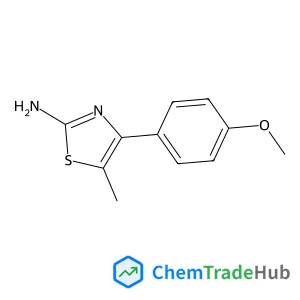
4-(4-Methoxyphenyl)-5-methyl-1,3-thiazol-2-amine
CAS Number:
105512-88-7
Molecular Formula:
C11H12N2OS
Liangrong Yang, Xiangfeng Liang
Rapid and sensitive detection of thrombin has very important significance in clinical diagnosis. In this work, bare magnetic iron oxide nanoparticles (magnetic nanoparticles) without any modification were used as fluorescence quenchers. In the absence of thrombin, a fluorescent dye (CY3) labeled thrombin aptamer (named CY3-aptamer) was adsorbed on the surface of magnetic nanoparticles through interaction between a phosphate backbone of the CY3-aptamer and hydroxyl groups on the bare magnetic nanoparticles in binding solution, leading to fluorescence quenching. Once thrombin was introduced, the CY3-aptamer formed a G-quartet structure and combined with thrombin, which resulted in the CY3-aptamer being separated from the magnetic nanoparticles and restoration of fluorescence. This proposed assay took advantage of binding affinity between the CY3-aptamer and thrombin for specificity, and bare magnetic nanoparticles for fluorescence quenching. The fluorescence signal had a good linear relationship with thrombin concentration in the range of 1–60 nM, and the limit of detection for thrombin was estimated as low as 0.5 nM. Furthermore, this method could be applied for other target detection using the corresponding fluorescence labeled aptamer.

Journal of Enzyme inhibition and Medicinal Chemistry

Photochemical & Photobiological Sciences

Lab on a Chip

Green Chemistry

European Journal of Organic Chemistry

Mini-Reviews in Medicinal Chemistry

Coloration Technology

Angewandte Chemie International Edition

Current Pharmaceutical Biotechnology

Journal of Medical Biochemistry
Panayiotis Bilalis, Leto-A. Tziveleka, Spyridon Varlas, Hermis Iatrou
DOI: 10.1039/C5PY01841B
Sven Kurch, Holger Frey, Katharina Landfester, Frederik R. Wurm
DOI: 10.1039/C5PY01418B
Xiaoyong Zhang, Bin Yang, Yaling Zhang, Ke Wang, Jinying Yuan, Lei Tao, Yen Wei
DOI: 10.1039/C4PY01769B
William Guerin, Marion Helou, Martine Slawinski, Jean-Michel Brusson, Jean-François Carpentier, Sophie M. Guillaume
DOI: 10.1039/C4PY01660B
Yongjun Men, Jiayin Yuan
DOI: 10.1039/C4PY01665C
Jianbing Huang, Hui Liang, Du Cheng, Jiang Lu
DOI: 10.1039/C5PY01656H
Qun Ye, Tingting Lin, Jing Song, Hong Yan, Hui Zhou, Kwok Wei Shah
DOI: 10.1039/C4PY01608D
2-(2-Chloroacetamido)-3-phenylpropanoic acid (CAS: 7765-11-9) is generally consi...
2-(Benzyloxy)-5-bromobenzoic acid can be handled safely if appropriate precautio...
(4-Methyl-1,2,5-oxadiazol-3-yl)methanamine hydrochloride is a chemical compound ...
2-(5-Hexylthiophen-2-yl)-4,4,5,5-tetramethyl-1,3,2-dioxaborolane (CAS: 917985-54...
While 4-(8-Methyl-9H-1,3-dioxolo[4,5-h][2,3]benzodiazepin-5-yl)benzenamine (CAS:...
The market for tert-butyl 3-hydroxy-4,5,7,8-tetrahydro-2H-pyrazolo[3,4-d]azepine...
Waste containing 3,5-Diamino-1H-pyrazole-4-carbonitrile (CAS: 6844-58-2) should ...
(6-Fluoro-3-pyridinyl)boronic acid can be synthesized through the reaction of 6-...
Dibenzyl carbonimidoylbiscarbamate (CAS: 10065-79-9) finds applications in vario...
The market for (beta,beta,2,3,4,5,6-~2~H_7_)Phenylalanine (CAS: 74228-83-4) is g...

Analyst publishes analytical and bioanalytical research that reports premier fundamental discoveries and inventions, and the applications of those discoveries, unconfined by traditional discipline barriers.